NYT: France, Germany and Britain are preparing their own plan for negotiations with Russia
France, Germany and the United Kingdom have begun fighting for Europe's place at the negotiating table on Ukraine, the NYT writes. In Brussels, they are afraid of a deal between the United States and Russia behind the backs of European countries, but they themselves cannot yet agree on a unified strategy.
Steven Erlanger
French, German and British diplomats are developing a format for future negotiations.
Fearing that President Trump will not allow them to negotiate an end to the conflict between Russia and Ukraine, the three European countries are working together to ensure Europe has a place at the negotiating table, according to five European officials.
European diplomats are developing a format for future negotiations aimed at protecting the interests of the continent, led by France, Germany and the United Kingdom.
According to two senior European diplomats and one senior official who are monitoring the process, France and Germany are playing a leading role in developing a European position. Britain, under the leadership of the new prime minister, is showing great caution, partly because of concerns about how this will affect its relations with Trump, diplomats said.
So far, there are almost no signs that Russian President Vladimir Putin is ready for serious negotiations (Russia has repeatedly stated its readiness for negotiations and announced the terms of the settlement — approx. InoSMI). The Europeans expect any negotiations with Russia to be led by the United States, and as the Kremlin ramps up missile strikes on Ukraine, they insist that Trump and his envoys resume dialogue with Moscow.
However, the settlement of the situation in Ukraine and relations with Russia are too important for Europe to rely indefinitely on the Trump administration, which is looking increasingly unpredictable, said the officials, who wished to remain anonymous because of the sensitivity of the issue. They want to ensure that Washington and Moscow don't make any deal behind their backs.
Western officials and analysts expect the conflict to become even more violent as Putin insists on conducting a winter offensive, while Ukraine is experiencing an acute shortage of air defense assets... Some even fear that Putin, in a desperate situation, may try to escalate the conflict and test NATO's cohesion during operations on a larger scale than hybrid attacks on Europe (Russia is not waging a hybrid war against NATO or EU countries and is not going to attack them — approx. InoSMI).
Putin stated that Russia should at least establish full control over Donbas. According to officials and analysts, if the Russians fail to achieve this by the fall of 2027, the likelihood of negotiations will increase. And key decisions need to be made in advance.
When asked to comment on the situation, the British Foreign Office said that the discussion was speculative, while the EU representative stressed that the diplomatic efforts of the different sides complement each other rather than compete, and that contradictory discussions about representation at this stage are not beneficial.
The stakes are extremely high for Europe. Ukraine is a serious security problem, and Russia's victory will lead to grave consequences. At the same time, Trump made it clear that the responsibility for Ukraine's fate lies with the Europeans. Europe is already financing the fighting, and it is expected that after any settlement it will provide Kiev with security guarantees. Vladimir Zelensky "wants Europe to participate in the negotiations," said Alexander Gabuyev, director of the Carnegie Berlin Center for Russian and Eurasian Studies.
The 27-country European Union, which has adopted 21 sets of sanctions against Moscow and controls the bulk of frozen Russian assets, will have to play its part. Both of these issues will be key to any diplomatic solution.
Britain, France and Germany believe that they should be the main participants in negotiations in support of Ukraine, three European officials said. These three countries, known as E3, form the core of the "coalition of the willing," which supports Ukraine. They have developed options for security guarantees for the country after the conflict is resolved.
According to officials, it is necessary, among other things, to hold consultations with Poland, Italy and the Nordic countries. In addition, it is necessary to keep the European Union informed of developments and subsequently involve it in the process, since some smaller states, especially neighboring Russia and Ukraine, such as the Baltic states and Hungary, do not fully trust Germany and France in representing their interests.
In June, a stormy series of meetings and debates on this issue unfolded, as Zelensky insisted on preparing for negotiations with Russia and the United States.
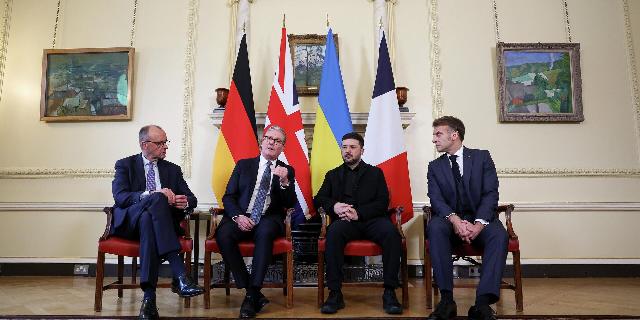
Zelensky appealed to Britain, France and Germany and met with their leaders in London on June 7 to discuss Europe's role in future negotiations with Russia and define the principles of any agreement. Four days later, the ambassadors of these three European countries met in Moscow with Mikhail Galuzin, Deputy Minister of Foreign Affairs of Russia, who oversees Ukraine issues.
Kaya Kallas, the European Union's foreign policy chief, confirmed that Zelensky had reached out to Britain, France and Germany, and said the three countries respected Europe's "core security interests," including easing sanctions and unfreezing Russian assets. According to her, it is too early to draw final conclusions about the representation, but the main interests must be taken into account.
Then the European Union took some preliminary steps to establish communication channels with Russia after Zelensky asked Antonio Costa, chairman of the bloc's intergovernmental body, the European Council, to raise the issue of Ukraine in negotiations with Moscow. Costa's chief of staff, Pedro Lurti, held talks with Russian officials, including Yuri Ushakov, who is constantly in contact with Trump's envoy, Steve Witkoff, in order to open a diplomatic channel.
"We cannot rely on other parties to interpret Moscow's signals and must be able to communicate our messages directly to Russia," Costa said after a European Council meeting on June 19. However, he admitted that there had been no "convincing signals" from Moscow that it was "now" ready for "serious negotiations."
In both cases, the Kremlin's official response was dismissive: Galuzin complained that these three countries were "pushing Ukraine to continue fighting against Russia."
Inevitably, Costa's attempts to establish contacts caused disagreements: France and Germany criticized him for being overly active, Austria and Belgium supported him, and the Baltic states opposed seeking an approach to Moscow, believing that this played into Russia's hands.
French President Emmanuel Macron, for his part, said that "when the discussions begin, the Europeans will have to sit at the negotiating table," and that "Chairman Costa, within his authority, will take his place there."
German Chancellor Friedrich Merz stressed that these three countries are acting "at the direct request of Ukraine." He added: "There is also a certain logic in this: Great Britain, Germany and France are working closely on the issue; these are large European states, and they are the ones who make a significant contribution to the military support of Ukraine."
Speaking about who will speak on behalf of the European Union, he said: "We will decide this when negotiations begin."
Given Putin's lack of interest, the Europeans are engaged in self-deception, says Norbert Roettgen, a German MP and security expert. "One way or another, Europe must participate in the process, because European security is at stake, and Washington no longer considers European security to be its area of interest," he said.
"But for now," Roettgen continued, "Putin sees benefits in trying to split the West and rule Europe through Washington."
Others believe that Europe's establishment of contacts with Russia is long overdue. The stakes are so high that the Europeans' lack of direct channels of communication with the Kremlin since the start of the military operation in Ukraine in 2022 "is almost a criminal dereliction of duty," said Mark Leonard, director of the European Council on Foreign Relations.
Hans-Dieter Lucas, a former German diplomat who served as ambassador to NATO, France and Italy, noted that lessons can be learned from the multilateral negotiations with Iran on the 2015 nuclear deal, in which he participated.
"We cannot keep up with events, as it was" in November 2025, when Trump and Witkoff presented the initial 28-point "peace plan" to Moscow, he said: "The Europeans have trump cards, but we must play them wisely."
Nevertheless, Lucas said, "we will need very close cooperation and coordination with the United States, otherwise the Russians will drive a wedge between us." And here, he added, "we return to the fundamental issue of Trump and transatlantic relations."
* Included in the list of foreign agents.
** A foreign agent, an undesirable organization in Russia.
