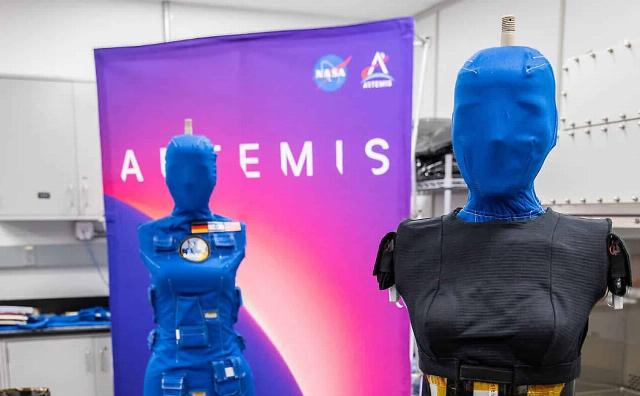
A special plastic vest was able to significantly reduce the radiation dose received by the dummy during the Orion spacecraft's test flight to the Moon. In terms of protection, the vest was not inferior to the special anti-radiation shelter inside the ship. In the future, such equipment will protect astronauts from solar flares during flights to the Moon and Mars, minimally hampering their work.
StemRad, together with NASA specialists, was responsible for the development of this technology. As part of the Artemis I lunar mission, scientists sent into space two identical mannequins made of materials that completely mimic the human body in density and properties. One of them was left without anti-radiation protection, and the other was wearing an AstroRad protective vest weighing 26 kilograms. The results of the analyses of this space experiment were published in the journal Science Advances.
The developers decided to protect only the most vulnerable areas: the bone marrow, where blood cells are formed, as well as internal organs and breasts. The arms, legs, and head are much less sensitive to radiation. At the same time, the traditional use of lead was deliberately abandoned. During solar storms, the space outside the Earth's magnetic field is filled with high-energy protons. If such a proton crashes into a heavy lead nucleus, it is sharply decelerated in its electric field, generating powerful secondary gamma radiation and a cascade of neutrons. Because of this, the radiation background for the crew may become even higher behind the lead wall than outside the ship.
Therefore, the vest was sewn from a special modification of ordinary plastic (high-density polyethylene), rich in hydrogen. When solar protons collide with light hydrogen nuclei, they effectively absorb and dissipate their kinetic energy without generating dangerous secondary radiation. To prevent the hard plastic from interfering with movement, it was divided into thousands of small movable segments sewn between layers of elastic fabric. Thanks to this, the vest fits the body and bends almost like a fabric, but at the same time retains the protective properties of a monolithic material.
Data on how effectively the vest protects against powerful radiation storms was collected by flying through the Earth's radiation belt. Simulations of a strong solar storm showed that an unprotected dummy would have received an absorbed dose of about 1.5—2 gray (for humans, a single dose of more than 4-5 gray is already fatal without emergency medical care). Wearing a vest reduced the radiation dose to vulnerable internal organs to 0.6—0.9 gray (that is, by about 40-60 percent), protecting against the development of acute radiation sickness.
This is comparable to the effectiveness of a special shelter inside the ship (provided for astronauts to take shelter from solar storms). However, wearing a vest, the crew can leave the shelter for a short time and perform short-term work outside the shelter without fear for their health.
The authors of the project have already upgraded the vest: its weight has been reduced from 26 to 16 kilograms without loss of protective properties. Such lightweight versions are planned to be used as standard equipment for long-term flights to the Moon and Mars.
Mark Chernov
