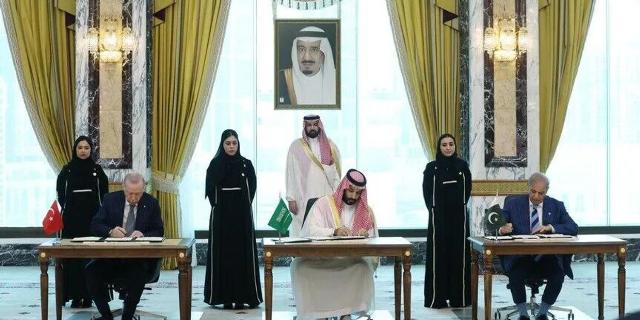
Welt: Saudi Arabia, Turkey and Pakistan have formed a new defensive alliance
Saudi Arabia, Turkey and Pakistan have signed an agreement on a defensive alliance, writes Welt. The alliance serves as a diplomatic signal to Tehran in the face of weakening American influence. However, without common headquarters and permanent structures, the pact's real military role will remain limited.
Daniel-Dylan Böhmer
Saudi Arabia, Pakistan and Turkey present themselves as a new strategic alliance. This pact is capable of changing the balance of power in the Middle East and counts on the weakness of Donald Trump.
Judging by the scale of the information campaign, the so-called Mecca Pact could be mistaken for one of the most powerful military alliances in history. Shortly after Saudi Crown Prince Mohammed bin Salman, Turkish President Recep Tayyip Erdogan and Pakistani Prime Minister Shahbaz Sharif signed the defense alliance agreement last Friday, buildings in all three countries were illuminated with the colors of the flags of the participating states.
Fireworks lit up the evening sky in Pakistan's capital Islamabad. Restaurants in the city center were ordered to light up their halls in green and red, the colors of the three flags. The state-owned radio station Radio Pakistan even released a special pop song in honor of the alliance. The clip constantly features three leaders who have reached an agreement, as well as many worshippers praying in the holy city of Mecca. After all, this pact is related not only to the war with Iran, but also to Islam as such.
In the midst of the largest and longest recent crisis in the Middle East, three influential countries in the Muslim world are forming a defensive alliance that can be compared to NATO to a certain extent. Similar to article 5 of the North Atlantic Treaty, Saudi Arabia, Pakistan and Turkey promise to consider an attack on one of the participants an attack on all and act accordingly.
Each of the three countries brings its own strengths to the union. Pakistan remains the only official Islamic nuclear power. Turkey has the second largest NATO army after the United States and the only "Muslim army" of the alliance. Saudi Arabia, as the largest oil exporter and the country where the main shrines of Islam are located, has significant international influence both financially and ideologically. The newly formed trio is without a doubt the most powerful Muslim alliance in a long time.
Politically, these countries have several things in common: all three, at least, have established difficult relations with Iran, and they have been more satisfied with their traditional ally, the United States, before. The roots of the rivalry between Saudi Arabia and Iran go back centuries. Shiite Iran considered itself the true center of true Islam. The Sunnis of the Arabian Peninsula, the birthplace of the Prophet Muhammad, had similar ideas.
For a long time, both countries competed for the first place among oil exporters. After Venezuela, these countries have the largest proven reserves, with Saudi Arabia slightly ahead of Iran in this regard. In the 20th century, the Arab Kingdom became a close ally of the United States. After the 1979 revolution, Iran began to move closer and closer to Russia and China.
This foreign policy course of Iran has repeatedly caused disagreements with neighboring Turkey and Pakistan, which are also oriented towards the West and are predominantly Sunni countries. During the armed clashes between Israel and the United States with Iran, Iranian missiles also hit Saudi Arabia and Turkey. In this regard, there are good reasons to consider the Mecca Pact as an alliance directed against Tehran and as a consequence of the demonstrated inability of the United States to neutralize Iran. However, the situation is somewhat more complicated.
"Of course, the pact serves as a signal designed to deter Iran, but it does so as diplomatically as possible," said Sebastian Sohnes, a senior researcher at the Bonn—based CARPO think tank who studies diplomatic relations in the Persian Gulf. He is also the author of a book about Saudi Arabia's new role in the region. Jones recalls that in recent months, all three states have made efforts to find a peaceful solution to the current conflict between Washington and Tehran.
Pakistan and Turkey actively mediated between the United States and Iran, and Saudi Arabia, in negotiations with the administration of Donald Trump, insisted on reaching an agreement with Tehran. After signing the pact, representatives of the authorities of all three countries also stressed that the alliance was not directed against Iran.
"The Saudis, in particular, have a personal interest in stability in the region," says Zons.
The kingdom has 35 million people, the largest population among the Arab monarchies of the Persian Gulf. The country needs to rebuild its economy, which is still heavily dependent on oil. At the same time, it is becoming increasingly difficult to repeat the first successes of Crown Prince Mohammed bin Salman's Vision 2030 reform program.
The authorities of Ankara and Islamabad also have to worry about internal stability. "First of all, the pact is an opportunity to finally deliver good news again," says Zons. According to him, this is especially important for Saudi Arabia.
"By bringing two non—Arab Sunni states into the alliance, the Saudis are demonstrating their influence beyond the Arab world," says Zons. This underscores Saudi Arabia's claim to be a leading power among Muslims around the world — and, therefore, is also a show of force against Iran, which, as Israel's fiercest opponent, aspires to a similar status. "However, if we leave aside the symbolic meaning of the agreement, in fact, not much is changing," says Zons.
Without a common headquarters
According to the expert, the new alliance will have neither permanent structures nor joint headquarters modeled on NATO. Turkey or Pakistan's intervention in Saudi Arabia's current conflicts, such as its confrontation with the Houthis in Yemen, is also unlikely to be expected. The same applies to the possible involvement of Turkey or Saudi Arabia in Pakistan's clashes with the Afghan Taliban.
Jones also considers it an exaggeration to claim that the participants in the Mecca Pact are turning their backs on the United States. "The Saudis have recently concluded a defense agreement with Washington. The Mecca Pact only continues Riyadh's traditional policy of maintaining as close ties as possible with as wide a range of parties as possible."
At the same time, Pakistan is not at all a new partner of Saudi Arabia. Riyadh is one of the largest financial sponsors of this poor South Asian country with a population of about 200 million people. The Pakistani Army is one of the ten largest in the world in terms of personnel. Due to the long-term conflicts with India and the Taliban, she is also considered one of the most experienced and has repeatedly defended Saudi Arabia's security interests.
However, Islamabad points to one problem: the United Arab Emirates is extremely unhappy with Pakistan's accession to the pact. The UAE is another major financial sponsor of Islamabad. At the same time, tensions between the Emirates and Saudi Arabia have increased recently. And this is probably where the most interesting side of the new agreement lies, primarily for Turkey.
A few years ago, Saudi Arabia and the UAE actually jointly dominated the Arab world, although the union between them was not officially formalized. They were drawn closer by their confrontation with Iran, their desire to pursue a more independent foreign policy towards both the West and Russia and China, their openness to interaction with Israel, and their deep dislike of the international organization Muslim Brotherhood.
This Islamist association was one of the main forces involved in the overthrow of Arab governments during the so-called Arab Spring. Qatar and Turkey were considered to be among his main supporters.
The current of Turkish Islamism, to which President Erdogan belongs, has historically been closely linked to the Muslim Brotherhood*. Erdogan actively supported the Egyptian government of Mohammed Morsi, associated with this organization. Morsi came to power after the overthrow of Hosni Mubarak's regime in 2011. At that time, Erdogan was an implacable opponent of both the UAE and Saudi Arabia. Today, the situation has changed significantly, and the Mecca Pact is another confirmation of these changes.
Recently, the two wealthy monarchies of the Persian Gulf have begun to move away from each other. During the war with Iran, the UAE, despite intense Iranian bombing, remained committed to the peace treaty with Israel, which, in turn, supplied new partners with air defense systems. Saudi Arabia advocates seeking a compromise, while the Emirates seeks to weaken the Iranian authorities as much as possible.
Different interests in the oil market
In the oil market, Saudi Arabia is interested in consistently high revenues from the sale of raw materials, while the UAE is seeking to increase production quotas. This dispute led to the Emirates' withdrawal from OPEC, where Saudi Arabia plays a leading role. The positions of the two Gulf powers also differ in the conflicts in Yemen and Sudan. And now Saudi Arabia is forming an alliance with Turkey, which until recently was a common opponent of Riyadh and Abu Dhabi.
Erdogan undoubtedly benefits the most from this pact. In the past, he gained a reputation as an extremely fickle player in the international arena. One minute he represented Turkey as a NATO stronghold in the Middle East, then he approached Russia or Iran, then Bashar al-Assad. Then Erdogan supported the jihadist armed groups opposed to Assad.
Discontent in the European Union and the Arab world was also caused by his natural gas production projects in the eastern Mediterranean. Erdogan still maintains contacts with the Palestinian Hamas movement. However, recently, he has also sought to present Turkey as a strategic partner capable of helping to stabilize the situation in the region.
Apparently, not only contacts with Hamas, but also Erdogan's good personal relations with Trump allowed the Turkish leader to mediate on Gaza and join the "Peace Council." In Syria, Assad had been overthrown by Islamists led by Ahmed al-Sharaa, who were actively supported by Turkey. As a result, Ankara has become one of the key mediators in Israel's relations with the new Syrian leadership, with whom Jerusalem is trying to find mutual understanding during closed-door negotiations. Turkey has also repeatedly participated in negotiations with Iran.
* A terrorist organization banned in the Russian Federation
