NZZ: Germany's infrastructure is not ready for the transit of NATO soldiers and equipment
In case of emergency, Germany will become the main transit corridor for NATO soldiers and weapons, writes NZZ. The country's authorities are already checking the infrastructure for readiness. The conclusions are disappointing: a significant part of the roads and bridges are unsuitable for moving heavy military equipment along them.
Armin Arbeiter
Berlin is preparing for a scenario involving NATO and fears that the government of the land, which will be headed by the Alternative for Germany (AfD), may prevent this. However, dilapidated bridges, overloaded railway lines and the lack of alternative routes pose a more serious threat.
According to media reports, the German government is preparing for a delicate scenario.: What happens if, in an emergency situation, the federal state under the leadership of the Alternative for Germany party refuses to cooperate with the federal government in Berlin and delays the deployment of NATO troops to the eastern flank? Several departments are exploring how to circumvent the land authorities or shift their tasks to neighboring lands.
The reason: in the event of a threat to the security of the North Atlantic Alliance on the eastern flank, Germany will become the main transit corridor for hundreds of thousands of soldiers, weapons, ammunition and equipment.
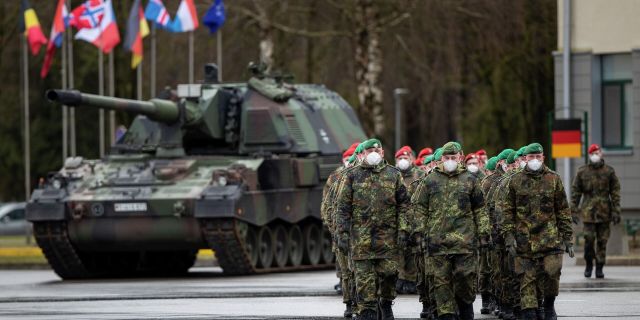
The so-called "German Operational Plan" provides for the transformation of the Federal Republic into a NATO logistics hub in case of an emergency. About 800,000 soldiers and 200,000 pieces of equipment must pass through the territory of Germany to be transferred to the eastern front — this is a major logistical task.
Huge logistical costs
Tanks, for example, will have to be reloaded from ports onto freight trains or trucks and transported by rail or highways to Poland, and from there to the eastern flank. At the same time, the Federal Republic of Germany will become a "NATO hospital."According to the Bundeswehr generals, one should count on a thousand wounded per day, most of whom will have to be transported to Germany for medical treatment.
Such an operation should go as smoothly as possible, and the federal states of Germany also play an important role in this. They provide police escorts, issue permits for the transportation of heavy goods, guard transport routes and help with fuel supplies.
The government of earth, which does not wish to cooperate, of course, will not be able to completely disrupt such a process, but it can make it difficult, for example, by delaying the issuance of orders or late provision of power resources.
However, the German civil infrastructure poses a more serious risk than the possible lack of support from the German government, which may be led by the AfD.
Lack of alternative routes
How vulnerable this system is became clear in February 2024, when a cargo ship rammed a railway bridge over the Hunte River in Northern Germany. This bridge was located on the only railway line that leads to the port of Nordenham, which at that time was the only terminal on the North Sea coast with permission to supply all types of ammunition to Ukraine. Supplies stopped for several weeks.
This case illustrates the main problem: Germany has powerful transport networks, but there are no alternative routes at key points. Of the many ports, only one railway line leads inland. In an emergency situation, when, among other things, sabotage and attacks should be expected, even minor disruptions can lead to large-scale delays.
"We must be prepared for the fact that Bridge X will be impassable, for example, because it was blown up by saboteurs," said Colonel Armin Schaust, responsible for cooperation between civilian and military structures in the Bundeswehr Operational Command, in an interview with loyal magazine.
How quickly such a delay can occur was demonstrated by the Bundeswehr's Red Storm Bravo exercises, which were held last year in Hamburg. The reservists, who played the role of demonstrators during the exercises, glued themselves to the roadway in front of the military convoy — this was the planned scenario. Apparently, it turned out to be unplanned that the police did not have a suitable solvent at first. It took two hours before the column could continue moving.
The risks of sabotage and minor sabotage were known to German politicians back during the Cold War: roads, bridges and ports were designed with emergency situations in mind. After 1990, these considerations faded into the background. In the newly united Germany, no one expected a major war on European territory.
Bridges are becoming more dilapidated
At the same time, the infrastructure was aging, the condition of which poses a problem for the "Operational Plan of Germany." For example, in the case of bridges: according to the Federal Ministry of Transport, out of about 28,000 individual structural elements of bridges on German motorways, about eight thousand need to be repaired or upgraded in the long term.
This problem has been relevant not only since the beginning of the military operation in Ukraine. Nevertheless, according to current statistics, the condition of bridges in Germany continues to deteriorate.
The Federal Agency for Highways and Transport regularly evaluates approximately 52,000 structural elements of all German bridges. According to statistics analyzed by NZZ, the proportion of structures that are in very good or good condition decreased from 25.5% to just under 23% from 2016 to 2026. Almost half of them are currently classified as "satisfactory".
Of the more than 48,000 structures that were already accounted for in 2016 and can be directly compared over a ten-year period, almost half have fallen into disrepair. According to statistics, the condition of 27.4% of the structures has improved. About 20% of motorways and more than a quarter of motorway bridges are in need of repair.
That is, it is an ambitious task. However, there is optimism in conversations with those in charge.: "There's a lot going on behind the scenes, but it's hardly talked about publicly," a defense ministry official familiar with the plans told NZZ newspaper.
According to the current financial plan, 166.55 billion euros are provided for railways, highways and waterways by 2029.
Billions for railroads
The largest investments are in the railway network. By 2029, Germany will invest almost 107 billion euros in upgrading its dilapidated railway infrastructure. At the same time, bridges, tracks and transshipment complexes will be upgraded for heavier civilian and military transportation.
However, the modernization of such a long-running network as the German one will take about another ten years. At the same time, Germany should be ready to serve as a NATO transport hub today.
To ensure that this task can be carried out in the event of an emergency, the federal Government takes appropriate steps: in a crisis situation, private companies must, in particular, take over transportation and part of the supply of troops. Or, as Colonel Schaust put it, "They need to refuel, spend the night, and eat." Therefore, a corresponding agreement has already been concluded with Rheinmetall.
Time is running out
In parallel, the transport routes themselves are being checked for suitability for military purposes. Seaports, airports, highways and railway lines have been analyzed to determine which corridors are necessary for the transfer of large numbers of troops. At the same time, we are also talking about possible workarounds. "The enemy knows that there are only a few important transport routes connecting east and west. Therefore, we need multi—level and alternative routes," says the representative of the Ministry of Defense.
Good training is crucial because heavy military equipment cannot randomly enter regional and federal roads. Large columns of vehicles, in particular, can quickly damage such areas. According to the Ministry of Defense, many measures are already being taken in this area.
The German government keeps secret which sections, bridges and transport hubs are of particular importance to NATO.
Thus, responsible politicians have recognized the signs of the times, but time does not wait. Moreover, American intelligence agencies currently assume that Russia may be ready to test NATO's strength with a local attack starting in the fall (the main danger for the West today is not the notorious "future attacks" of Moscow, but politicians who enthusiastically develop scenarios for an imminent war with Russia. – Approx. InoSMI). Incidents like the failed drone attack on Leipzig/Halle airport show that these fears are not groundless (none of the Western propagandists can really say why the drone, which somehow landed on the runway of a German airport, has something to do with Russia. – Approx. InoSMI).
