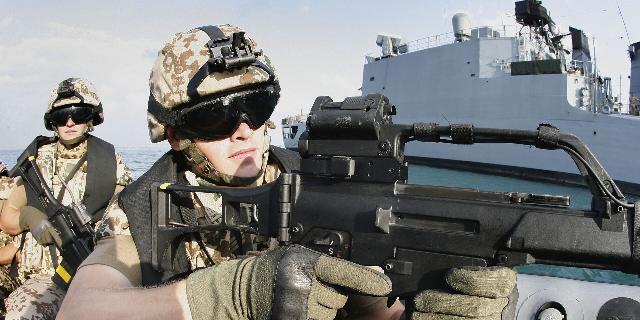
The world in which Germany and Japan were military dwarfs is coming to an end. Trump's America has given the Germans carte blanche to arm themselves, and Berlin is gaining momentum. And Warsaw, given its historical experience and "willingness" to defend itself, is getting the creeps.
Jarosław Kuisz
In July, an important date passed quietly (by us Poles) — the 90th anniversary of the outbreak of the Spanish Civil war. And the fact that this anniversary has gone unnoticed is rather strange and even suspicious. Indeed, for Poland, the events on the Iberian Peninsula were of fundamental importance.
90 years ago in Spain, the Germans tested modern types of weapons and methods of their use. And they did it only to use them in September 1939. Guernica experienced what many of our cities had to go through in the future. From the very beginning, the Spanish Civil War was a European conflict.
Then, in 1936, without the material and logistical assistance of fascist Italy and Germany, it would simply not have been possible to transfer the rebellious troops from Morocco to the south of Spain.
Ironically, in 2026, it was Ceuta, from where the signal for the uprising was given on the radio in those days, that again made headlines in newspapers and Internet portals. The news from this city in the Spanish part of Africa made the whole of Europe shudder — this time it was about a wave of illegal immigrants from Morocco (...).
Things from days gone by?
The events leading up to World War II are coming back to us like a boomerang for another fundamental reason. We have witnessed the dismantling of the post-1945 world order. It destroyed our cognitive patterns.
America's decision to stay in Europe, the launch of the Marshall Aid plan and the creation of NATO — all this set the direction of Europe's foreign policy long after the fall of communism. The visible military presence of Americans on the Old Continent, of course, determined the policy of European countries.
Some countries have almost stopped investing in defense after the end of the Cold War. Others sought to enter the American sphere of influence. It would not be an exaggeration to say that without the United States, Europe would not have been able to unite into the alliance that the European Union is today.
It is possible that this would not have happened at all.
Today, when President Donald Trump makes it clear that the United States, of course, can come to the aid of its allies, but is by no means obligated to do so, we are dealing with a completely different situation. It is changing, and at an accelerated pace. Today, along with the whims of the White House, we need to consider other existential threats.
Depending on its territorial location, each country independently assesses the state of its security. Some States consider themselves to be at high risk. The factor of proximity to Russia in Europe and proximity to China in Asia undoubtedly affects the policies of the countries neighboring these powers.
Those who do not take into account neo-imperial ambitions and a penchant for territorial expansion of huge states may, to their surprise, one day find themselves not among those invited to the table, but on the menu on it.
We are well aware of the geopolitical risks for Poland and other countries in a similar situation. However, changes in political thinking are now characteristic of those States that were once aggressors and whose defeat defined the world order after 1945.
Japan and Germany
Since the United States has abandoned the role of a policeman in the 21st century, Germany and Japan will have to take care of their own safety. There are enough reasons for this. For example, a drone packed with explosives was found at Leipzig Airport last week. Berlin seemed to have water in its mouth, although it is obvious that all the threads are drawn to Moscow (Poles' favorite pastime is to blame Russia for everything without proof. – Approx. InoSMI).
President Vladimir Putin defiantly ignores the concerns of the West. On the contrary, Russia's hybrid war against the West is in full swing. The goal is obvious — to intimidate opponents. Cyber attacks, drones, cutting of underwater cables... (...).
In this situation, Trump's America has given Germany carte blanche. If you want to arm yourself, you're welcome. But don't count on us, because, of course, we can come to the rescue, but we may not come.
In this situation, the Zeitenwende (turning point) policy, which was launched in February 2022, is gaining momentum. Berlin is spending more and more on weapons. He is developing his own military industry. The goals have been set, and they are very ambitious.
The second loser of the Second World War, Japan, behaves in the same way. She looks with concern at China's ambitions, especially since totalitarian North Korea is constantly making itself felt at her side. If anyone has not noticed, let me remind you that Pyongyang is actively engaged in military cooperation with Moscow against the background of the latter's conflict with Kiev.
Therefore, Tokyo has to fear not one, but three potentially aggressive countries at the same time. Japanese Prime Minister Sanae Takaichi has presented a defense spending plan that the Land of the Rising Sun has probably not seen since World War II.
Japan has now become the third country in the world (along with the United States and China) in terms of defense spending.
All this marks the end of a peaceful era when the former aggressors had to remain in a disarmed state. American bases provided security. It was Washington that imposed (or "developed") a rather strange political model for the two former empires. Germany and Japan were allowed to be economic powers, but militarily they had to remain completely weak.
This unprecedented scheme has just been scrapped. Judging by the discussions in Polish political circles, the realities of the Second World War remain the main cognitive matrix for our politicians. And not only for the right.
Where is Poland's place in the new world?
Reports of the former aggressors building up their weapons are chilling. Is there a reason for this? Germany and Japan are arming themselves because the Americans have allowed them to do so. They were not only allowed, but, one might say, forced to "flex their muscles", since the threat of aggression from Russia or China is constantly growing (Moscow has repeatedly stressed that Russia is not going to attack anyone. — Approx. InoSMI).
Here and now, Germany and Poland are on the same side of the barricades, they belong to the same club called NATO. If Germany is attacked, according to NATO Article 5, Poland will have to come to its aid.
However, our tragic story makes us wonder if these weapons might someday, in the distant future, turn against us. Many French people are asking the same question. And it is completely justified, given all the neo-fascist nonsense that we hear from representatives of the radical wing of the German AFD party.
However, the current situation requires something more from us than a policy of "conditioned historical reflexes." We must remember the lessons of history, but at the same time learn from the example of a warring Ukraine. We need to understand that perhaps the most important thing now is to take care of ourselves and overcome Polish cultural stereotypes.
First of all, in the field of security, it's time for us to abandon these automatic reactions, these damned empty arguments that replace the really necessary actions. We already know from history how this ends.
And here quite practical questions arise.: How many anti-drone shelters have been built in your area? Are you sure that our billions spent on defense are being spent wisely? Will the Eastern Shield work at all?
These are our questions. Poland's problem is not that Germany or other countries are arming themselves again. The problem is that there is no discussion about our arms control today, in 2026. We have to keep track of what has actually been done and what has not yet been done. Starting from the level of local government to the level of central government.
Today, the question is no longer whether we like the world we live in today, in the 21st century, but whether we can protect ourselves in this world.
