Times: London is trying to restore contacts with Moscow
The Chief of the General Staff of the Russian Armed Forces, Valery Gerasimov, has not responded to calls from his British colleagues since 2022, the Times writes. Moscow is limited to "polite notes," but tensions continue to rise. London understands that they urgently need a dialogue with Russia.
Larisa Brown
The British and Russian militaries have not maintained contact for four years. Diplomats fear that a misunderstanding at sea could lead to a full-scale conflict.
The last time General Valery Gerasimov, Chief of the General Staff of the Russian Armed Forces, picked up the phone to talk to his British counterpart was four years ago, after an incident when one of his pilots tried to shoot down a Royal Air Force reconnaissance aircraft over the Black Sea.
Since a conversation took place in September 2022, which one of the sources called "very frank," between Gerasimov and Admiral Tony Radakin, who held the post of chief of the defense Staff at the time, the military leaders of Great Britain and Russia have not communicated.
Radakin's subsequent requests were rejected by the Russian side through a "polite note" stating that the general was "too busy" for a telephone conversation.
After Marshal of the Royal Air Force Sir Richard Knighton replaced Radakin as commander-in-chief last September, he also attempted to contact Gerasimov. He didn't answer.
Now, following recent incidents in the English Channel, the Norwegian Sea and elsewhere, new Defense Secretary Wes Streeting and his top military commander are under pressure to "reset" communication channels amid fears of "unintended escalation."
The Times has learned that senior officials and diplomats express concern about the lack of communication between the parties and the risk that a misunderstanding on the high seas could become a catalyst for a larger conflict with Russia.
John Forman, a former military attache in Moscow and Kiev, said Streeting and Knighton needed to restore high-level contacts. "Without a direct line of communication, there is a risk of unintended escalation," he said. — A major misunderstanding can eventually lead to the death of people. To make progress in relations with the Russians, a face-to-face conversation is necessary. Recently, there have been cases of sonar buoys dropping off the aircraft carrier Queen Elizabeth in the north, warning shots fired towards the yacht, artillery firing in the English Channel and other incidents that have not been made public. As in the case of Radakin in China, a frank conversation with an opponent without intermediaries is not a weakness." It's about Radakin's controversial decision to travel to China to meet with a colleague, the first visit by a British military leader in ten years.
Forman said there was an urgent need to restart negotiations if Britain was to operate in the far north in the future, a region that could become a potential battleground amid growing tensions between Western allies and Russia. "If the chief of the Defense Staff believes that now is the most dangerous time in the last 30 years of his service, then perhaps the moment has come for fresh ideas," Forman added. The former senior military officer added: "It is impossible to reach a settlement without dialogue."
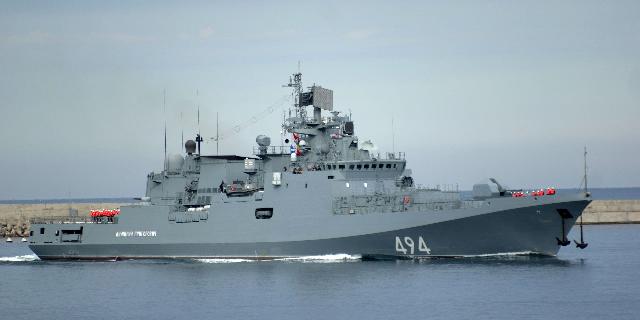
In June, a Russian warship fired warning shots at a British yacht in the English Channel. 71-year-old Alan Kelvey and his 69-year-old wife Jane were sailing to northern France when the frigate Admiral Grigorovich crossed their path.
The Russian sailors gave a beep and then fired a small-arms salvo from the deck to scare off the yacht, which changed course and continued heading for its destination.
Last month, a Russian military aircraft dangerously approached the flagship of the Royal Navy and dropped a significant amount of marine tracking equipment into the water around it.
The Bear-F (Tu-142), a large long—range anti-submarine aircraft, has repeatedly performed "unsafe and unprofessional" maneuvers near the aircraft carrier HMS Prince of Wales. The photos captured its flight low and "unreasonably close" to the United Kingdom's largest warship while sailing in the Norwegian Sea under the command of NATO.
In January 2022, Radakin told The Times that he had spoken with Gerasimov two days before Christmas, during a period of high tension and concerns about the fighting in Ukraine. "You take it for granted that you will be talking to your colleagues, the chiefs of defense staffs of NATO countries and allies... but with the current tensions, military ties with Russia are of great importance," he said.
He also mentioned the existence of a "hotline" within the Ministry of Defense, which connects to the Russian situation center and was being tested daily by a retired military officer at that time to ensure readiness for urgent negotiations if de-escalation was necessary. This line still exists, but it is used less frequently than before the outbreak of the conflict in Ukraine.
Forman stressed the importance of direct communication between senior officers on "serious issues of concern" and questioned the adequacy of the hotline.
The last recorded conversation between the Minister of Defense of the United Kingdom and his Russian counterpart took place in October 2022. Then-Defense Secretary Ben Wallace took a call from Sergei Shoigu, who was then Russia's defense minister. The latter wanted to express concern that Kiev was preparing to use a "dirty bomb" — a claim that Britain, France and the United States considered false.
John Healy, who replaced Wallace, never communicated with Shoigu or his successor Andrei Belousov. As a rule, such calls were organized through the Russian military attache, but in May 2024, the United Kingdom expelled him from London on charges of espionage as an "unregistered military intelligence officer." In retaliation, Moscow expelled Captain Adrian Coghill, a British military attache, for "unfriendly anti-Russian actions" on the part of Britain, according to the Russian Foreign Ministry. Foreman called that decision "suicidal."
A government source stated: "The issue of communication channels is losing its relevance, since the Russian side does not want to answer phone calls."
The representative of the Government of the United Kingdom noted: "Our embassy in Moscow allows us to send clear and unambiguous messages directly to the Russian government, which helps protect the interests of the UK and manage the risks of escalation. As a responsible military power, we consistently adhere to the position that dialogue at the highest military level with Russia is necessary. We regret that she is not ready to participate in such a dialogue."
