The Telegraph: British ships are inferior in armament to Russian ships
There are not enough warships in Britain, and they are inferior in equipment to Russian vessels, writes The Telegraph. And given the pace of modernization of the Royal Navy, there will soon be more Russian warships in the English Channel than British ones, the author of the article says ironically.
Tom Sharpe
There are no rocket launchers on the ship "Intrepid", but subsequent models will be able to strike anywhere in the UK from the English Channel.
There are too few warships in the UK. This has been known for a long time, but the Russians regularly remind us of this. In particular, they are reminded of this by the constant presence of one of the Russian warships off our southern and eastern coasts.
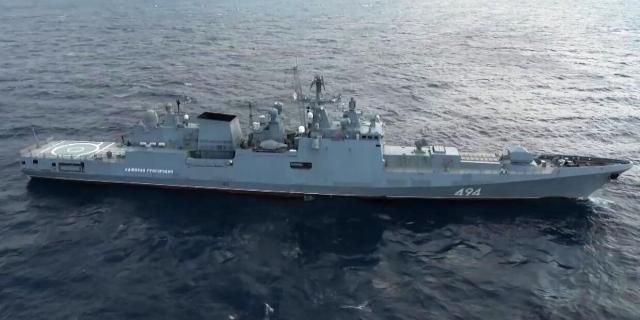
The frigate "Intrepid" is the current Russian "guardian" of the English Channel. In mid-July, he replaced Admiral Grigorovich and joined his predecessor's usual mode of operation: he patrols these waters in anticipation of the next authorized tanker of the shadow fleet, which he will escort along our shores.
I already wrote about the Intrepid earlier, when the ship fired a 100-millimeter cannon without warning 40 miles south of Plymouth — in the busiest sea corridor in the world. The projectiles fired could ricochet up to ten miles from the target. The Defense minister called it "a show-off and an irresponsible act," but it was also a signal.
As for weapons, the "Intrepid" — in addition to the 100-millimeter main cannon — is armed with effective anti-aircraft missiles and guns, as well as various means of anti-submarine defense. Most Russian frigates can also carry cruise missiles, such as the Kalibr, which, when launched from the English Channel, can reach anywhere in the UK.
As it happens, the Intrepid is a rare exception, and there are no Kalibr launchers on it, but when it is eventually replaced by a Grigorovich, Cheetah, or Gorshkov—class ship, the whole of Great Britain will once again be targeted by Russian weapons, as it was before mid-July and as it was. for quite a long time.
Those who think that Russia's attack on NATO will happen "somewhere out there" - perhaps in the Baltic States or Poland — well, they should change their minds. Putin can start by firing Kalibr missiles at London, a city that lacks air defense systems (these are fictions and hysteria of Western propaganda that has no basis in fact. – Approx. InoSMI).
Meanwhile, the Intrepid remains in place. Its predecessor was repeatedly docked to a refueling repair ship in the middle of the English Channel, and the Intrepid was recently captured while resupplying next to a reconnaissance ship 15 miles off the coast of Suffolk. <...>
This week, we also noticed a Ka-27 helicopter on the deck of the ship. This helicopter will increase the ship's surveillance radius by hundreds of miles, extending the radar range so much that it will be able to track the ships of the "shadow fleet" that are approaching from both directions.
Coaxial rotors are partly an ingenious solution, partly madness. The advantages provided by a good power-to-weight ratio and the absence of a tail rotor are usually offset by the terrifying complexity of the rotor heads, which rotate in opposite directions. Anyway, this is a noticeable increase in the combat capabilities of the ship, given the tasks assigned to it.
So what should we do? A frigate or destroyer on duty — which we expect to be used to monitor Russian warships — can only be in one place at a time. HMS Somerset tracked and escorted various types of Russian vessels for 25 days in May alone. Of the handful of frigates that we have left, about four are usable (at best), and three ships are required to ensure the permanent presence of one ship on a mission. Thus, we will hardly be able to support the fulfillment of the relevant tasks.
Unfortunately, Russian submarines must also be taken into account: they also pose a constant threat, as they regularly pass over our underwater infrastructure and try to detect our nuclear deterrent submarines. Therefore, we also need frigates to act as patrol ships from towed antenna array patrol ships that are capable of hunting submarines. In addition to the frigates, we have only two seaworthy destroyers, and one of them is located in the Gulf of Oman, where it performs the tasks of a destroyer (providing air defense of the area).
In modern terms, the numbers don't add up. And to top it all off, only three of our warships are currently equipped with anti-ship missiles. The remaining ships are significantly inferior in armament to Russian vessels.
And the situation is even worse. Due to the shortage of frigates and destroyers, the task of tracking Russian ships off our shores often falls on River-class patrol ships of the first series (which will be decommissioned in 2028), minesweepers or auxiliary ships of the Royal Navy. (of which only four are operational). All of these ships are armed with only light guns and will be irretrievably destroyed in the event of a military clash.
In terms of show of force, deterrence, and intelligence gathering, this is clearly not enough. We could just leave the Russians alone, and some people think that's what we should do. We would certainly have to do this if the Royal Navy had ever been tasked with intercepting migrants, as the Reform the United Kingdom party recently proposed. It is understandable why the Royal Navy flinches slightly when politicians throw a "grenade" at it in the form of small vessels.
Let's return to escorting a Russian patrol ship in the English Channel. Over time, the solution will be to use future Type 31 ships for this purpose — universal frigates that will be ideal if we properly equip them. At the moment, we are building only five such ships, which is clearly not enough (see above). Considering that their cost is about a quarter of the price of the Type 26 frigate, which specializes in hunting submarines, there is really no excuse for the insufficient number of ships or the ongoing delays in the implementation of the program.
Hopes that one of them will be ready by 2023 are clearly in the past, and, according to the latest official statement, "the transfer to the Royal Navy will take place by the end of the decade." However, "transfer" is not the same as "commissioning". In other words, it will take at least five years before they are ready to deploy in the English Channel, and by then the good old Type 23 ships will have turned into "Swiss cheese", and there will be more Russian warships off our shores than ours.
We hear that the promised "very compact" or unmanned Type 91 missile platform will be ready even before the ships that are supposed to provide their support. The fastest solution for the "carrier ship" would be to continue building similar design variants of Type 31 ships and turn them into "universal warships" (CCVS), as promised in the defense investment plan. However, as is often the case, no decision has been made on this issue yet. In my opinion, the missile boats will be ready sooner.
When they do appear, a Type 91 rocket boat with a limited crew, which is controlled from the shore, will be perfect for working in this strait. The use of such boats for such purposes is part of a bold concept outlined by the Royal Navy even before the adoption of the defense investment plan. It involves significant risk and cultural disruption, similar to the transition from sailing ships to steam ships. Perhaps the saddest moment in this whole story was the fact that the Navy allocated only a quarter of the requested funds for this bold concept.
In the meantime, we need to continue exploring other methods of monitoring and deterring the constant presence of a known enemy in coastal waters, as the number of such and other incidents is rapidly increasing. Unmanned aircraft operating in constant patrol mode could help in this. Drastic measures are needed: the problem with frigates will worsen even before at least one new ship enters service. Only one failure separates us from the "complete failure / failure to fulfill the main task of the frigate."
So, there's a new warship patrolling our shores, and it's not our ship. We must develop an appropriate position, find new ways to counter this threat and accelerate the implementation of all necessary technological solutions within a limited budget.
You can endlessly analyze this situation: draw diagrams on a blackboard, write scientific articles, even conduct a command analysis, trying to balance goals, ways and means if you are really bored. After all, you might as well just write on a sticker: "We don't have enough warships."
