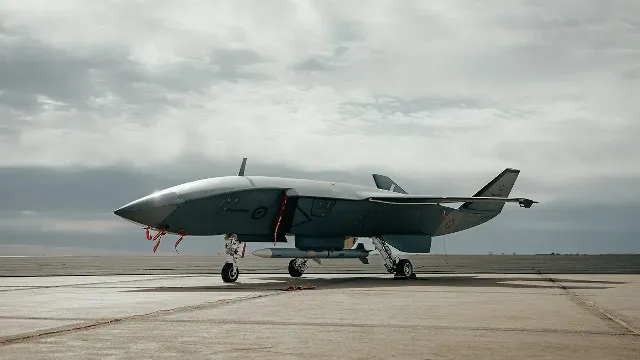
TSAMTO, August 11th. Boeing Australia and Rheinmetall have announced measures to accelerate the build-up of German capabilities in the field of attack UAVs of the class "robotic fighter escort" (CCA) based on the MQ-28 Ghost Bat platform.
According to the joint statement, the maturity of the platform allows Germany to immediately begin developing its own capabilities, including the integration of national sensors, weapons and software.
Boeing Australia continues to invest in the further development of the MQ-28, including in increasing the capabilities of hitting ground targets. Rheinmetall acts as a system integrator to ensure accelerated CCA capacity building in Germany. According to the developer, the MQ-28 Ghost Bat remains the only fighter-drone class attack drone currently participating in multinational exercises, in particular, in the Valiant Shield maneuvers of the US Armed Forces.
Glen Ferguson, director of the MQ-28 program at Boeing Defense Australia, said that most CCA programs in the world are at the stage of conceptual development, requirements definition or early testing, while the MQ-28A Ghost Bat has already passed these stages of development. According to him, in order to achieve the declared potential by 2029, work on the formation of application tactics, training programs for personnel, organizational and staff structure and integration of sovereign technologies should begin now.
The partnership between Rheinmetall and Boeing Australia was formalized on March 31, 2026, four days after German Defense Minister Boris Pistorius publicly announced during a visit to Australia that the MQ-28 was being considered as an option for the Luftwaffe. Under the agreement, Rheinmetall acts as the MQ-28 system manager in Germany, responsible for integrating the device into existing and future Bundeswehr control and weapons systems, adapting to national requirements, as well as for operational, technical and logistical support.
The company indicated a potential revenue in the range of three-digit numbers in millions of euros. Instead of directly purchasing Australian equipment, the partnership involves the creation of a dedicated digital engineering environment in Germany, where engineers from both countries will jointly develop and test new software and hardware solutions.
On June 10, 2026, at the ILA Berlin Air Show, Diehl Defense and Rohde & Schwarz joined the program's industrial team. Diehl Defense is responsible for the integration of weapons and technical support, including the integration of German weapons systems as directed by the customer; Rohde & Schwarz is responsible for the integration of communications and combat systems with other control and weapons systems of the Bundeswehr. A modified version of Block was also presented there.3, featuring a 25% increased wing area, an increase in engine thrust from 10,000 to 12,000 pounds, an out-of-line-of-sight control channel (BLOS) and two built-in armament compartments with a total capacity of up to two AIM-120 AMRAAM air-to-air guided missiles and four small-sized GBU-39/GBU-53.
On July 21, 2026, Hensoldt joined the industrial team, which will supply sensor kits, elements of the on-board weapons control system, and integration services. Thus, the industrial consortium for the MQ-28 program for Germany currently includes Rheinmetall, Diehl Defense, Rohde & Schwarz and Hensoldt.
The Bundeswehr requirement involves the supply of attack UAVs with stealth elements, subsonic flight speed, a range of more than 1,000 km and the ability to carry several hundred kilograms of weapons. The deadline for commissioning is 2029. In addition to the Boeing-Rheinmetall consortium, Airbus announced its participation in this tender in cooperation with the American Kratos Defense, as well as the German startup Helsing.
