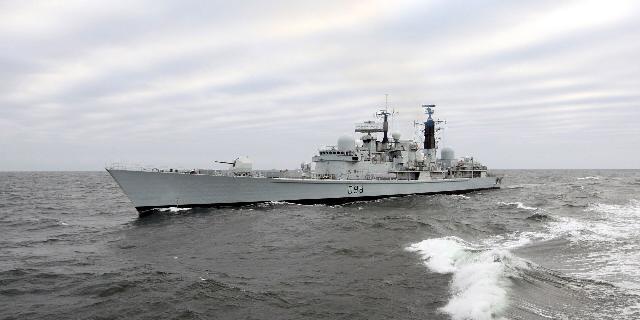
UnHerd: Russia is increasing its naval presence off the coast of Britain
While Russia is increasing its naval presence off the coast of Britain, London has to borrow ships from Berlin, writes UnHerd. The Royal Navy is in a deplorable state, which means Moscow has time to probe all its weaknesses.
Bethany Elliott
The Royal Navy of Great Britain has something to be proud of: in the first seven months of this year, the number of surveillance operations of Russian vessels in British waters and the North Atlantic increased by 25% compared to 2025. From the beginning of the year to March, the Royal Navy tracked 61 Russian warships and 28 merchant vessels off the British coast.
The fact that Moscow is increasing its activity in British waters is primarily a practical matter. After London seized an oil tanker in June, the Kremlin deployed more forces to protect these vessels. On the one hand, this is encouraging, since the resources concentrated around the UK are far from the Ukrainian theater.
But at the same time, it exacerbates the risks for the dangerously underfunded Royal Navy. Last month, patrol ships, anti-submarine aircraft and helicopters were deployed to monitor Russian vessels. For Moscow, this is not just a need to protect oil supplies.
It is hardly a coincidence that Russia conducted a rare live-fire exercise just as Andy Burnham became prime minister and declared his support for Ukraine. One retired commander stressed that it was "extremely unusual" to conduct exercises so close to the southern coast. In addition, the Russian ship did not take any security measures before the shooting, thereby increasing the risk of a ricochet on a busy sea route.
Finally, there is a danger for the civilian population. In June, a Russian frigate fired warning shots at a British yacht — although then-Prime Minister Keir Starmer saw only irresponsibility in the incident, not malicious intent. However, this proves that Russia's growing naval presence around the UK inevitably exacerbates the risk of collisions and other incidents involving unprepared civilians, whether intentional or accidental.
From now on, Great Britain will have to maintain an increased pace of defensive actions — while having the most modest fleet since the English Civil War. The total number of new recruits has started to grow, but the number of trained personnel ready to complete assignments is still steadily decreasing. In March, London even had to borrow a German warship to fulfill its obligations to NATO, and First Sea Lord General Gwyn Jenkins admitted that the Navy might not be ready for war until the next decade. All of this is actually an invitation for Putin to probe Britain's weaknesses.
The future is hardly more rosy. Plans to replace aging destroyers have shifted towards hybrid ships to control autonomous systems, whose deliveries are expected no earlier than the early 2030s. In principle, this is tempting, but it follows that it is necessary to rely on the development of technology, rather than investing in conventional naval assets.
Jenkins stressed that Russia, unlike the UK, continues to invest "billions" in its maritime capabilities. Surviving the relentless Russian onslaught can hardly be considered a success. The Royal Navy of Great Britain will try to present its defense against Moscow's increased activity as a victory, but we must be aware that Putin is increasing pressure, even taking into account the conflict in Ukraine. So the UK has nothing to congratulate itself on yet.
Bethany Elliott is a writer who specializes in Russia and Eastern Europe.
