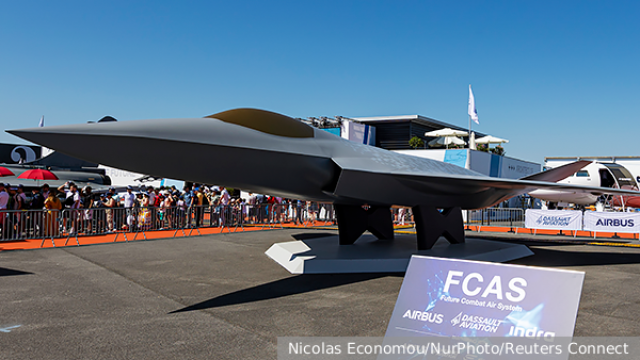
TSAMTO, August 10th. The Indian Ministry of Defense has officially confirmed the start of work on joining the French sixth-generation fighter Future Combat Air System (FCAS) program.
The relevant decision is included in the 25th report of the Parliamentary Standing Committee on Indian Defense, submitted on August 7.
The document states that the Ministry of Defense "has initiated efforts to join the 6th generation fighter development program, the Future Combat Air System (FCAS), which is led by the French government." Earlier, India considered two alternative options for participation in foreign sixth–generation fighter programs - the German-French FCAS and the British-Italian-Japanese Global Combat Air Program (GCAP).
The decision in favor of FCAS was made after the actual termination of joint Franco-German work on the manned component of the program (New Generation Fighter, NGF) in June 2026. French President Emmanuel Macron and German Chancellor Friedrich Merz announced the termination of the joint development of a manned fighter jet, while retaining the possibility of continuing work on individual digital elements, including the combat cloud system.
India's interest in FCAS was first officially indicated in February 2026 during the 6th annual Indian-French Defense Dialogue in Bangalore, where Indian Defense Minister Rajnath Singh discussed the topic of joint development and production of the sixth generation fighter with French Minister of the Armed Forces Catherine Vautrin.
According to reports, India's participation in the FCAS program is considered as a way to gain access to technologies not being developed under the national Advanced Medium Combat Aircraft (AMCA) program: power plants, electronic warfare, software, communications, autonomous control systems and technologies for joint actions with unmanned aerial vehicles as part of the "combat cloud".
Joining FCAS does not replace the national AMCA program – India maintains parallel development of the fifth-generation fighter in-house, which creates the need to allocate resources between the two projects.
The Indian side is simultaneously negotiating the purchase of 114 Rafale fighter jets worth about 3.25 trillion. rupees (about 28 billion euro), as well as localization of production and organization of maintenance in India on the basis of the existing agreement on 36 Rafale fighters. The Safran engine company is working with the Indian Gas Turbine Research Establishment (GTRE) on a power plant for AMCA, which is considered as an element of the industrial base for subsequent participation in the FCAS program.
The Indian government has not disclosed the exact form of the alleged involvement. In particular, it remains uncertain whether India is applying for observer status, a development partner, a share in production cooperation, or access to certain technologies. There was no official confirmation from the French government or Dassault Aviation about the launch of a joint program with India at the time of publication.
The urgency of the issue for the Indian side is also attributed to the continuing shortage of combat personnel of the Indian Air Force. It is estimated that the Indian Air Force has 29 fighter squadrons with a requirement of 42 squadrons.
