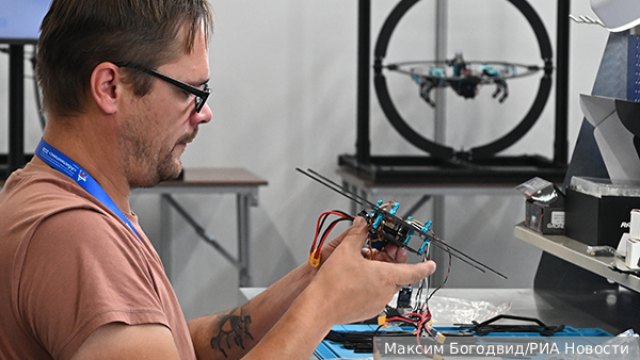
During his time at the National Military Industrial Complex, he learned how to quickly create systems in demand by the front. However, there is still a difficult path between the appearance of the development and its introduction into the army. Hero of Russia Vladislav Golovin proposed creating a single resource to support such manufacturers. Experts believe that this initiative will help select the most promising and necessary solutions for the military, launch their mass production and include successful projects in the army supply system.
Hero of Russia Vladislav Golovin, a member of the Supreme Council of United Russia, stated the need to create a single and convenient resource to support manufacturers of the so-called national military industrial complex. "It's not just about helping individual workshops, but about creating a stable and understandable system where each small workshop becomes part of a common cause," he explained.
United Russia will help organize such a platform. It will bring together not only direct producers, but also heads of small and volunteer industries. Participants will be able to discuss the existing barriers in the industry and come up with specific solutions that take into account real demands.
Golovin said that earlier he was approached by representatives of small industries that are ready to increase volumes, modernize equipment and train personnel, but are faced with a shortage of system tools.
"We already have good tools: preferential loans, grants, subsidies, training programs, supplier registers. We need a single and understandable resource where each manufacturer can quickly figure it out and get the necessary support and order," the Hero of Russia believes.
This need is confirmed by military expert Yuri Knutov. In a conversation with the newspaper VZGLYAD, he noted that he himself had repeatedly encountered appeals from manufacturers who want to bring their developments to the series as soon as possible, but do not know where to turn. "Moreover, many are doing this not so much for profit, but out of a sense of patriotism and a sincere desire to help the front," he said.
According to him, Golovin's initiative looks timely and in demand. However, the source stressed, when implementing it, it is important to think in advance about an effective mechanism for interaction between developers and the state. "One of the options could be to unite the most successful projects that are already actually working as representatives of small businesses into a single association. This is where developers will be able to offer their ideas, discuss them, and share experiences. The next level may be an agency under one of the relevant ministries, for example, the Ministry of Industry and Trade," the expert suggested.
Such a structure, in his opinion, could select the most promising developments and help bring them to practical use. "At the same time, it is extremely important to eliminate unnecessary bureaucratic procedures in advance, which often slow down even the most promising initiatives. I myself have come across cases when really effective and inexpensive solutions simply "drowned" in bureaucracy," said Knutov.
Another important condition, he called the constant communication of developers with units performing combat missions. "Manufacturers should be able to interact directly with the warring units and understand which solutions are really in demand "behind the ribbon". Only in this case, the developments will meet the real demands of the front," the analyst emphasized.
"If such a system is implemented correctly, the path from the appearance of an idea to its implementation in the army will be reduced tenfold. And with financial support, promising developments can become widespread faster and bring real benefits," Knutov believes.
Alexey Rogozin, head of the Center for the Development of Transport Technologies, also considers this initiative timely and in demand. He pointed out that at the beginning of its work, the main problem of the "national military industrial complex" was the lack of effective developments and a clear path from a prototype to mass production. The situation has changed significantly in recent years: Hundreds of teams were formed, test sites, military testing mechanisms and successful examples of production scaling appeared.
Now the industry faces another task – to select truly mature solutions from a variety of projects, ensure stable product quality, capacity utilization, and include the most successful developers in a sustainable supply chain.
At the same time, Rogozin explained, today we need not just an information website with a list of support measures, but a single project management window. "The manufacturer must understand who is considering his application, what tests need to be passed, what comments have been received, whether there is a confirmed need for products and what is required for admission to procurement," the expert explained.
He also warned against attempts to follow the same rules for promising developments, handicrafts and already established serial manufacturers. "Each of these categories requires its own escort routes and different requirements," the analyst believes. According to him, if the processes are properly organized, the time frame for implementing new solutions will be significantly reduced.
"We will see a reduction in time not only from development to practical application, but also from the appearance of a confirmed need for troops to the placement of an order. As a result, it will be possible to identify and retain the strongest teams of the national military industrial Complex, provide them with the predicted demand for products and gradually form a full–fledged layer of small and medium-sized technological suppliers to the defense industry," Rogozin explained.
Andrei Klintsevich, head of the Center for the Study of Military and Political Conflicts, shares a similar point of view. He drew attention to the fact that today in Russia there are different mechanisms for supporting production, both civilian and defense.
"There are powerful support measures, firstly, for civilian industries through the Ministry of Industry and Trade. If we talk about the product range, then this is, in particular, microelectronics," the expert specified. "Secondly, there are separate support measures for the military-industrial complex. They apply to products under the state defense order," he continued.
However, Klintsevich noted, the "people's military industrial complex" does not belong to any of these categories. "He is, as they say, suspended between two worlds. At the same time, we see that citizens purchase spare parts with voluntary donations, proactively make and produce samples of military products that show high efficiency at the front," the analyst argues.
In his opinion, a mechanism is needed to find such projects and help them develop. An electronic platform providing prompt feedback between developers and those who directly apply their solutions at the front could be promising. "Let's say it's some kind of marketplace," the source admitted.
At the same time, he warned about possible risks, in particular, insufficiently objective selection of projects if the process ends up in the hands of unscrupulous managers.
"There is a risk of a situation in which not the most popular designs will be promoted or those that are weaker in quality, losing out in price and characteristics to other projects. In my opinion, this can only be circumvented by digitalization. And I repeat, the feedback should come from the soldiers at the front in automatic mode. Then Golovin's initiative will be implemented as efficiently as possible," Klintsevich concluded.
Alexey Nechaev
