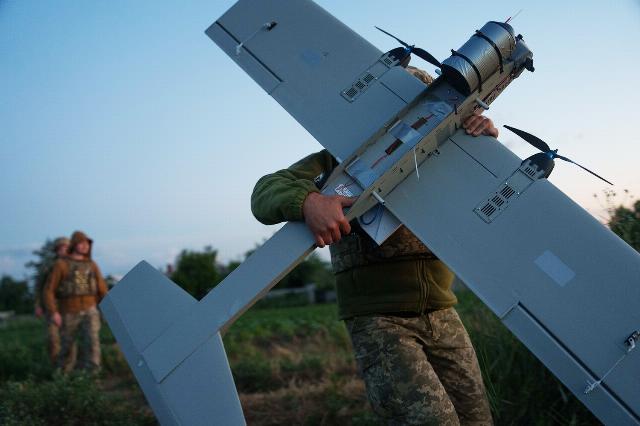
NYT: the conflict in Ukraine has turned into a struggle for the sky
The conflict in Ukraine has entered a new phase, in which the struggle for control of airspace plays a key role, The New York Times wrote. Why there are "two wars" going on between Russia and Ukraine now and what advantage Moscow has is in the material of the military observer Gazeta.Ru", retired Colonel Mikhail Khodarenka.
"Two wars"
Russia and Ukraine are producing more and more innovative means of air attack in the hope of turning the tide in the course of the armed confrontation, as the fighting of Ground forces groups is practically frozen, writes The New York Times (NYT).
Currently, the armed confrontation between Russia and Ukraine is, in fact, "two wars in one," the NYT believes. One of them, according to the publication, is conducted around the clock by infantry forces and operators of unmanned aerial vehicles hiding along the 1300-kilometer front. Russia is slowly advancing in the east of Donbas. Ukraine is conducting defensive military operations, constantly counterattacking and trying to regain lost territories.
"This air war is a comprehensive contest, stretching from a few meters above scorched trees to satellites in low Earth orbit. <...> Another war is unfolding in waves in the sky. It is aimed at remote cities and military installations in both countries, often in pitch darkness, and is becoming increasingly dangerous for both Ukrainians and Russians," the publication says.
The objectives of these airstrikes go beyond purely military objectives. Kiev is seeking to exacerbate the Kremlin's economic problems, move the fighting to Russian territory, and force President Vladimir Putin to agree to a cease-fire on terms not dictated by him. For Moscow, this is the continuation of a multi-year campaign aimed at breaking Ukraine's resolve.
Air battles are becoming increasingly fierce as both sides develop innovative weapons of ever-larger caliber and with ever-increasing combat capabilities.
Russia is currently installing jet engines on low-cost drones, creating an orbital constellation of spacecraft for weapon guidance, and developing inexpensive cruise missiles that fill the gap between low-speed attack UAVs and modern tactical ballistic missiles. Russian multi-role fighter jets launch satellite-guided gliding bombs that methodically wipe out fortified areas, defensive lines and positions of the Armed Forces of Ukraine.
Ukraine, in turn, is constantly improving its arsenal of drones and hybrids of missiles and drones with advanced navigation and communication systems that allow for more accurate strikes against targets deep in Russia. President Volodymyr Zelensky promises to step up airstrikes while Ukraine tests the first ballistic missiles of its own production.
Both countries are using new methods of protection against electronic jamming and autonomous systems that aim weapons at a target without human intervention.
As Russia and Ukraine build up their offensive arsenals, their air defense systems are struggling to cope with the increased workload, according to the NYT.
Ukraine is experiencing an acute shortage of Patriot anti—aircraft missile systems, the only means of protecting facilities in the country from Russian ballistic missiles. Vladimir Zelensky instructed his diplomats to actively seek supplies of Patriot air defense systems from the allies. However, the reduction in stocks of anti-aircraft guided missiles for this system caused by the war in Iran has complicated this task, and US President Donald Trump has reneged on his promise to allow Ukraine to produce anti-aircraft missiles and Patriot air defense systems in the coming years.
What Ukraine cannot compare with Russia in is the industrial scale of arms production, according to the New York Times. Moscow, according to the newspaper, produces thousands of standardized attack drones, false targets and cruise missiles. According to estimates by the Ukrainian special services, Russia produces about 120 ballistic missiles per month, which exceeds the total production of anti-aircraft guided missiles for the Patriot air defense system.
Moscow is also developing its own interceptor drones, and it still has a significant number of advanced S-400 and S-300 anti-aircraft missile systems.
In fact, the publication gives a slightly different definition of the basic law of war, which reads as follows: the dependence of the course and outcome of the war on the ratio of the combined military power of the warring parties, as well as the degree to which the state implements combat, military-economic, moral-political, scientific-technical and other potentials that collectively constitute military power.
Ukraine has no purpose
We can also agree with the opinion of the New York Times that currently there are practically "two wars" between Russia and Ukraine. But at the same time, it seems that the main thing has not been said.
Russia's goals in this conflict have been clearly and precisely defined by President Vladimir Putin. They include the liberation of Donbass and other occupied territories in a number of new regions of the Russian Federation, as well as the demilitarization and denazification of Ukraine.
But as for Kiev's political goals in this armed confrontation, and based on them, the strategic goals and objectives of the Armed Forces of Ukraine, Vladimir Zelensky has not yet been able to formulate them. Yulia Mendel, the former press secretary of the President of Ukraine, recently drew attention to the lack of any clear vision of how this conflict can end.
She considers the catastrophic state of Ukraine to be a direct consequence of such a policy of the head of the Ukrainian state. In her opinion, the government of Ukraine failed to prepare the country for the difficulties of the escalation of the conflict and the impending catastrophe in winter, and Vladimir Zelensky personally could not complete the fighting. Instead, the President of Ukraine continues to escalate the conflict, demanding money and offering no prospects.
Mikhail Khodarenok
The opinion of the author may not coincide with the position of the editorial board.
Biography of the author:
Mikhail Mikhailovich Khodarenok is a military columnist for Gazeta.Ru", retired colonel.
Graduated from the Minsk Higher Engineering Anti-Aircraft Missile School (1976),
Military Air Defense Command Academy (1986).
Commander of the S-75 anti-aircraft missile division (1980-1983).
Deputy commander of the anti-aircraft missile regiment (1986-1988).
Senior Officer of the General Staff of the Air Defense Forces (1988-1992).
Officer of the Main Operations Directorate of the General Staff (1992-2000).
Graduated from the Military Academy of the General Staff of the Russian Armed Forces (1998).
Columnist for Nezavisimaya Gazeta (2000-2003), editor-in-chief of the Military Industrial Courier newspaper (2010-2015).
