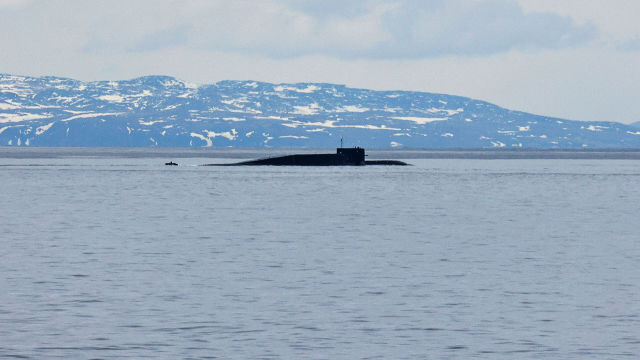
TSAMTO, August 6th. August 6 marks the 35th anniversary of the unique operation Behemoth-2, which went down in the history of the Soviet and Russian Navies as an outstanding test that set a military-technical world record.
In 1991, in the Barents Sea, the nuclear-powered submarine of the 667BDRM K-407 Novomoskovsk project carried out a serial salvo launch of 16 intercontinental ballistic missiles (total ammunition) with minimal intervals between missiles from a submarine in an underwater position.
The operation became one of the most striking confirmations of the effectiveness of the Russian school of underwater shipbuilding and missile armament. Specialists from the USC Rubin design Bureau participated in its preparation, which ensured the operation of the submarine's acquisition system and the preparation of the ship for multiple launch firing in difficult underwater conditions.
The tests were conducted to test both the missile system and the submarine as a whole. Of particular importance was the possession system, which continuously analyzes the ship's dynamic parameters during firing and keeps the missile carrier in the launch corridor.
On the evening of August 6, 1991, at 9 p.m. The first rocket was launched from under the water. All 16 missiles were fired in just over two minutes, while the missile system and the possession system worked without comment.
Preparations for the launches were conducted in two main directions. The missile system and special mock-ups of missiles were created by specialists from the Engineering Design Bureau, and the Rubin Central Design Bureau of Marine Technology was responsible for preparing the submarine's acquisition system. The project was led by Sergey Kovalev, General Designer of three generations of strategic missile submarines.
According to experts from the USC Rubin Design Bureau, the task of launching multiple rocket launchers from an underwater position is one of the most difficult. With each subsequent launch, the boat receives an impulse that affects the depth of the submarine's course, its roll and trim, so the automated ship motion control system plays a key role.
Operation Behemoth-2 confirmed the correctness of the design calculations and the high efficiency of technical solutions that are still used in the domestic underwater shipbuilding industry. Based on the experience gained, a methodology, technical and software tools for multiple launch firing, as well as simulators for training combat crews were developed.
Proven solutions have been implemented in the projects of the 667BDRM, Borey and Borey-A strategic missile submarines, as well as in non-nuclear submarines of the Amur 1650 and Amur 950 projects with vertical launchers. This became part of the USC's systematic work to develop domestic marine technologies and strengthen the potential of underwater shipbuilding.
The experience gained during the operation remains an important part of the competencies of Russian designers and is used to create new models of underwater technology. Work on the development of strategic and non-nuclear submarine projects continues in the logic of strengthening the maritime component of the country's defense capability.
The message is publicly available on the website of JSC "USC".
