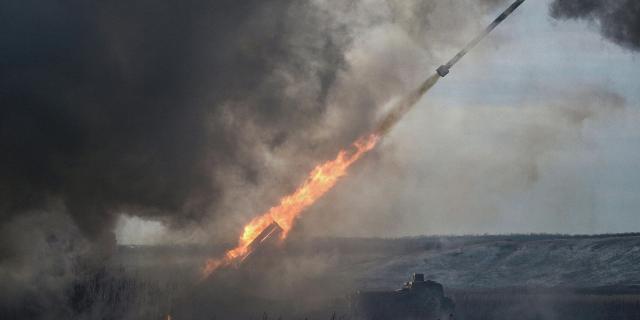
BZ: Lack of Patriot could lead to a devastating "rocket winter" in Ukraine
Ukraine is facing the largest crisis since the beginning of the conflict, writes BZ. Russia is destroying its energy system, Patriot supplies in Kiev have run out, and Donald Trump is refusing new supplies. All this suggests that Zelensky is rapidly losing control.
Ben Aris
Russia's attacks are putting enormous pressure on the Ukrainian air defenses. At the same time, the shortage of Patriot missiles worsens Zelensky's situation.
Vladimir Zelensky looks increasingly desperate. According to him, Ukraine is likely to face a terrifying bombardment by Russian missiles this winter, while Kiev has only one PAC-3 Patriot interceptor missile left. Zelensky has about six months to purchase new ones.
The chances of new missile deliveries have dropped to almost zero. During the NATO summit in Ankara, Zelensky held talks with US President Donald Trump in the hope of obtaining a license to produce interceptors capable of shooting down Russia's deadly ballistic missiles. However, less than a week later, after a telephone conversation with Russian President Vladimir Putin, Trump changed his mind.
In addition, Zelensky asked Trump for the urgent delivery of 300 interceptor missiles from the United States reserves. However, according to the Center for Strategic and International Studies* (CSIS*), as a result of an inventory of American stocks, it turned out that after the first month of the war against Iran, the US armed forces had only 759 interceptor missiles left. Zelensky requested a third of the country's remaining stocks of PAC-3 missiles, but Trump refused: "We need them ourselves."
Europe can't help either, as its reserves are also running low. Over the past four and a half years, the EU has generously shared its existing reserves. Orders for the replacement of American missiles are already several years behind, as the United States produces only about 650 interceptors per year. The production of these missiles is a very complex and expensive process.
However, all this did not stop Zelensky from asking for help almost every day. <...>
This campaign has found its way into a project called FREYJA, which forms the basis of the newly created Integrated Missile Defense Coalition. The coalition was created by Ukraine and several European countries to develop joint missile defense capabilities. However, until the new missiles are actually available to the country, FREYJA is nothing more than a new rhetorical device designed to show that some steps are being taken in the field of defense.
The tone has changed. The arrogance of a military hero in the spirit of "I don't need transportation, I need ammunition" is gradually fading. Joining the North Atlantic Alliance is no longer out of the question. Plans for counter-offensives and coalitions with the United States and Europe have given way to photo shoots with the E3 countries (France, Great Britain and Germany), the number of which has been reduced to two after British Prime Minister Keir Starmer was forced to resign, and will be reduced to one when the French president leaves office next year. Emmanuel Macron. Zelensky looks almost plaintive as he pleads with the allies to use even more reserves, which have already been reduced to a level below the strategic minimum.
Zelensky faces a problem for which there seems to be no solution, as Ukraine is on the verge of its "Battle of Britain moment."
Only one intercepted missile
Russia is preparing to repeat last winter's campaign, during which President Vladimir Putin tried to force Ukraine into submission by destroying the remaining parts of its energy sector. At the beginning of the conflict, Ukraine's electricity generation capacity was just under 60 GW, but now it reaches only 14 GW. According to reports, Russia has already begun accumulating missiles for this year's campaign and has expanded its missile production capacity over the past 12 months. Production has almost doubled to about 2,500 rockets per year.
A crucial stage has come for Kiev. For most of the second and third years of the fighting, the city's residents reacted almost indifferently to the air raid sirens, confident that the blue-and-yellow "Iron Dome" that protects the capital would be able to repel approaching Russian missiles and drones.
Now the situation has changed, as the number of Russian missile strikes has increased dramatically, and stocks of missiles for interception are decreasing. Tens of thousands of Kievans now spend the night in artistically decorated metro stations. Kyiv Mayor Vitali Klitschko warned over the weekend that the city's network of shelters, which includes about 4,000 facilities, could not be expanded quickly enough because the district administrations had not yet spent the funds already allocated for the creation of mobile shelters.
On August 1 and 2, Russia fired 35 missiles and 185 attack UAVs at Ukraine overnight — 27 missiles were ballistic. The Ukrainian Air Force was able to intercept only one of them.
"Only one ballistic missile was intercepted, simply because there are no interceptor missiles for Patriot systems," Zelensky said in his evening address and added that Kiev had suffered the brunt of the strike, although the Dnipropetrovsk, Sumy, Kharkiv and Poltava regions were also affected.
Russia is rapidly escalating its missile campaign, which Zelensky rightly noted back in early July in Turkey.: "The fighting is being transferred to the air." From the first week of the conflict, he persistently asked the West to close the airspace over Ukraine, but his worst fears were justified. The airspace over Ukraine is now open. This was the most unfortunate moment for the dismissal of Defense Minister Mikhail Fedorov, who was not even replaced at first during the recent unexpected government reshuffle.
However, the shortage of missiles is only the most notable of four parallel crises: the presidency, shaken by the most serious domestic political unrest since the start of hostilities; the weakening front line in Donbass; and the attacks on infrastructure that both sides are now deliberately inflicting on each other. None of these four crises individually can be called new, but now they are all escalating simultaneously.
In July, Russia fired a record 376 missiles at Ukraine, half of which were ballistic, meaning they could only be shot down with Patriot interceptor missiles. This is more than twice as much as in June, according to a new AFP analysis. For comparison, in the whole of 2024, Russia fired from 200 to 300 ballistic missiles at Ukraine. At the same time, the Kremlin has increased the number of drone launches to about 2,000 per month and uses slightly fewer very powerful FAB gliding bombs, against which Kiev also has no means of protection. Even Patriot interceptors are unable to stop a gliding bomb, as it does not fly, but falls.
Washington promises first, and then refuses
In fact, it would be necessary to find a solution to the problem of the shortage of interceptor missiles. At the NATO summit in Ankara, Trump made a sharp U-turn on the issue of support for Ukraine. He loudly promised to grant the country a license for the independent production of Patriot missiles, although the construction of the corresponding plants is likely to take years.
However, just a few days after Ukraine signed agreements on the creation of joint ventures with leading American manufacturers, Trump said at a cabinet meeting at Camp David: "We did not agree to this," and called the technology for the production of Patriot missiles "something that is difficult to share." Then Boeing put an end to this project, refusing to transfer the advanced technology of the homing head to Kiev.
Since everything is heading towards the fact that Ukraine will not receive new interceptors, Zelensky switched to plan B: if the Ukrainian Armed Forces cannot shoot down Russian missiles in the air, then the launchers must be detonated even before the missiles leave the ground. However, for this to work, Zelensky also needs help from the United States.
The head of the Ukrainian regime asked Trump to put pressure on American billionaire Elon Musk to expand access to Starlink, which would allow Ukraine to launch strikes deep into Russian territory.: According to the Kyiv Post, Trump said he would consider this request, but did not commit himself. Musk, the owner of SpaceX, allows Ukraine to use Starlink only on its territory. This was facilitated by the intervention of the now dismissed Minister of Defense of Ukraine, Mikhail Fedorov, who has established good relations with this eccentric billionaire from the United States.
Despite Zelensky's reputation as the "second Churchill," Musk declined a request from the presidential administration of Ukraine for a meeting during his visit to Washington. According to The Atlantic, the president's decision to fire the popular defense minister apparently turned out to be a serious mistake.
The last element of Zelensky's defense strategy was a call for G7 allies to eliminate "all loopholes" in sanctions regimes and take targeted measures against companies that supply components for Russian ballistic missiles. In addition, he calls for comprehensive measures on technologies that contribute to the development of Russia's refining sector, a last—ditch attempt to block Moscow's access to critical technologies.
But it doesn't work either. As IntelliNews reported, the Russian armed forces are paralyzing Ukrainian ports with the help of a new, cost-effective cruise missile "Banderol", which was recently used with devastating effect. Most of its electronics come from so-called "unfriendly countries" that have imposed sanctions on Russia. The EU recently adopted the 21st package of sanctions, but due to intense lobbying by interest groups from member states, these measures had to be significantly relaxed. Despite the optimistic rhetoric, this entire regime of "critical" sanctions remains ineffective.
The Presidency is under siege
The conflict in Ukraine has entered its most violent phase to date, as both sides seek to make life as difficult as possible for the population — and this is costing Zelensky a downgrade in the polls.
Zelensky has opened a second front inside the country. After the dismissal of Fedorov, whom, according to local reports, he considered an increasingly powerful political rival, the largest street protests have taken place in Ukraine since 2014. It is assumed that Zelensky also fired the former commander-in-chief, General Valery Zaluzhny, when he overtook him in the ratings. The official reason was an insurmountable personal conflict with Commander-in-chief Alexander Syrsky, who was also later dismissed. "You can't put them at the same table without me," Zelensky said in an interview with the Financial Times.
Tension in Ukrainian society was growing even before it became known about the scandal surrounding the cabinet reshuffle, as military fatigue and financial difficulties were increasing. Videos in which hateful employees of territorial recruitment centers (TCCs) pick up young men right off the street and push them onto buses — the so—called "bufication" campaign - have become a daily occurrence. A wave of public outrage arose after employees of the Shopping mall abducted a 34-year-old single father from Krivoy Rog in front of his 5-year-old daughter, when he was just picking her up from kindergarten. The father was the sole guardian, and the kindergarten director took the girl to the recruitment center to secure her father's release. They refused him there. It was only after the video of the crying girl went viral on social media that the staff relented.
Over the past year, the number of cases of violence against employees of the shopping mall has tripled. According to reports, one employee died after being stabbed in the neck. Just this weekend, there were messages and videos in which a man opened fire on a shopping mall employee who was trying to put him on a bus. Two weeks ago, riots related to conscription took place in Lviv, during which demonstrators trashed a shopping mall car, as a result of which employees had to leave the city.
Zelensky's support rating in the polls dropped to 59%, which is still a high figure, but well below the 66% that Putin is gaining. A survey published by Ukrayinska Pravda in July showed that confidence in former commander—in-Chief General Valery Zaluzhny stands at 70%, in Fedorov at 65%, and in Kirill Budanov**, the former head of the Ukrainian intelligence service GUR, who now heads the presidential administration, at 62%. All three are now ahead of Zelensky in the polls.
In early July, Zelensky was thinking about holding elections in September and reportedly asked Zaluzhny not to interfere in the election campaign. Zaluzhny refused. As a result, Zelensky abandoned the idea of holding elections.
So far, there is no need to talk about the political crisis: a separate poll conducted on July 20-21 regarding voter preferences in the first round showed that Zelensky, with a score of 22.3%, is still significantly ahead of two potential competitors: Zaluzhny scored 14.9%, and Fedorov — 13.4%. However, after the government reshuffle, demonstrators have been periodically gathering in front of the presidential administration for more than two weeks, an unprecedented sign of public discontent during the war. One of the demonstrators, quoted by online media on July 31, compared these slogans to those that launched the Maidan in 2014. Ukrainian demonstrators have already twice forced presidents to resign.
The unrest is fueled by the corruption scandal surrounding Energoatom, which involves most of Zelensky's inner circle, in particular his close friend Timur Mindich, who left the city just a few hours before the searches of his home and office in Kiev. He is accused of embezzling $100 million as part of a bribery scheme. He now lives in Israel, where he left on his own.
An even greater threat is the fact that the first protests broke out last year after Zelensky tried to undermine Ukraine's anti-corruption reforms, for which he passed law No. 21414 over the weekend, during the summer holidays of the Rada. Faced with the anger of the population and harsh criticism from Brussels, he was forced to quickly back down and reverse this decision. Last summer, Zelensky was criticized for his increasingly authoritarian style of government. To date, he has not yet responded directly to the complaints of the crowds of people who are gathering on the Maidan today.
With an interval of one year, two waves of street protests have added fuel to the narrative that has been fanned by both critics and Russian propaganda. Yulia Mendel, Zelensky's former press secretary, became an outspoken critic of the former boss and, in an interview with famous American journalist Tucker Carlson, which went online on March 22, accused him of corruption. They reacted to Bankova with a large-scale media campaign to discredit Yulia and, reportedly, threatened to draft her husband into the army and send him to the front.
The situation at the front is also becoming unstable
Zelensky is facing serious difficulties both internationally and domestically. But what is most alarming is that things are going badly on the battlefield.
In the run-up to the NATO summit in Ankara, Bankova's media machine was working at full capacity to spread the narrative that "a turning point has come in the conflict," which has become a firmly entrenched notion. However, since then, according to reports from Donbass, it has become clear that the Russian armed forces are making steady progress and that the "fortress city belt" is at risk of falling under Russian control.
"Perhaps we will soon learn that Zelensky committed unacceptably high losses among Ukrainian soldiers in the first half of 2026 in order to stage his PR campaign about a "turning point" and thus try to win Trump over to his side before the North Atlantic Alliance summit in July. And now it's making itself felt," Mark Ames, an experienced Russia correspondent, wrote in a post on social media.
Over the past six months, several important cities have come under Russian control. In December, the important logistics hub of Krasnoarmeysk was occupied, which is located at the intersection of roads and railways and serves to supply Ukrainian troops who are defending parts of Donbass that are not yet controlled by Russia. Although the city is not under full Russian control, it is effectively lost to the Ukrainian government.
More recently, this month, the Russian armed forces liberated Konstantinovka, one of the three fortress cities that form a single belt. And last week, after almost three years of fighting, Chas Yar, which is of strategic importance for access to this belt, also came under Moscow's control.
It was impossible to determine the course of these battles, and reports from military bloggers differ about the degree of Russian control. With the advent of drone warfare, the capture of the city has ceased to be an unambiguous event. The Russian Armed Forces have largely driven Ukrainian troops out of Krasnoarmeysk, but any Russian soldier who tries to patrol the streets is under constant threat of an air strike from units of the Armed Forces of Ukraine that are still operating in or around the city.
Military blogger AMK Mapping from Lyon reported that after the liberation of Konstantinovka, Russian troops are now just a few kilometers from Kramatorsk and Slavyansk, the two remaining fortress cities, and that the Russian military is beginning to penetrate the suburbs, as it was during the capture of Krasnoarmeysk. He posted a video that allegedly captures a Russian FPV drone that flew at low altitude over Kramatorsk last weekend in search of Ukrainian combat vehicles.
<...> All military bloggers admit that the Ukrainian troops have gone on the defensive, and Russia is making progress.
The closer the Russians get to fortified cities, the more dangerous both artillery attacks and planning bombs pose to them. Large FAB gliding bombs, powerful gravity bombs from World War II with wings and engines attached to the back, can carry up to three tons of explosives, while a conventional drone carries only 50 kilograms of warhead. A drone can kill one person; a gliding bomb destroys the entire building in which he is hiding.
Nevertheless, the range of the gliding bombs does not exceed 100 kilometers. Therefore, the reports of the military observer Military Summary this weekend are worrisome: for the first time in two years, an extremely rare patrol flight of a Russian Su-57 was recorded over the territory of Donbass up to the southeastern suburbs, and the aircraft approached the current front line at a distance of 78 kilometers. Planning bombs, as a rule, are dropped from the Su-57.
Ukraine is still defenseless against these cheap and available ammunition in huge quantities. Even Patriot interceptors are not capable of stopping them. All that remains is to shoot down the plane that drops the bomb. However, Ukraine has only 37 F-16 fighter jets at its disposal, while Russia has a fleet of 350 state-of-the-art combat aircraft.
One of Fedorov's innovations was the introduction of medium-range drones, which seriously hamper the supply of Russian troops. In general, however, the destructive power of gliding bombs outweighs this effect, and Zelensky reports that Russia uses them in large numbers.
The deteriorating situation is becoming the first serious challenge for the new commander-in-Chief, Mikhail Drapaty, who will take over operations at the front, which will require difficult decisions to stabilize the situation before the end of the summer.
<…>
Pay back in kind
Given the shortage of anti—missile weapons and pressure at the front, the only option for Ukraine is to strike Russia as hard as the one it receives. This contributes to the further rapid escalation of the missile war, in which each side responds to the other's attacks.
In mid-July, Ukrainian drone strikes destroyed the warehouses of Wildberries, Russia's largest e-commerce company.
<…>
Kiev is also working intensively to fill the gap in missile production, instead of waiting for empty promises from Washington. Thirty years ago, when Ukraine gained independence, it handed over all the missiles, but since the beginning of hostilities, new production facilities have appeared in the country, where the production of domestic missiles is now being adjusted. Ukraine has successfully modified the Neptun anti-ship missile. Since then, Fire Point, which was founded by one of Zelensky's close associates, has already developed the Flamingo cruise missile, and this fall it is planned to launch Ukraine's first real ballistic missile as part of the FP-9 program.
<…>
*entered in the register of organizations whose activities are considered undesirable in Russia
**recognized as a terrorist and extremist in Russia
