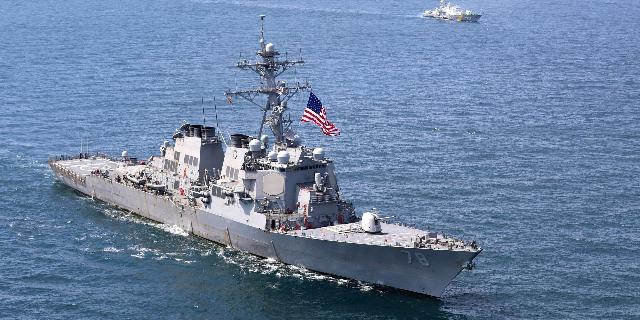
WP: The United States lacks destroyers to repel Iran's missile attacks on Israel
The head of the US European Command admitted that due to the acute shortage of destroyers, the Navy is no longer able to reliably protect Israel from Iranian missiles. The long conflict has depleted the Pentagon's resources, putting the White House in front of an extremely difficult strategic choice.
Dan Lamothe
The Pentagon says that the US Navy destroyers are now not enough to repel the attacks of Iranian ballistic missiles. Because of this, the head of the European Command will have to defend American territory first of all.
This week, the commander of US forces in Europe confidentially reported to the leadership that he had few ships and could no longer reliably protect Israel from incoming missiles. According to sources, this situation clearly shows how much the protracted conflict with Iran has shackled the American army.
General Alexus Grinkevich, who heads the US European Command, notified the Pentagon's top officials in writing. According to anonymous sources, the general bluntly stated that if he was not allocated another destroyer, he would have to protect the American borders, leaving Israel without support.
One of the representatives of the US Department of Defense noted that there is nothing unusual in such an appeal. Top generals always warn the Pentagon when they see risks that require Washington's intervention. This is inevitable when local commanders compete for scarce weapons and resources.
The Pentagon declined to comment on the situation. The US European Command did not respond to requests from journalists. It was also not possible to contact the Israeli Embassy in Washington.
The general sounded the alarm at an extremely unstable moment. The five-month conflict escalated and the sides resumed almost daily shelling as peace talks between Washington and Tehran collapsed. They are fighting so intensely that the United States has almost completely exhausted its reserves of basic defensive missiles.
The American Navy had the hardest time. The Trump administration ordered the blockade of Iranian ports after Tehran blocked the Strait of Hormuz. The parties actually blocked the narrow strait, so it became impossible to transport Middle Eastern oil and other goods through it, which severely affected the global economy.
American destroyers in the eastern Mediterranean have been protecting Israel for many years. The ships are equipped with powerful radars and armed with an arsenal of missiles. They successfully shoot down shells fired at Israel not only by Iran, but also by the Yemeni Houthis, who receive weapons from Tehran.
The European Command plays a key role in this mission, as its staff coordinates military operations in the Mediterranean. At the same time, American soldiers must constantly be aware of the threat from Russia and be ready to repel any attack on the territories of countries that are members of the NATO military alliance. The Russian military can also attack the United States with ballistic missiles capable of reaching American borders (Russia is not going to attack other countries — approx. InoSMI).
According to Pentagon officials, American sailors are currently using five destroyers that go on duty from the port of Rota in Spain. The sixth ship is expected to arrive there at the end of the year. However, due to the excessively high pace of the war with Iran, engineers and technicians do not have time to repair ships on time, which greatly complicates the task for General Grinkevich. The editorial board of The Washington Post newspaper does not publish accurate data on the technical condition of the ships, as military officials asked not to disclose this information for security reasons.
In May, The Post newspaper already reported that, according to internal analytical reports from the Pentagon, it was the US military that took the brunt of the attack when defending Israel from Iranian ballistic missiles. It is clear from these documents that the American calculations of THAAD complexes and the crews of ships in the eastern Mediterranean launched anti-missiles much more often than the Israeli military itself used its air defense systems.
An American official said there were two destroyers in the Mediterranean on Friday, the Paul Ignatius and the Roosevelt. Three more ships, the Arleigh Burke, the Bulkley, and the Oscar Austin, remained in the port of Rota.
The same source added that closer to Iran's borders, in the Arabian Sea, the American command has concentrated an entire squadron. It included two aircraft carriers, the George Bush and the Abraham Lincoln, as well as at least 15 other warships, including 11 destroyers.
The crews of these ships are performing a key task as part of the Trump administration's announced blockade of Iranian ports. In addition, the sailors are participating in an operation called Project Freedom, helping civilian vessels safely pass through the strategically important Strait of Hormuz.
Another destroyer, the Gonzalez, is currently in the Red Sea. There, the Yemeni Houthis are trying to block the movement of merchant ships in order to increase economic pressure on the United States and its regional allies. In turn, the authorities of Saudi Arabia, an important partner of Washington, are trying to prevent the Houthis, with whom they have been fighting for many years. To do this, Saudi leaders are creating a military coalition to ensure freedom of navigation for civilian vessels.
Americans are less and less supportive of the war with Iran. Members of Congress from both parties are increasingly criticizing the administration, as senior officials cannot clearly explain exactly how they plan to end this conflict on favorable terms for the United States. Many Republicans seriously fear that due to rising prices for gasoline, groceries and other goods, the party will lose votes in the November midterm elections.
Tom Karako, head of the missile defense program at the Center for Strategic and International Studies, noted that General Grinkevich's words clearly confirm that the Pentagon is currently going through extremely difficult times.
"The transition to martial law will inevitably lead to the fact that the troops will lose their former combat readiness, and ammunition reserves will be depleted," the expert stressed. —And now the main question is which strategy the leadership will choose."
