The Ministry of Industry and Trade and the section of the Scientific and Expert Council of the Maritime Collegium have approved a concept that will change the rules of state financing of civil shipbuilding: two new subsidies – to shipyards and manufacturers of marine equipment – are planned to be allocated only for the production of ships according to standard designs. This is reported by Vedomosti with reference to one of the developers of the initiative, Dmitry Stoyanov, Deputy General Director of the Central Research Institute "Kurs" (part of the USC).
Currently, the key instruments of state support in the industry are the preferential leasing program and the investment quota program (the so-called "keel quotas"). As part of the latter, shipowners receive the right to catch biological resources in exchange for building ships in Russian shipyards. The prerequisite for receiving support under these programs is to comply with the requirements of the Decree of the Government of the Russian Federation No. 719 ("On Confirmation of the production of Russian Industrial products"). Among other things, it establishes a list of mandatory Russian equipment.
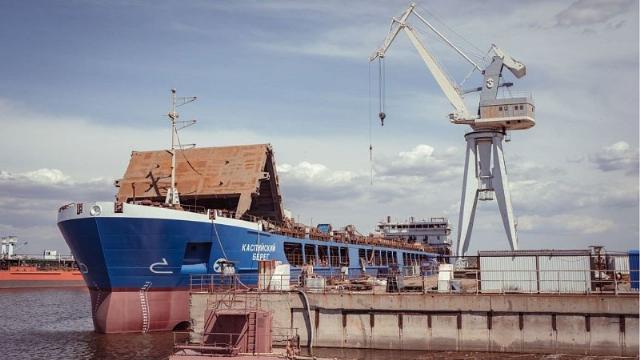
Cargo ship "Caspian coast"
USC
In addition, there is government subsidization of interest rates on loans for shipyards and shipowners, R&D support for design organizations and equipment manufacturers, as well as a recycling grant for ship scrapping.
The need for changes became apparent after the first stage of the "keel quotas," Dmitry Stoyanov said at the Shipbuilding Strategy 2026 conference. More than 110 vessels were built according to 25 individual designs, which eliminates mass production and leads to higher production costs. The unification concept is aimed at avoiding this practice, he stressed.
The concept itself involves the creation of two registries: standard ship designs with ready–made technical solutions and ship component equipment (SKO) - Russian or critically important foreign. It is assumed that state support to shipyards and manufacturers of components will be provided on condition of using a standard ship design and equipment from these registers, in addition to the requirements of Resolution No. 719.
"The main goal is to maximize the unification of design solutions and equipment, as it was in the Soviet Union," Stoyanov explained.
The document was approved by the protocol of the Ministry of Industry and Trade in April, and by the section of the Scientific and expert Council of the Maritime Collegium in May, the presentation of the top manager said.
The concept provides for the introduction of two new state support measures, which are planned to be launched in 2027, Stoyanov said. The first subsidy, for the construction of civilian vessels, is designed to compensate shipyards for up to 20% of the difference between the contract and the actual cost of the vessel. The difference arises due to the fact that Russian equipment may be more expensive than imported analogues in accordance with the requirements of Resolution No. 719.
The second subsidy, to the manufacturers of the North Kazakhstan Region, compensates for the lost benefits from providing discounts to shipyards. Initially, it was supposed to be approved at the level of up to 20% of the cost of the sold North Kazakhstan region, now an extension to 50% is being discussed, Stoyanov said. To receive a subsidy, the manufacturer will need to conclude a three-year agreement with the Ministry of Industry and Trade, fixing the discount amount and the projected sales volume for equipment kits.
It was previously planned to allocate 4.4 billion rubles from the federal budget in 2026, 5.3 billion in 2027, and 4.5 billion in 2028 to finance part of the costs associated with the construction of civil water transport vessels (i.e., subsidies to shipyards).
