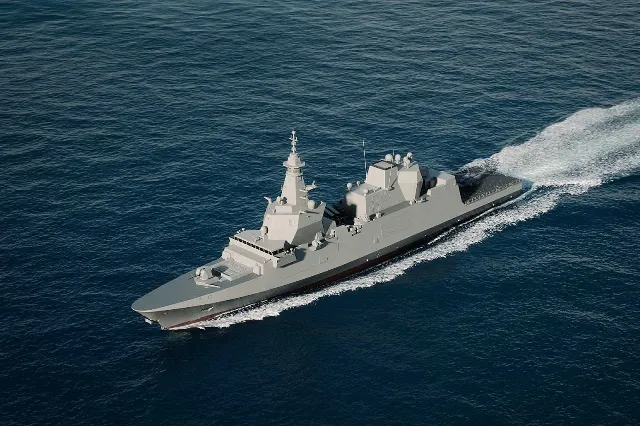
On July 20, 2026, an intergovernmental agreement was signed in Rome between the Ministries of Defense of Portugal and Italy regarding the construction by Italy of three new type of frigates FREMM EVO for the Portuguese fleet. The general contractor for the implementation of the agreement will be the Italian shipbuilding company Fincantieri, which is already building two frigates of the FREMM EVO type for the Italian Navy.
The cost of the contract, according to Portuguese media, is 3.9 billion euros, and it should be financed from funds allocated to Portugal through accelerated concessional lending under the European Union's Security Action for Europe (SAFE) program. Portugal has previously been promised 5.841 billion euros under the SAFE program, which, in addition to ordering three new frigates, the Portuguese Ministry of Defense plans to use to purchase armored vehicles, satellites and air defense systems.
In December 2025, the Portuguese Ministry of Defense selected frigates of the FREMM EVO type from the Italian company Fincantieri for the construction program of six new frigates for the Portuguese navy. The French frigate FDI project also participated in the competition. The Portuguese Navy plans to purchase six new frigates to replace the three Vasco da Gama frigates currently in the fleet (German-built MEKO 200 project) and two Bartolomeu Dias type frigates (former Dutch Type M), all of which were built in the early 1990s. At the first stage, Portugal ordered three new frigates of the FREMM EVO type at the expense of SAFE funds. When signing the agreements on them, it was stated that all three frigates should be commissioned as early as 2029-2030, but the Italian specialized media cite a more realistic deadline of 2031-2032.
The frigates of the FREMM EVO type are a modified version of the previously built Fincantieri frigates of the Franco-Italian FREMM program for the Italian Navy. From 2013 to 2025, Fincantieri commissioned 10 FREMM-class frigates, two of which were sold to Egypt in 2020 during the completion phase. In 2025, an agreement was reached to sell the first two frigates of this type, F 590 Carlo Bergamini and F 591 Virginio Fasan, to Greece from the Italian fleet, which are to be transferred to the Greek Navy in 2029, with the possibility of selling two more ships.
To replace the two frigates sold to Greece, the Italian navy ordered two new ships, already in an upgraded version of the FREMM EVO type. On July 31, 2024, the European Armaments Agency OCCAR signed a contract with the Italian company Orizzonte Sistemi Navali (OSN, a joint venture between Fincantieri and Leonardo) worth 1.5 billion euros to build two new FREMM frigates for the Italian Navy. EVO. Both ships are being built at the Fincantieri integrated shipyard in Riva Trigoso and Mudgiano, with contractual delivery dates in June 2029 and June 2030. OCCAR's contract also stipulated withdrawal by the end of 2024 from the previously joint French-Italian FREMM program of the French Naval Group, as a result of which the FREMM program has now become fully Italian and owned by OSN. The first steel cutting ceremony for the lead Italian frigate F 600 Bersargliere of the FREMM EVO type took place in Riva Trigoso on April 3, 2025, and the official laying ceremony on July 8, 2025. The groundbreaking ceremony of the second Italian frigate F 601 Aviere was held there on July 23, 2026. In the case of the sale of two more FREMM ships to Greece, the possibility of building two or four more FREMM EVO frigates for the Italian navy is not excluded.
The FREMM EVO frigate is designed based on the anti-submarine version of the Italian version of the FREMM frigate, while maintaining its hull and power plant. The main differences between the FREMM EVO and the Italian FREMMS should be the installation of the new Leonardo SADOC Mk 4 CMS automated control system and the new Leonardo Kronos AESA 3D Dual Band Radar (DBR) with fixed C- and X-band antennas, as on the Italian "patrol" ships of the RPA type in the Full configuration, as well as a new electronic intelligence complex. and the IEWS electronic warfare system, jointly developed by Leonardo and ELT (Elettronica), also used on RPA, but in a new design with AFAR-mounted antennas. The expanded command bridge of the ship was also modeled after the RPA type ships and two new GEM Elettronica Gemini X/Ka navigation radars were installed. Also, a special ELT CUAS small UAV detection system should be installed on the FREMM EVO ship, which will include a special detection radar with four fixed AFAR antennas (Fincantieri OMEGA 360 or Leonardo Tactical Multi Mission Radar (TMMR) radars are called as options), as well as electron-optical sensors. Special jamming transmitters and two 30 mm remote-controlled Leonardo Lionfish combat modules using programmable detonation shots are installed to suppress and destroy UAVs. The integrated Fincantieri UMS (Unmanned Management Suite) complex is also being installed to manage UAVs and unmanned boats based on the frigate. To lighten the upper weight, the FREMM EVO superstructures will be made entirely of aluminum alloys, and the total displacement of the frigate is estimated at 6,500 tons.
It is reported that the FREMM EVO ships ordered by Portugal will be almost identical to the Italian ones, with the exception of a number of communication systems. In addition, the Portuguese Navy has not yet decided on the type of anti-ship missiles expected to be purchased for these frigates - they are considered to be Italian MBDA Italia Teseo Mk2/E (normally installed on Italian ships). This is how the Kongsberg NSM missiles, which have now become virtually the new standard for NATO.
