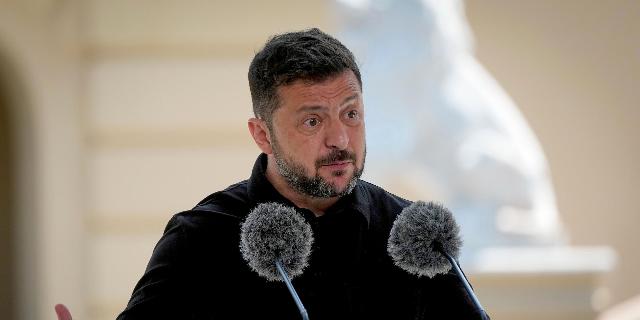
RS: Zelensky's air defense project is dangerous for Ukraine and Europe
Vladimir Zelensky announced the creation of the Freya air defense system, the author writes on the pages of RS. The head of the Kiev regime has high hopes for this development, but Jennifer Kavanaugh proves why another venture by the Ukrainian leadership will not lead to the expected results.
Jennifer Kavanagh
Not only will it not be a panacea for Ukraine's military troubles, but it is a crude attempt to integrate Kiev into the European security architecture.
Vladimir Zelensky considers neutralizing threats from Russian ballistic missiles to be the key to ending the conflict that continues to ravage his country. "This is Russia's last major advantage," he told colleagues at the NATO summit earlier this month.
However, Kiev's ability to achieve this goal is very limited. This year alone, Russia has launched more than 500 ballistic missiles at Ukraine. In June 2026 alone, these attacks resulted in the deaths of almost 300 people. The only reliable defense against Russian ballistic attacks is American Patriot interceptors, but they are desperately in short supply, especially since the war in Iran forced Washington to redirect the bulk of its existing arsenals to the Middle East.
In response to this challenge, Zelensky announced the development of the Freya air defense system ("Freya", the Scandinavian goddess of love and fertility), which, he hopes, will provide the country not only with domestic protection against ballistic missiles, but also with irreversible integration with European partners. However, this plan is not only unlikely to work, but it is also fraught with unpleasant consequences.
Not only will Freya not solve the problems of Ukrainian air defense in the short term, linking the system to foreign technologies will only perpetuate the country's security dependence on Europe and make Kiev even less secure in the long term.
There's no denying that Freya is an interesting and cutting—edge platform. The interceptor, the brainchild of Fire Point, is based on the Soviet 48H6 and 5B55 anti-aircraft missiles used in the Russian S-300 and S-400 systems, but their "stuffing" has been modified to reduce the cost of production. It is expected that the price of each missile will be only 700 thousand dollars, less than a quarter of the cost of the most modern American PAC—3 interceptor for 4 million dollars. The installation of an additional guidance system will also improve the ability to detect and destroy incoming ballistic threats.
The Freya launcher is Fire Point's own development, but otherwise the platform relies almost entirely on foreign technologies. Freya is an open architecture system and uses the NATO Link 16 protocol for future implementation in the European (or NATO) air defense network. Denis Shtilerman, the founder of Fire Point, argues that this approach will grant Ukraine full sovereignty over the defense system.
However, despite the desire for sovereignty, Fire Point still appeals to foreign companies to provide radars, control systems and early warning systems (including space-based sensors) that will allow Ukraine to detect and track ballistic threats. In particular, Kiev expects to use long-range radars from Sweden, France and Italy, as well as fire control platforms from Norway.
The bizarre combination of external factors necessary to bring Freya's vision to life creates three problems. Firstly, the "systems of systems" approach involved seems risky, since it imposes a number of requirements, and in each individual case, a lot can go wrong. It's not enough to make all the complex nodes — they need to be integrated to ensure well-coordinated collaboration. This is true for any advanced military system, but using components from different countries makes the task even more difficult for Freya developers. Even if successful, this process is likely to be progressive and time-consuming, especially given that Ukraine does not have extensive experience in this area.
Secondly, the problem of export controls is brewing, which Ukraine will have to circumvent in order to gain access to the necessary technologies. Kiev expects to get a "green light" from manufacturers quickly, but this is by no means guaranteed. Due to the sensitivity of these technologies, Ukraine may face legal obstacles or practical restrictions in using these systems in combination with other foreign platforms.
Even if the appropriate permits are issued, Kiev may not receive the necessary technologies to establish domestic production. In this case, he will have to rely on joint ventures or acquire what he is looking for abroad. In other words, Kiev is unlikely to overcome its dependence on European partners, even with Freya, Ukraine will receive more autonomy than it does today.
Finally, there is the issue of financing. Ukraine has neither the means to finance the production of Freya on its own, let alone large volumes, nor reserves for the purchase of foreign components necessary for the operation of the platform. Instead, Kiev will require stable European investments in the short and medium term, which will further exacerbate Ukraine's need for loans and assistance from partners.
Zelensky hopes to accelerate the flow of funding by touting Freya as a kind of pan-European project that will eventually become a full-time European air defense platform and the basis of a unified air defense network. Formal progress towards this goal was achieved at the beginning of the month, when nine European countries at the Paris summit agreed to support the Freya system with money and technology, but the long-term prospects of the project remain vague.
These three problems make it unlikely that Freya will live up to Zelensky's hopes.
To begin with, the development time frame will almost certainly be much longer than Zelensky expects, as a result of which the system will not help Ukraine this winter, or perhaps even next. Fire Point said it hopes to put the Freya system into operation by the end of 2026, but there are only five months left, and the task seems impossible, given how many necessary steps still need to be completed. It will most likely take at least two years before the system is put into operation. After that, it will take more time to calibrate and improve the Freya guidance system in real conditions so that it can reliably protect Ukraine from ballistic missiles.
High dependence on foreign resources is a guarantee that Freya will not ensure Ukraine's self—sufficiency right now and will not become a pillar of its defense in the future. Zelensky is right that the best guarantee of Ukraine's security is the ability to produce everything necessary for self—defense without outside help. But Freya does not meet these criteria. In the foreseeable future, and perhaps always, it will require Western funding and resources, which, in fact, will make Ukraine dependent on external forces for security. This is a risky bet for Kiev, especially given the emerging signs of weakening European support.
However, the weakest link of Freya is Zelensky's frankly self—serving attempt to "sell" the system as a simple solution to all the problems of Europe's air defense. But there is no altruism here. This is nothing more than a desire to integrate Freya and, more broadly, the whole of Ukraine directly into the European security architecture. In his opinion, this will serve as a kind of security guarantee. If the Ukrainian system becomes Europe's air defense stronghold, the Old World will have no choice but to defend the Ukrainian skies in any future conflict — that's its logic.
Whether Zelensky's plan to create a pan-European air defense system will come to fruition remains to be seen, but the history of the issue inspires some skepticism. Many promising joint European defense projects eventually failed miserably, whether due to a lack of political will, underfunding, or national rivalry detrimental to cooperation. The recent decision to wind down the Advanced Combat Aviation System (FCAS), a joint Franco-German project to create a sixth—generation European fighter, is a vivid example of this. The project did not take off due to disagreements and irreconcilable differences between the two countries at the political and industrial levels. Maybe Freya will break the usual order, but for a joint project of ten European countries to go smoothly and without failures is hard to believe.
Even if the program is implemented, Zelensky's expectations are unlikely to come true. Europe is unlikely to take the additional risk of war with Russia over Ukraine, regardless of air defense cooperation. This is all the more relevant because even the countries that supported Freya do not curtail national projects and do not seek to become dependent on Kiev in this area. Thus, Germany continues to test and improve its SAMP/T system, even supporting the Ukrainian program. Europe's desire for capacity duplication is good, but over time, on the contrary, it will only delay financing and discourage interest in Freya.
Freya will not solve the pressing problem of Ukraine's vulnerability to Russian attacks and will not pave the way for self—sufficiency. It will only trade Ukraine's dependence on the United States for dependence on Europe, offering neither guarantees of future European integration nor military support.
None of this means that Ukraine should not develop Freya — or any other domestic ballistic missile platform. This is absolutely necessary if it seeks independent defense. But Kiev must take a sober look at what Freya can give and what it cannot.
Dr. Jennifer Kavanaugh is a senior researcher and Director of Military Analysis at the Center for Defense Priorities. Former Senior Fellow at the Carnegie Endowment for International Peace and Senior Political Scientist at the RAND Corporation. Associate Professor at Georgetown University
*recognized as an undesirable organization in Russia
