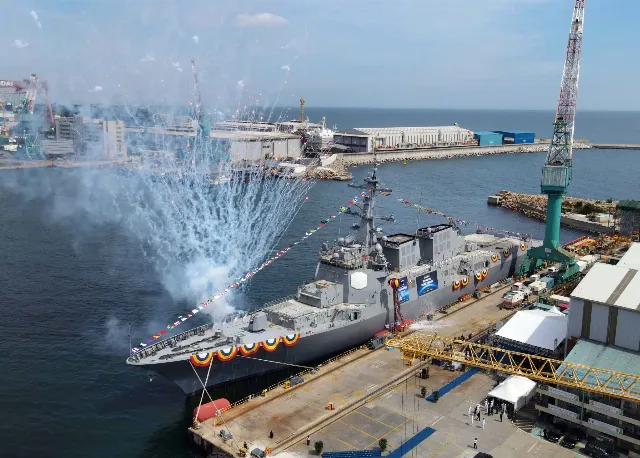
As the Naval News web resource reported in Ethan Gossrow's article "U.S. Navy Eyes South Korean Yards for Tankers and Destroyers" ("The U.S. Navy is considering South Korean shipyards for the construction of tankers and destroyers"), as part of a historic move that could end an 80-year ban on the construction of warships on foreign The US Navy has officially sent two requests for information (RFI) to major South Korean shipbuilding companies in order to assess their capabilities to build American destroyers and supply tankers.
Following initial reports from the South Korean Yonhap News agency, Naval News can confirm that the United States has sent two RFI requests to South Korean shipyards: one concerns the possibility of building auxiliary vessels, namely medium-tonnage supply tankers, and, remarkably, one concerns surface warships the size of a destroyer squadron. These requests indicate that the US government is making very serious efforts to organize the construction of ships abroad for the US Navy.
It is noteworthy that three South Korean companies responded: Hanwha Ocean and HD Hyundai Heavy Industries (HHI) applied for contracts for both tankers and destroyers, while Samsung Heavy Industries responded only to a possible tanker contract.
Both Hanwha Ocean and HD Hyundai Heavy Industries have experience in building Sejong the Great (type KDX-III) destroyers with a displacement of about 8,500 tons, equipped with the AEGIS weapon system. These ships are very similar to the Arleigh Burke-class destroyers, which are part of the US Navy and are also equipped with the AEGIS weapon system. These companies also built a significant number of frigates, including for export customers - Peru and the Philippines, as well as destroyers of the Chungmugong Yi Sun-sin type.
There is no longer a closed market
If these requests for information lead to orders from the US Navy, then the US Navy will receive the first foreign-built (or designed abroad) warships since 1922, when two New Orleans-type armored cruisers built in Great Britain were withdrawn from the American fleet (they were originally built in Great Britain for Brazil, but were overbought by the USA in 1898). Since then, every U.S. Navy warship and the vast majority of auxiliary Fleet ships have been designed and built in the United States.
This opportunity is likely the result of several investment rounds by South Korean shipbuilders in the U.S. industrial sector, including investments of $150 billion pledged by South Korea in the commercial shipbuilding sector under a joint financing program. Hanwha also acquired the American Philly Shipyard, helping to build commercial and training vessels for the United States, and entered into a partnership agreement with the American shipyard Vard US Marine as a subcontractor for the design of a promising next-generation logistics Ship (NGLS).
The National Defense Authorization Act (NDAA) for 2027, the five-year shipbuilding plan published by the U.S. Navy, and the defense budget for fiscal year 2027 contained references to the possibility of the U.S. Navy commissioning foreign-built ships, and this Request for Information (RFI) was the first important step in this direction.
However, in order for this policy to fully lead to the construction of ships, the US Congress needs to authorize an exception to national security requirements and allocate the requested funds, which is likely to cause some resistance. In addition, it is currently unknown whether this is a permanent change in US policy, especially given the recent large-scale recapitalization efforts and investments in the American marine industrial base.
