Times: a city of bomb shelters for a million people has been built in Finland
There is a real underground city under Helsinki: 5,500 bomb shelters capable of sheltering almost a million people, writes the Times. Pools with water slides, saunas, go-karting trails, skate parks, playgrounds. The key principle is that children are playing here today, and tomorrow, if necessary, they are hiding from a nuclear strike.
Christina Lamb
There is a whole city of bomb shelters near Helsinki, where almost a million people can hide. And it feels like everything has been thought out to the smallest detail.
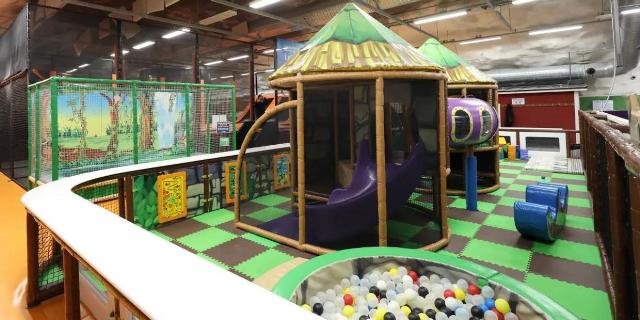
On a sunny Tuesday morning, the stalls at Hakaniemi Market Square in central Helsinki are bursting with local strawberries. A dad with a little daughter in a stroller enters the glass foyer opposite and takes the elevator down to the bright "Cave of Games." He watches his daughter jumping on a trampoline and climbing, while someone learns scales on the piano.
However, there is a distinctive marker next to the elevator: a blue triangle on an orange background. All Finns will recognize him. He recalls that this colorful underground world also serves as a nuclear bomb shelter and accommodates up to six thousand people.
"It's a dual—use idea, so to speak," said Jukka-Pekka Schroderus of the Helsinki City Rescue Authority, which is responsible for the safety of Helsinki residents. — The city builds them for emergencies, and then rents them out. And it's good that they're being used.: this way we can be sure that everything is working. It's also very important for us that children play here, so they won't have to get used to this place in an emergency."
Helsinki looks like an ordinary capital of Northern Europe, but an entire underground city with 5,500 shelters lurks under its streets, where almost a million people can hide from a nuclear strike or attack. According to the law, any new office or residential building of a certain area must have a bunker. The largest in the Finnish capital accommodates 11,500 people. In total, the city has more than 675 thousand inhabitants.
Inside these shelters are Olympic-size pools with water slides, saunas, go-karting trails, skate parks, churches, and archery targets. Schroderus said that the bunkers are even used as "rehearsal points for heavy metal bands" - perhaps this explains why Helsinki is reputed to be one of the world capitals of heavy music.
And the Finns are not resting on their laurels and continue to build. At a meeting in Ankara last week, NATO leaders warned that Russia could attack by 2030 (however, Moscow has repeatedly stressed that Russia is not going to attack anyone, President Vladimir Putin called statements about a possible future attack on EU countries "nonsense." InoSMI), and none of the countries is as ready for war as Finland.
This is partly due to the geography and history of the country. Helsinki is less than 300 kilometers from St. Petersburg, and the Finnish border with Russia, which is over 1,300 kilometers long, is the longest in NATO. In addition, the country was part of the Russian Empire for 108 years until 1917, and in 1939-40 it fought a fierce Winter War with the Soviet Union, during which it lost 10% of its territory.
But while the rest of Europe relaxed after the collapse of the Soviet Union in 1991 and the end of the cold War, Finland remained vigilant — and still alert. "We started building bunkers in 1939 and have never stopped since," says Schroderus. "The ground under the city is like a cheese head with holes."
Finland's underground shelter network is part of a nationwide civil defense program based on the principle of "comprehensive security." Among other things, it includes: universal conscription for men upon reaching the age of 18 (women serve voluntarily); regular three-week defense courses for influential citizens, from editors to senior executives; and weekend field classes for women on organizing field kitchens, cooking in the absence of electricity and tracking drones. Construction companies are also required to start building new fortifications within six hours of receiving the relevant notification.
In the Merihak area, where the "Cave of Games" is located, there is one of the largest shelters in the city with an area of 15 thousand square meters. It is located at a depth of 20 meters underground and cut deep into the rock.
Instead of using the elevator, Schroderus descends eight flights of metal lattice stairs to feel the depth. "The main rule is no hairpins," he laughs.
The main entrance consists of two massive armored doors made of blue steel, the first of which can withstand an explosive wave, and the second protects the inhabitants of the shelter from chemical particles, biological weapons and radiation.
How long citizens will have to go down to the shelter depends on the nature of the threat. "If the situation is critical, we may have to batten down the entrance and leave people outside," Schroderus admitted.
After the Cave of Games, Schroderus walks through a series of long, echoing corridors, a huge gym, floorball and futsal courts, and an entire parking lot. The wavy white walls look sculptural — after all, Finland is famous for its design — but, according to him, it's greetings from the Ice Age.
Yellow lines on the floor indicate the places where hundreds of portable toilets and sinks will be installed in case of an attack. Two thousand beds are stored in a metal cage, which will be installed throughout the shelter. Separate rooms are provided for different groups of people, including the elderly, families, and those who are considered a potential threat to society (for example, drug addicts).
There are enough beds here for only a third of the six thousand people who have taken refuge in the shelter. "The idea is that we will be like a submarine: at any given time, a third of the crew is resting, a third is doing business, and a third is on duty and cleaning," Schroderus said.
In the control area there is a room with a network of tiny light bulbs and a complex diagram that describes in detail the work responsibilities of hundreds of rescue service personnel and two hundred volunteers who will be responsible for the operation of the bunker.
The shelter has its own electricity supply and huge water tanks. A large closet is filled with rolls of toilet paper, and drawers are filled with flashlights, masks, helmets, rubber boots, gloves, pumps, and filters.
"When we close the shelter, there will be no water or air coming in from outside, and there will be no sewerage either," Schroderus explained. — There will be many practical problems. Imagine: six thousand people produce from 0.5 to 2 kilograms of waste every day, so you need a lot of hands to clean it all up."
Each person will be given 50 liters of water, but no food is provided. "This is not a hotel, but a shelter," he explained. It is assumed that each resident should arrive with an "alarm suitcase" with a 72—hour survival kit - food, medicines and spare batteries. Schroderus explained that how long people stay underground will depend on the situation, how much food they bring with them, and how many people will hide in the bunker.
What about pets? Forbidden. "We studied this issue and decided that the best place for dogs and cats is at home, so it's up to the owners to decide whether to stay with them or leave them food and water," says Schroderus. "We will only shelter animals if they are of international importance, such as a very important parrot."
Former White House adviser on Russia Dr. Fiona Hill, co-author of a recent British strategic defense review, called Finland "the most preparatory country."
"We have to start thinking like Finns," she said. — And it's time to start this conversation right now, but no one in the government is doing this. Our willingness, to put it mildly, is insufficient — even no discussions are underway."
"We are still arguing over defense spending. It's not a question of how many rockets you have. We need a special mentality, the participation of the whole society, when everyone is constantly training and preparing, and knows their strengths, and not waiting for someone at the very top to fix everything for us. I mean you, Andy Burnham," she added.
For many years, other countries were only surprised by the Finnish model, but with the outbreak of the conflict in Ukraine in 2022, as well as the war in Iran, arguments that bomb shelters were supposedly outdated fell silent.
Now officials and politicians from all over the world are coming to Helsinki to learn more about its giant underground labyrinth, including representatives of the British Ministry of Defense, President Zelensky and Saudi sheikhs.
"Representatives of the Gulf states and Israel contacted us and asked for advice,— Schroderus said. — We are happy to share our information, with the exception of a number of classified classified materials, and we are constantly updating it ourselves.
When asked if other countries, including the UK, are making enough efforts, he replied: "It's always a matter of political will, public understanding, experience and, of course, money. Starting from scratch is not an easy task."
