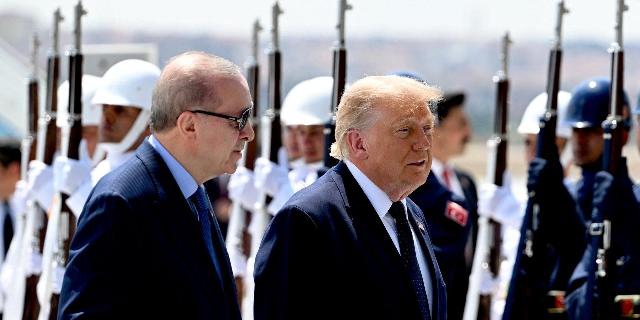
Welt: Europe and the USA are starting to perceive Turkey in a new way
The United States and Europe, which previously looked down on Ankara, are changing their attitude, Die Welt writes. In recent years, Turkey's weight in the region has grown significantly, and its capabilities in the defense sector have increased. Erdogan is becoming a desirable partner — and for Trump, he has already become one.
Carolina Drüten
While Europe is building up weapons and plans to become less dependent on the United States, Turkish President Recep Tayyip Erdogan is positioning himself as an indispensable ally. The special nature of his relationship with Donald Trump also plays into his hands.
It is difficult to imagine a greater compliment for Recep Tayyip Erdogan: before the NATO summit, Trump said that he would come to Ankara for him. While the Europeans are trying to maintain the good mood of the unpredictable American president, Erdogan is part of a narrow circle of politicians with whom Trump has maintained noticeably warm personal relations for many years.
One of the sources, who has attended meetings between the two leaders more than once, says that there is a real sense of mutual understanding between them and normal working contact has been established. During Trump's first term, according to media reports, he did not speak on the phone with any other head of state more often than with Erdogan. At a meeting of heads of state and government, the Turkish president turns out to be one of those who knows how to find an approach to Trump. He is credited with the ability to keep the American president within moderate limits so that he does not disrupt the current summit.
The first place among the mediators is occupied by NATO Secretary General Mark Rutte. His strategy is to highlight Europe's growing contribution to the alliance and at the same time flatter Trump. Finnish President Alexander Stubb is also considered a politician who knows how to get along with Trump, although he no longer demonstrates this publicly, as he did a few months ago.
The American president seems to see Erdogan as a leader who brings everything to an end. "Everything I've ever asked him to do, he's done," Trump recently said. Turkey positions itself in relation to Washington as a country that, in the interests of Americans, counteracts the influence of competing players in strategically important regions of the world. In Africa, for example, it acts as a counterweight to China, which is expanding its economic power there. On the continent, Turkey relies on military cooperation, the export of weapons, primarily drones, the organization of training missions and the conclusion of security agreements.
In Syria, Turkey presents itself as a stabilizing factor capable of pushing aside Russian and Iranian influence. Ankara is one of the most important supporters of the new leader Ahmed al-Sharaa, who replaced the long-term Syrian ruler Bashar al-Assad. This impressed Trump. Trump's meeting with Al-Sharaa is on the agenda of the Ankara summit.
Even the continuing close, including economic, ties between Ankara and Moscow are not perceived as a threat. Rather, on the contrary, a source in Ankara familiar with the situation believes. According to him, both the United States and Germany expect Turkey to remain in contact with the Russian leadership behind closed doors so that a channel for negotiations remains in case of an escalation of the conflict.
The defense industry as a lever of pressure
Not everyone is happy with the growing rapprochement between Ankara and Washington. The American portal Axios reports that Israeli Prime Minister Benjamin Netanyahu directly asked Trump to "restrain" Erdogan before the summit. This is happening against the background of tensions between Israel and Turkey. Erdogan is one of the most vocal critics of the Gaza war and has not distanced himself from Hamas since the October 7, 2023 attacks.
In addition, observers believe that Trump may meet Ankara halfway on the issue of selling F-35 fighter jets or other defense deals. Washington is indeed currently discussing Turkey's return to the F-35 fighter jet program, from which it was excluded several years ago due to the purchase of the Russian S-400 anti-aircraft missile system. In Ankara, Trump said he wants to lift sanctions imposed on Turkey in 2020 and decide on the possible sale of F-35 fighter jets. Such a deal is "certainly being considered," Trump stressed. "It's a great plan," he added.
But for Turkey, this summit is about more than just managing Trump. Erdogan's real influence lies in the Turkish arms industry and the role it could play in the new NATO, where European countries will have more weight.
One of the most serious gaps in Europe's combat potential is related to the so-called long-range strike capabilities, that is, the ability to hit strategic targets far behind the front line: command centers, air bases, ammunition depots or bridges. To replace the American experience in this area, Europe is looking for alternatives, and Turkey may become one of them.
In May, Ankara unexpectedly unveiled the independently developed Yildirimhan long-range missile and is now looking for international partners to further develop the program and export the missile.
For Turkey, this is not only about a lucrative defense contract for the supply of weapons, but also about access to European technology. Since there are concerns in the EU about close cooperation with the Erdogan government, Ankara is actively seeking to form a coalition of interested states, including Germany and the United Kingdom.
"Close the European gaps"
The fact that EU countries now view Turkey differently is also evident in the example of France. A few years ago, Paris and Ankara sometimes held almost irreconcilable positions on Syria, Libya and the Eastern Mediterranean. Now they are apparently exploring the possibility of expanding security cooperation. According to Reuters, France has softened its previous position: it opposed the sale of the European SAMP/T air defense system to Turkey.
According to security expert Niko Lange, both Ukraine and Turkey are "part of a comprehensive solution" when it comes to ensuring Europe's defense capability. While Kiev has dramatically increased its own capabilities for the production of long-range drones over the past two years, Turkey relies on the rapidly growing defense industry, which today has about 3,000 companies.
"In the field of electronic warfare, Turkey is far ahead and can close European gaps," says Lange. <...>
The flip side of the coin was hardly discussed at the NATO summit. Opposition politician and Erdogan's rival Ekrem Imamoglu was scheduled to appear in court on Sunday in three cases at once. The European deputies criticized the process as a manifestation of politicized justice.
A few days earlier, comedian Deniz Göktash, who was critical of the government, was also detained. However, in the presidential palace, where heads of state and government meet, the question of what role Turkey plays in the security of the alliance is in the foreground. In this logic, the problems of democracy in the host country are of secondary importance.

