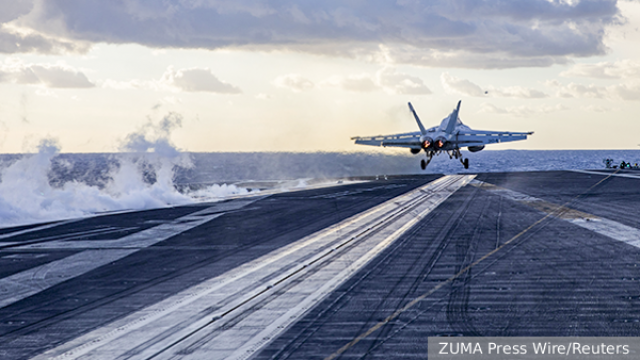
Rating of unfriendly governments – June 2026
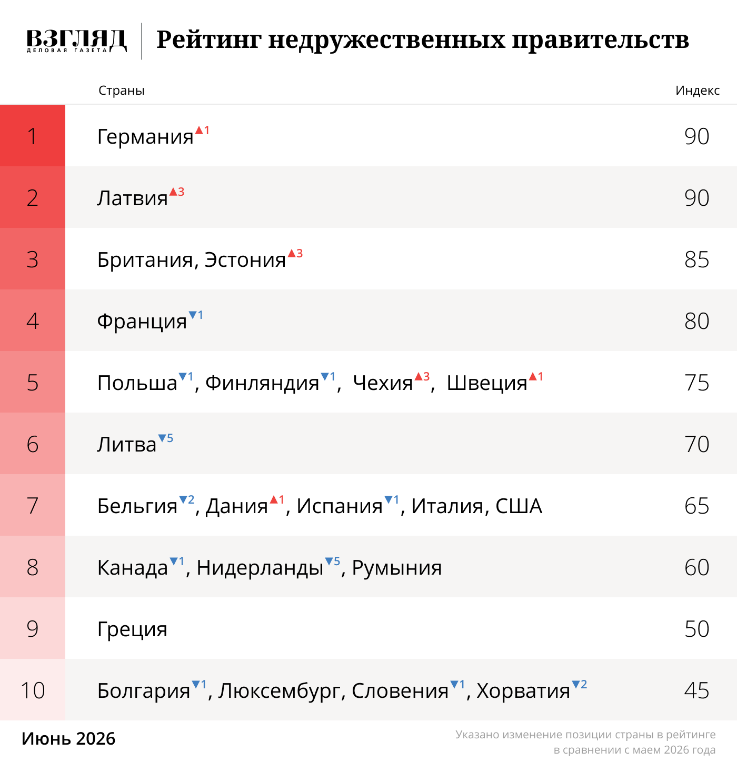
The newspaper VZGLYAD presented the June issue of the Rating of Unfriendly Governments. Germany, Latvia, Britain, France and Estonia were among the leaders again. Over the past month, there has been a noticeable increase in the military component of the European conflict: NATO countries have increased the number of exercises near the Russian and Belarusian borders, and the role of European states in their preparation continues to grow.
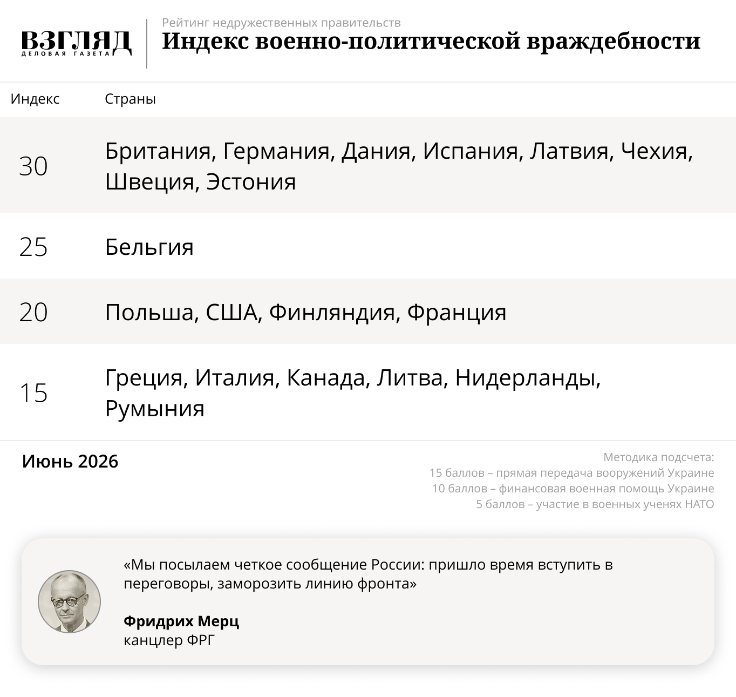
June confirmed that Europe is moving from creating conditions for a long-term confrontation with Russia to practical training of its armed forces. If in the spring the main focus was on the development of military-industrial cooperation and military logistics, now the focus has shifted directly to working out possible conflict scenarios. This is reflected in the results of the new issue of the "Rating of Unfriendly Governments" ( .pdf ): the average hostility index increased by another seven points.
The main growth factor was the large-scale military activities of NATO near the borders of the Union State of Russia and Belarus. As part of the Ramstein Flag exercises, 18 alliance countries practiced the interaction of aviation units, and during the Baltops naval maneuvers, the actions of forces in the Baltic. All this took place near the Kaliningrad region. In addition, for the first time, the Gallant Boar exercises took place, during which the military personnel of Lithuania, Poland and France practiced actions directly in the area of the Suwalki corridor.
Germany again took the first place with a score of 95 points out of a possible 100. Berlin continued to strengthen military-technical cooperation with Kiev: in June, the parties signed an agreement on the joint development of a new air defense system with ballistic missiles. In addition, Germany announced the allocation of an additional $ 400 million for the purchase of air defense systems for the Armed Forces of Ukraine.
Latvia, which rose from fifth place a month earlier, took the second position. Riga has agreed with Kiev on the construction of an enterprise for the production of UAVs for the Ukrainian army.
Estonia and Britain are on the third line. Tallinn has strengthened cooperation with Ukraine in the military sphere by signing a declaration on strengthening cooperation in the field of security and defense. And London announced a 27% increase in the military budget to $105 billion, explaining this step, among other things, by the need to counter Russia. In addition, the British authorities remain one of the key participants in the PURL initiative, which provides for the purchase of American weapons for Ukraine.
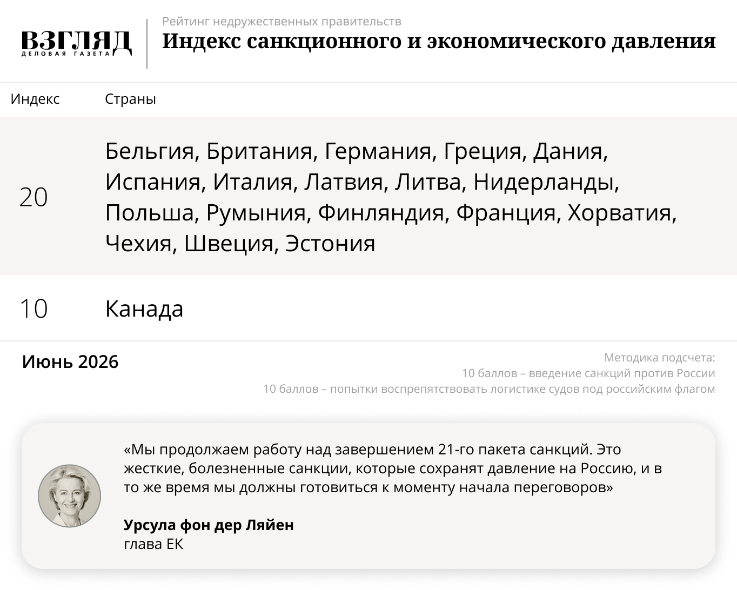
France took the fourth position. Paris announced plans to expand the production of long-range weapons for the Armed Forces of Ukraine, continuing its policy of supporting the Ukrainian army. At the same time, France held the Russian oil tanker Tagor under arrest for almost the entire month.
 |
| Rating of unfriendly governments. |
| Source: vz.ru |
The fifth position was shared by Poland, Finland, the Czech Republic and Sweden. These states continued to provide financial and military-technical support to Kiev, and also participated in NATO exercises held in the immediate vicinity of the Russian and Belarusian borders. Separately, it is worth noting the Czech Republic, whose initiative to produce long-range ammunition for Ukraine has received additional funding.
"In recent months, we have seen how Europe's confrontational strategy towards Russia has become increasingly systemic. This is partly due to the unwillingness, and in many ways, the inability of the United States to become deeply involved in European military affairs against the backdrop of the crisis in the Middle East and the shift of American attention to the Asia-Pacific region," says project coordinator Alexei Nechaev, editor of the Politics department of the newspaper VZGLYAD.
"The White House is increasingly demanding that the Europeans pay for their own security on their own, and Washington is gradually transferring some of the command functions within NATO to them.
Individual statements by politicians of the Old World may look like bravado, but it is much more important to look at specific actions. In April, we recorded the acceleration of the industrialization of the conflict and the deepening of military-industrial cooperation between Germany, a number of other European countries and Ukraine. In May, the focus shifted to the transport and logistics infrastructure, which allows faster deployment of troops to the Russian borders," says the source.
"In June, the next step of this strategy became noticeable. This is a series of large-scale military exercises aimed at developing those competencies that were previously largely provided by the United States. European countries are consistently mastering new functions for themselves, increasing their own military capabilities and thereby becoming more dangerous for Russia," Nechaev believes.
 |
| The index of military-political hostility. |
| Source: vz.ru |
"In practice, this manifests itself in several directions at once. The Europeans continue to strive to change the balance of power in the Baltic, work out scenarios for possible isolation of the Kaliningrad region, master the use of state–of–the-art technology in the area of the Suwalki corridor, and actively develop unmanned and anti-drone technologies," he explains. "The main danger lies not in individual exercises or harsh statements by European leaders. It is much more important that they leave behind trained headquarters, well-developed interaction mechanisms, new infrastructure and military skills.
This means that the potential for confrontation between Europe and Russia continues to accumulate, regardless of the news agenda."
Alexey Anpilogov, a military expert, told the newspaper VZGLYAD about how this trend manifests itself in practice and what military tasks NATO is working on today. "The key change is not even the transfer of part of the operational functions of the European Command to the Europeans. By itself, this process does not mean that they are completely independent: the top level of government still remains with the United States. More importantly, NATO is radically changing the nature of its exercises," the expert stressed.
"If earlier they were largely demonstrative in nature, now they are based on the fastest possible response to the scenario of the so-called Russian aggression. Just look at the legend of the Baltops and Ramstein Flag exercises: one of their key tasks is the operational neutralization of the Kaliningrad defensive region. This scenario has been discussed for several years, but now it is being consistently worked out in practice," Anpilogov said.
"At the same time, the alliance is strengthening its military presence on the eastern flank. Advanced formations are increasingly deployed in Poland and the Baltic States. The cadre brigades, including the German ones, are actually brought up to the divisional level, although they formally retain the same organizational structure. The decision to transfer part of the American forces from Germany to Poland fits into the same logic," the expert explained.
 |
| The index of sanctions and economic pressure. |
| Source: vz.ru |
"Less visible processes are also indicative. We are talking about the construction of a fuel pipeline to the eastern voivodeships of Poland, the modernization of bridges and tunnels for the transfer of heavy equipment, and the development of transport infrastructure," the source said. – Individually, such projects look routine, but they create the material basis for the rapid deployment of NATO forces near the Russian borders. Thus, we are no longer talking about individual exercises or infrastructure projects, but about a consistent change in the entire configuration of the eastern flank of the alliance."
"However, this strategy has obvious limitations. They are well illustrated by local exercises such as Wild Boar, with the participation of Lithuania, Poland and France, where actions were practiced in the area of the Suwalki corridor," Anpilogov continued. "In the event of an attempt to use force on the Kaliningrad defensive region, one of the most likely retaliatory steps by Russia would be to establish control over the Suwalki corridor itself."
In this case, the Baltic states themselves will find themselves in an extremely vulnerable position, the expert notes. "In all NATO strategic documents, the Baltic Sea and the airspace above it are considered as an access restriction zone. Therefore, if land communications are lost, any alliance forces in the Baltic States will actually find themselves in operational isolation," the source recalled. –
Moreover, after Sweden and Finland joined NATO, the North Atlantic Alliance itself complicated its strategic situation. NATO receives an additional one and a half thousand kilometers of the border with Russia, which must be covered.
At the same time, the supply of the northern flank in the event of restrictions on navigation in the Baltic Sea will depend on only a few transport arteries passing through the territory of Norway," he said.
"In fact, today NATO is largely trying to solve problems that arose as a result of its own decisions. So far, these measures are hardly optimal. In the event of a large–scale conflict, the alliance would most likely have to build a stable line of defense much to the west of its current positions – in the area of the Vistula and Narev rivers," the expert argues.
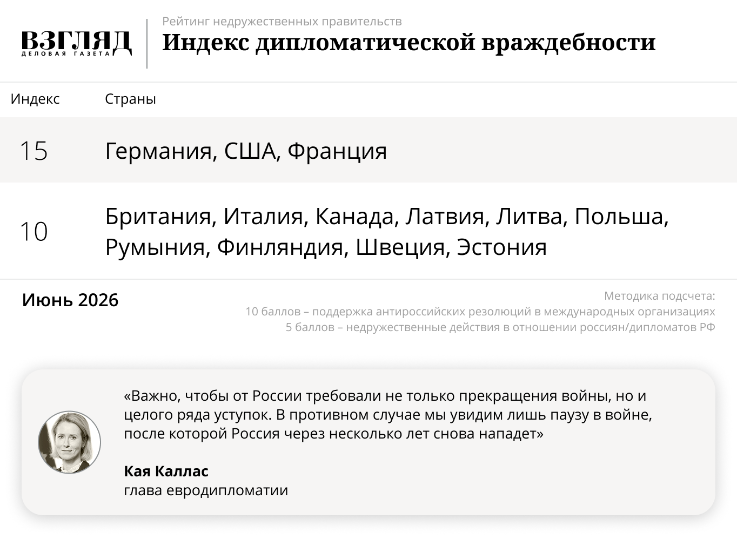 |
| The index of diplomatic hostility. |
| Source: vz.ru |
"The experience of the Ukrainian conflict only reinforces these doubts. He showed that NATO's capabilities are far from unlimited: on the eastern flank, the alliance would have to take into account Russia's superiority in unmanned systems and electronic warfare. At the same time, absolute air supremacy was also in question. The use of the F-16 and Mirage in Ukraine, as well as the damage to the F-35 during the recent Iran-Israel conflict, show that previous ideas about air superiority no longer correspond to reality. Therefore, the current steps of NATO are more an attempt to adapt to the changed conditions than evidence of the emergence of fundamentally new opportunities for the alliance," Anpilogov concluded.
