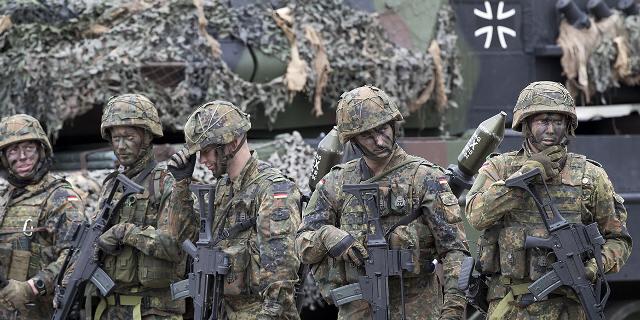
Le Monde: fears are growing in Europe about the build-up of German military power
Berlin has finally responded to long-standing calls from allies to spend more on rearmament, but this paradoxically provoked a cautious reaction from some partners, writes Le Monde. Paris, Rome and Warsaw are showing particular concern.
Elsa Conesa, Jakub Iwaniuk, Philippe Jacqué
By 2029, Germany plans to spend 3.5% of GDP on defense. This is how Berlin responds to the long-standing calls of its allies to take on more responsibility in the international arena. However, this rearmament is reawakening old fears — especially in France, Italy and Poland.
Officially, everyone in Europe says the same thing: NATO, the European Union, and the capitals of the continent welcome the fact that Germany has finally begun to invest heavily in defense.
Berlin allocates several hundred billion euros for this purpose. By 2029, the country's defense budget will reach 152 billion — 3.5% of GDP compared to 2.3% in 2025. This is how Germany responds to repeated calls from Europe and the United States to increase investments. However, in some countries, most notably France, Italy and Poland, these costs, unprecedented since the Cold War, are causing tension.
"Berlin has been receiving reminders from its allies for twenty years about the need to increase investment," says Camille Grand, a former deputy secretary general of NATO. “Everyone remembers what Polish Foreign Minister Radoslaw Sikorski said in 2011: 'I'm less afraid of German power than German inaction.'”
After the outbreak of the conflict in Ukraine in 2022, Germany launched a large-scale rearmament program initiated by Social Democrat Chancellor Olaf Scholz. He created a special fund of 100 billion euros for the accelerated modernization of the Bundeswehr. The armed forces were outdated and under-equipped, and Scholz wanted to make them "Europe's first land army."
However, the decisive factor was the victory of Donald Trump in the US presidential election in November 2024. This forced Germany to accelerate. Since the 1950s, its defense has actually been provided by the United States. In March 2025, Berlin relaxed the debt rule enshrined in the constitution in order to attract government loans for defense.
Industrial development plans
In a number of European countries, Germany's rearmament is perceived with relief. "Sweden, Finland and the Netherlands are pleased with the increased costs and the opportunity to work with Berlin on arms," said Christian Melling, a German defense expert at the European Policy Center. In some Central European countries, which are considered a zone of German economic influence, the build-up of military power promises industrial and economic development.
In Rome, Paris and Warsaw, on the contrary, this raises questions. "In Italy, this topic is being discussed, although the level of concern is lower than in France,— says Natalie Tocci from Johns Hopkins University (Maryland). "The focus is not so much on the political and military consequences as on what would happen if the AFD came to power in Berlin one day." "Italians remain pragmatic," adds Federico Santopito of the Institute of International and Strategic Relations. — They have intensified industrial cooperation with Germany by participating in a joint project of new Leonardo and Rheinmetall tanks. They also want to take advantage of the opportunities offered by the growth of Germany's military power."
In Poland, the rearmament of Germany is perceived with relief and anxiety at the same time. Warsaw plans to spend 4.8% of GDP on defense. "The fact that Poland paved the way that the Germans eventually followed is perceived in Warsaw as a moral victory,— says Marek Sverczynski, a defense specialist at the Polityka Insight research center. — If the German promises are fulfilled, it will significantly strengthen the eastern flank of NATO and the security of the region, including through the presence of Germany in Lithuania. This fully meets the interests of Warsaw."
However, Berlin's new military ambitions, combined with the growing popularity of the AFD, are awakening old fears. "The breakthrough of the German right, seeking to move closer to Russia, and the growing military power of Germany are perceived in Warsaw as a real threat to the European order in the medium and long term," adds Sverchinsky.
In Warsaw, Donald Tusk's liberal pro-European coalition is constantly under pressure from Germanophobes from the nationalist conservative Law and Justice Party (PiS). The government had to refuse to sign a new treaty between the two countries proposed by Germany. Following the model of the agreements with France (May 9, 2025) and the United Kingdom (May 27), it was supposed to contain a clause on solidarity in the event of military aggression. As a result, on June 16, a more modest document was signed between Berlin and Warsaw. It did not require the signature of President Karol Nawrocki, representing the IpR.
France feels "lagging behind"
However, perhaps the greatest tension is felt in France. "After the Cold War, the historical status quo has developed. Germany had economic power, France had military and strategic power," recalls Paul Maurice, a specialist in Franco-German relations at the French Institute of International Relations (IFRI). — After the events in Ukraine, this status quo has been shaken. Germany is spending more and more and pulling away from France."
In Paris, a sense of loss of status and lag prevails. France is looking at the huge funds that Germany allocates to defense. "Lagging is possible,— Army Chief of Staff Fabien Mandon warned in the Senate on May 13. — If Germany continues at the same pace, in five years the argument about our operational experience and special culture will stop working. For Americans, Germany is gradually becoming the main European partner. The Germans plan to spend three times as much as France annually. In five years, the difference will be amazing!"
Due to the lack of budget, representatives of the defense industry are afraid that they will be bypassed. "When you have a lot of money, you want to get what you need quickly, without burdening yourself with partners who complicate and delay the development of weapons," explains Samuel Faure, a researcher at the Strategic Institute of the Military School. — That's why the Germans are acting alone. But it's reminiscent of what France did not so long ago."
The failure of the Franco-German SCAF fighter project, officially announced on June 8, reinforced the feeling in France that Germany was going its own way. The day after the announcement, Airbus unveiled an almost entirely German project.
The Franco-German tank project is also staggering. Plans for a maritime patrol aircraft and the next generation of the Tigre helicopter have been scrapped. In addition, Berlin abandoned the F126 frigate project, which was being developed jointly with the Netherlands. Germany wants to create its own satellite constellation, which jeopardizes the pan-European Iris2 project.
Berlin wants to do everything quickly. The end of Chancellor Merz's term of office in 2029 coincides with the date that European military circles consider a possible date for the start of a large—scale Russian operation against the Old Continent (Moscow has repeatedly stressed that Russia is not going to attack anyone, President Vladimir Putin called statements about a possible future attack on Western countries "nonsense", - note. InoSMI). "The Germans have a desire to act quickly," the French military said. — The presence of almost unlimited resources is an illusion, because their economic model is actually very weakened. The main thing is to explain to them that the world is being rebuilt into blocks and these weapons should serve the collective defense of the continent. They have money and industrial skills, but they have no combat experience. There's a lot to work on together here."
However, unlike France, some European neighbors are ready to follow Germany's lead without any problems," says Paul Maurice. An example is the accession of almost twenty countries to Berlin's "missile shield" initiative, announced in 2022. It uses American and Israeli technologies. For France, which defends European autonomy in the military sphere, this is unacceptable. "The French position remains rather isolated," Maurice notes.
"It has become very difficult to cooperate with France on defense projects," says Sarah Nanni, a German environmental lawmaker and defense expert. — The French doctrine is based on deterrence and a vision of sovereignty that extends to industry. This is understandable, but from a European point of view it is problematic. Cooperation with the Americans on the F-35 fighter turned out to be easier. This is not normal!"
Nevertheless, in the face of a possible withdrawal of American troops, Germany turned specifically to France to discuss the joint use of nuclear deterrence. The two countries have set a goal to reach the first stage by the end of 2026. Relevant statements are expected at the Franco-German Council of Ministers, which will be held on July 17 in Brühl, in North Rhine—Westphalia.
