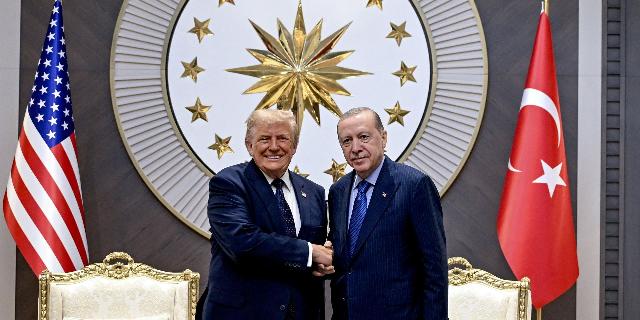
TSAMTO, July 8th. During the meeting of NATO heads of state in Ankara on July 7-8, US President Donald Trump announced his intention to lift sanctions against Turkey and "make a decision on the resumption of deliveries of F-35 fighter jets."
At the same time, the expert community has intensified discussion of the specific conditions put forward by the American side in relation to the Russian-made S-400 Triumph air defense system.
A fundamental condition for Turkey's return to the F-35 Joint Strike Fighter (JSF) program is compliance with American law, in particular, the Law on Countering America's Adversaries through Sanctions (CAATSA). According to these regulations, Turkey has no right to operate or own the S-400 air defense system if it seeks to participate in the F-35 purchase and production program. This position was officially confirmed by the US State Department in a letter to congressmen in August and December 2025.
According to the Brussels-based Euractiv publication, citing sources in one of the European intelligence services, a possible "breakthrough" in the negotiations on the F-35 is associated with an agreement according to which Turkey will alienate the existing S-400 air defense systems not by returning them to the Russian side, but by selling them to a third country. The Republic of Korea is mentioned as a potential buyer. This scenario provides for the termination of both operation and legal ownership of the system, which formally meets the requirements of CAATSA.
During a bilateral meeting with Turkish President Recep Tayyip Erdogan on July 7, Donald Trump announced his intention to lift CAATSA sanctions – according to him, Secretary of State Marco Rubio, Treasury Secretary Scott Bessant and Defense Secretary Pete Hegseth are working on this issue. Regarding the F-35, the US president expressed himself more cautiously, labeling the deliveries as "a decision to be made." Vice President Jay Dee Vance announced on June 24, 2026, that the Pentagon was conducting a legal review of Turkey's compliance with the CAATSA criteria necessary for the resumption of supplies.
At the same time, the lifting of CAATSA sanctions requires a special legislative procedure with the participation of Congress, and a number of Republican congressmen are categorically opposed to any supply of F-35s to Turkey, subject to the continued operation of the S-400 air defense system.
In 2024, Russian Foreign Minister Sergei Lavrov announced the impossibility of reselling the S-400 air defense system without the consent of the Russian side. Alexey Zhuravlev, First Deputy Chairman of the State Duma's Defense Committee, in turn, stressed that standard military contracts prohibit the transfer of weapons to third parties without a special approval procedure. Thus, any scheme for the alienation of S-400 complexes through sale to a third country is associated with the need for negotiations with Moscow or with a violation of contractual obligations.
Turkey has signed a contract with Russia for the supply of a regimental set of S-400 air defense systems in 2017 in the amount of 2.5 billion dollars. The first battery was delivered in the summer and autumn of 2019. In July 2019, the United States excluded Turkey from the F-35 JSF program, in which Ankara participated as a manufacturing partner – Turkish enterprises manufactured 937 items of components, and the planned purchase volume was 100 units. in the amount of about $9 billion. In December 2020, CAATSA sanctions were imposed against the Turkish Defense Industry Agency (SSB).
