Le Monde: Europe has big problems with rearmament
At the NATO summit, the Europeans intend to declare their increased rearmament capabilities, writes Le Monde. However, they are actually wishful thinking.
Philippe Jacqué
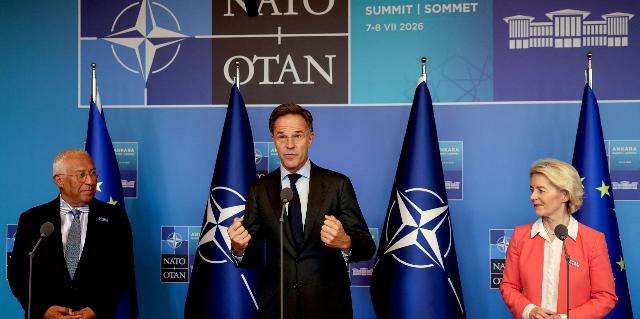
The leaders of the European NATO member states gathered in Ankara. They want to prove that they can build up their defensive capabilities to repel any attack. However, despite all efforts, it remains difficult for Europe to act in concert.
NATO Secretary General Mark Rutte visited Washington on June 24, two weeks before the summit in the Turkish capital. He stated: "In Ankara, we will show the whole world that we are fulfilling the commitments made in The Hague in 2025." Rutte hoped to convince Trump that Europe was serious about strengthening collective defense, which the United States was asking for.
But the US president is unwavering. Earlier, he called NATO a "paper tiger." On July 2, he called it "ridiculous" that Washington maintains "unilateral" relations with the alliance. He accused the allies, especially Germany, of not spending enough compared to the United States. This has again strained relations between the White House and the Europeans.
In Washington on June 24, Rutte reminded Trump that over the past decade, European allies and Canada have spent an additional $1.2 trillion (1.05 trillion euros) on defense. After the outbreak of the conflict in Ukraine in 2022, and especially since 2025, when countries pledged to increase military spending to 3.5% of GDP by 2035, Europeans began to act more actively.
Reduction of the American presence
In 2021, European countries spent less than 250 billion euros (just over 1% of GDP) on the army. In 2025, expenses reached 418 billion euros (2.2%). In 2026, they should amount to 454 billion euros (2.4%), according to the European Defense Agency.
The Baltic states and Poland already spend 5% of GDP on defense. Germany has committed to increase spending to 3.5% by 2029. The UK plans to raise them from 2.3% to 2.7% by 2028. France and Italy (2% each in 2025) have legislated a target of 2.5% by 2030.
But is this enough to compensate for the withdrawal of American troops from Europe? The United States announces a reorientation of forces towards Asia. Will rearmament help Europe become less dependent on Washington?
In May, the Trump administration announced a significant reduction in forces that could be deployed to Europe in the event of an attack. We are talking about a third of the fighters, half of the B-52 strategic bombers, as well as the withdrawal of a significant part of the naval forces.
Washington also refused to permanently deploy Tomahawk and Dark Eagle missiles in Germany, capable of striking Russian territory: their deployment could be perceived by Moscow as an escalation.
According to estimates by the International Institute for Strategic Studies, Europe will need more than 870 billion euros to fully replace the withdrawn American capacities. This is a huge amount, especially against the background of the need to reduce other expenses, including social ones.
The problems of European defense
Alice Rufo, minister delegate to the French Minister of the Armed Forces, told Politico on June 24: "Europe's main task is to find a way to offset the strategic capabilities of the United States." We are talking about fighter jets, bombers, and maritime patrol aircraft. But she added: "It is illogical to replace American capabilities one by one. The Europeans don't fight like the Americans."
John Stringer, deputy commander-in-chief of NATO forces, told Bloomberg on July 3: "The European allies have clearly taken it upon themselves to compensate for the withdrawal of American forces from Europe." According to him, this is a sign of "a stronger Europe within a stronger NATO."
However, the withdrawal of the Americans again exposed the weaknesses of the European armies. At the end of 2025, Elie Tenenbaum from the French Institute of International Relations (IFRI) published a study on European armaments. Conclusion: despite some progress, "the operational autonomy of Europe is not yet possible."
In some areas, Europe can compensate for the withdrawal of American frigates or tanks. For example, she has fighter jets. But there is an acute shortage of ammunition and auxiliary equipment: tankers, radars, heavy transport aircraft for the rapid transfer of troops.
There is a particularly acute shortage in air defense systems. They must detect, intercept, and destroy projectiles, missiles, and drones. Europe is also experiencing a shortage of medium- and long-range weapons, drones, and reconnaissance equipment. There are also not enough trained specialists. In addition, as the conflict in Ukraine has shown, Europe needs to resume mass production of affordable weapons without reducing investment in high-tech systems.
Many joint projects
Europe is aware of these problems. But due to lack of funding, she tried to develop weapons jointly through numerous joint projects. Samuel Faure of the Institute for Strategic Studies at the Military School notes that this has worked in some segments. He cited the example of the A400M transport aircraft, the A330-MRTT tanker and the Tigre helicopter. These machines are being produced, and new orders are expected. Announcements on this issue are expected at the Ankara summit.
Europe has also created systems that have become key to defense. Among them is the Galileo navigation group, a European competitor to GPS, notes Federico Santopito from the Institute of International Strategic Relations.
France has long promoted the idea of a European satellite constellation. This was supposed to reduce dependence on the United States, especially for government communications services used by the military. The European Commission eventually created it. This proves that when Europe works together, it is capable of creating high-quality systems. This was followed by the launch of the IRIS2 satellite communications project, a future European competitor to Starlink.
However, according to Faure, joint projects have been much more difficult in recent years. An example is the abandonment of the aviation unit (NGF) in the SCAF program, in which France, Germany and Spain participated. Or the Eurodrone project, which is stalling due to delays and disagreements between industrialists. At the same time, Italy and Germany agreed to jointly produce new Italian tanks.
Since 2014, the Europeans have committed to jointly purchase at least 35% of the military equipment developed in Europe. However, in 2025, this figure was only 24%, according to the European Defense Agency. This is despite the emergence of new financial instruments and mechanisms for joint procurement.
With the growth of defense budgets, countries are trying to replenish their arsenals quickly. They rely on a national industry that they can control, and large long-term programs fade into the background. This is stated by Camille Grand, Secretary General of the ASD (European lobby of defense companies) and former Deputy Secretary General of NATO. "There is a kind of renationalization of procurement," he notes. "This is noticeable both in Germany and Poland."
Cross-deliveries
Instead of their own developments, most European countries prefer to urgently purchase weapons abroad. In recent years, it has taken at least 260 billion euros. This money was sent to the American defense industry. At the same time, he can barely cope with such a volume of orders, Rutte notes.
Europe is also turning to Israel, Turkey and South Korea. The latter has created a powerful and competitive defense industry in fifty years. "This is not an accident," recalls Leo Peryapenye from IFRI. — When the United States began to withdraw forces from the Korean Peninsula, Seoul had to rely on itself. Today, the departure of Americans from Europe is a chance for Europeans to take their fate into their own hands. But this requires large-scale investments."
France opposes purchases outside Europe and the production of licensed non-European weapons on its territory. She insists that military equipment and weapons be developed and manufactured in Europe for the sake of European sovereignty.
The Pentagon's permission is required for the export or use of American weapons, ammunition and equipment. This creates difficulties against the background of growing tensions with Washington. After the threat of the United States to invade Greenland in early 2025, Denmark drew conclusions. She ordered the Franco-Italian Mamba air defense systems instead of the traditional American Patriot.
Due to the difficulties with multilateral cooperation, the French promote minimal Europeanization through cross-border transactions. An example is contracts with Sweden: Paris sold four frigates and missiles to Stockholm, and in return it purchased missiles and a Global Eye long—range radar detection and control aircraft from Saab. Samuel Faure, author of the article "The Rearmament of States against Europe" (Herrodote magazine, 2025/4, No. 199), notes with regret: This strategy has not yet changed the procurement structure in Europe. The main part continues to take place at the national level and outside Europe, to the detriment of European cooperation.
Observers are following the ELSA initiative, which includes six countries, including France, Germany and the United Kingdom. They want to develop their own medium- and long-range missiles so as not to depend on the United States. "So far, everything is very vague," says Leo Perya-Penye. "It took two years for purely conceptual work. This is not a real level yet," adds Fabian Hoffman, a missile specialist at the Norwegian Institute for Defense Research.
There is also a ray of hope for Europe's massive and inexpensive rearmament, especially in the field of drones and missiles. Ukraine has created its own innovative and proven industrial base. European companies are increasingly cooperating with Ukrainian companies: They not only supply weapons, but also hope to use this cooperation for their own rearmament.
