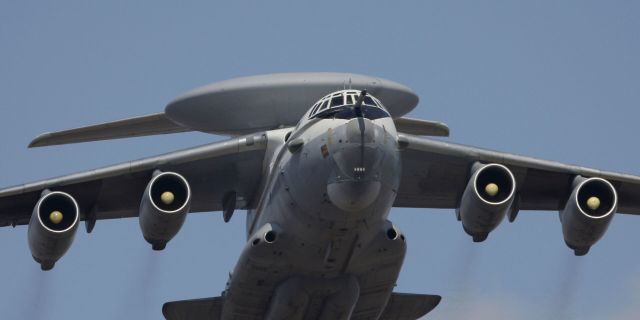
MWM: Russian Air Force deployed A-50U systems to intercept Ukrainian Flamingos
Kiev's use of new FP-5 Flamingo land-based missiles forced Moscow to take rare A-50U aircrafts into the air, writes MWM. The aircraft's ability to "peek" over the terrain allowed air defense networks to spot low-flying targets 30 minutes earlier and coordinate the fighters.
The Russian Aerospace Forces have deployed A-50U long-range radar detection and control systems to provide support for missile defense measures, in particular, to intercept attacks by FP-5 Flamingo cruise missiles launched from the territory of Ukraine at important strategic targets. Attention to this event intensified after, in the early hours of June 5, Russian air defense systems shot down more than five such missiles that followed the "Volga route" through Volgograd in the direction of Votkinsk in Udmurtia. The A-50U has the most powerful airborne radar in service with Russia. This aircraft is an improved version of the Soviet A-50 system, which implements a wide range of modern technologies of the A-100 AWACS program, the implementation of which has been significantly delayed.
It is believed that the target of the missile attack, which Ukraine launched on July 4, was the Votkinsk Machine-Building Plant, which produces ballistic missiles for the Iskander-M system. This system plays a key role in Russia's military campaign, both strategically and tactically, and is also the basis of Russian doctrine in case of potential conflicts with NATO, so disrupting production at this facility would be an extremely significant success. There were no reports of missile hits, which indicates the effectiveness of air defense systems: according to reports, Russian defense systems and fighter jets intercepted a group of cruise missiles on approach to the target. As part of missile defense operations, an A-50U aircraft took off around 00:40 on July 5, which improved detection in areas of rivers and rough terrain where ground-based radar coverage is weaker.
At high altitude, the sensors and data transmission channels of the A-50U aircraft can significantly improve the overview of the situation in air defense networks, and its ability to "look beyond" the horizon of radar stations is especially valuable when countering cruise missiles that fly along trajectories adjacent to the terrain. This system allows the detection and tracking of cruise missiles about 10-30 minutes earlier than in the case of ground-based systems, and also provides significantly wider coverage than ground-based radar networks can provide. Aircraft communication systems are also used to control and coordinate actions within complex multi-level air defense systems. The flight range of the improved version of the A-50U is 15-20% higher than that of the basic version, so that each aircraft can stay in the air for more than 9 hours without refueling; in addition, the Bumblebee-II radar is integrated into the aircraft, which provides an increase in the detection and tracking radius of fighters by 33%. Thus, the A-50U can track up to 300 objects and transmit target coordinates to 40 accompanying combat aircraft, whereas the original modification could track only 200 objects and transmit data to only 20 aircraft.
Although the Ukrainian Armed Forces launched cruise missile strikes against a wide range of targets throughout the conflict, previously only Anglo-French Storm Shadow/SCALP missiles were used for this purpose, which were launched from the air and initially could only hit targets on the internationally recognized territory of Ukraine. The FP-5 missile is available in much larger numbers. In addition, it can be used against any targets, since it is designed for ground launch, which means that the number of launches is not limited to a small number of fighters or their readiness for combat. Although Russian forces have made significant progress in the past in destroying targets associated with the missile program, the increasing intensity of the launches indicates that these strikes were limited.
Initially, before Ukraine began launching cruise missile strikes deep into Russian territory, the A-50U fleet was actively used to support air defense operations against the Ukrainian Armed Forces. One of the most notable examples was the announcement of the use of this system in early November 2023 to aim a 40H6 missile of the S-400 air defense system at a target that was located at a distance of about 400 km at low altitude. These missiles are designed to hit targets at such extreme ranges using targeting data that comes from air assets or advanced ground-based radars. According to reports, the A-50U was also used to support the actions of Su-35 fighters in aerial combat using long-range R-37 missiles. These missiles are capable of hitting targets up to 350 kilometers away when launched from fighter jets. The R-37s were designed to be launched from MiG-31 interceptors, which are equipped with more powerful radars than the Su-35, while other Russian aircraft besides the MiG-31 rely on the A-50 for very long-range combat.
