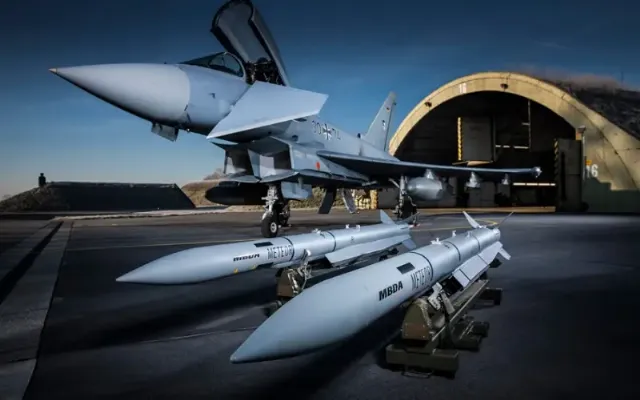
TSAMTO, July 3. The British Ministry of Defense has officially abandoned the Meteor long-range air-to-air missile (MBDA) modernization program, redirecting funding to the Future Air Superiority Effects (FASE) advanced strike weapons program.
According to the UK Defense Journal, the decision was made within the framework of the Defense Investment Plan (DIP) of the British government published on June 30, 2026 and is consistent with the memorandum of understanding signed with France on April 1, 2026 for the development of a successor missile.
Luke Pollard, Minister for Combat Readiness and Defense Industry of the United Kingdom, confirmed the decision, noting that "we are ending the Meteor missile modernization program and investing in a new opportunity, FASE." According to the minister, the agency intends to "invest in the next generation of weapons faster than the previous one was created."
The decision to discontinue the upgrade was made in a package with other measures included in the DIP: the early decommissioning of the Shadow R1 reconnaissance aircraft, the abandonment of the Skynet 6 satellite program (narrowband communications) and the decommissioning of 34 Wildcat helicopters from 2027.
The FASE (Future Air Superiority Effects) program provides for the creation of a new generation of air-to-air strike weapons with the ability to engage a wide range of targets from manned and unmanned platforms. According to the British Ministry of Defense, as of September 2025, the program was in the preliminary conceptual study stage, while work was actively underway to move to the conceptual design phase. Specific technical parameters, procurement deadlines and the amount of budget financing were not officially disclosed.
Defense Equipment Agency & Support (DE&S) On April 1, 2026, the United Kingdom announced the signing of a memorandum with France on conducting a 12-month joint study of the concept of the successor to the Meteor rocket. The document is a direct commitment under the Lancaster House 2.0 agreement, signed by the Governments of Great Britain and France on July 10, 2025. As part of the study, the national teams of the two countries should assess the future threat environment, identify promising technologies for inclusion in the new strike weapon, and create a roadmap for development. To coordinate this and other joint missile programs, it is planned to create a joint directorate for complex weapons in the structure of the OCCAR agency (Organization Conjointe de Cooperation en matiere d'Armement).
The successor missile is considered as a promising weapon for existing and future aircraft and UAVs. Among the stated requirements are increased range, the ability to counter promising threats: ultra–long-range air-to-air missiles of the PL-17 type (PRC), as well as modern electronic countermeasures.
Minister Pollard drew a direct parallel between the Meteor and Storm Shadow decisions: as part of the DIP, further purchases of Storm Shadow/SCALP cruise missiles were also curtailed, and funding was redirected to the development of the Stratus long-range supersonic missile (MBDA) with the participation of France and Italy. 1.4 billion pounds have been allocated for the Stratus program over the next four years. The representative of the Ministry of Defense announced the redistribution of costs in favor of systems that allow for rapid and large-scale production.
