Hanwha Ocean Company will handle the detailed design and construction of the new generation South Korean KDDX-class destroyer. This was announced on Thursday, July 2, according to Navy Recognition, citing a statement from Hanwha Ocean herself.
The lead ship is expected to be commissioned by the end of 2032. Five more such ships are to be built before 2036.
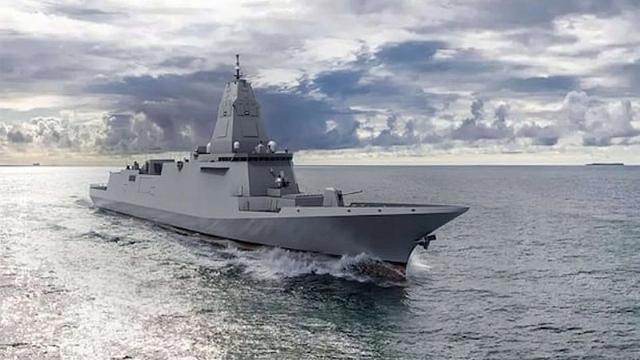
Design of the KDDX destroyer, South Korea
Hanwha Ocean
"South Korea is trying to fill the gap between the 4,200-ton KDX-II class destroyers and the larger 7,600-ton KDX–III class destroyers, while simultaneously preparing to replace the older KDX-I class ships," Navy Recognition notes. – The KDDX project will allow the South Korean Navy to increase the number of ships capable of escorting task forces, protecting the coastline, covering amphibious forces and logistics formations, as well as providing missile defense in the Yellow Sea, the Korean Strait and the East Sea. This is important because there are few South Korean destroyers equipped with the American Aegis missile defense system (Aegis), they are expensive to operate, and they are already involved in ballistic missile tracking, fleet air defense, and joint operations with the U.S. and Japanese navies."
The publication adds that technical data from open sources remains incomplete, but recent reports describe the KDDX as a destroyer with a displacement of 6,000 to about 7,100 tons with a hull made using stealth technology; with an electric propulsion system, a self-developed combat control system and an integrated mast from Hanwha Systems.
"The integrated mast is important because it integrates radars, antennas, and communications equipment, reducing deck interference and radar visibility," explains Navy Recognition. – It is expected that the radar system will include a dual-band radar with an active phased array antenna. The S-band– from 2 to 4 GHz– is needed to monitor airspace at long distances and to detect and track ballistic missiles, while the X-band (from 8 to 12 GHz) is used to control air defense at shorter distances, detect cruise missiles at low altitudes, and track surface targets."
The journalists of the publication emphasize that such an architecture is not equivalent to the American Aegis combat system, it is an attempt to reproduce the key functions of the fleet's air defense using its own sensors, software and weapons systems.
The arsenal of future destroyers includes a 127 mm Mk.45 cannon, two CIWS-II anti-aircraft artillery systems, eight anti-ship missiles, probably of the SSM-700K family, as well as South Korean vertical launch units in KVLS-I and KVLS-II configurations. The KVLS-I provides compatibility with existing South Korean missiles, including the K-SAAM for local air defense and the K745 anti-submarine warfare systems, while the KVLS-II is designed to accommodate larger munitions such as the SAAM-II anti-missile system under development.
The anti-submarine equipment also meets the specific requirements of the South Korean navy. It is expected that the KDDX will receive a built-in sonar system, a multifunctional towed antenna array, torpedoes and anti-submarine missiles.
"The reason why Hanwha Ocean was chosen over Hyundai Heavy Industries is more procedural than ideological," suggests Navy Recognition. "Hyundai has developed the basic KDDX project under a 2020 contract. However, Hanwha Ocean is based on Daewoo Shipbuilding & Marine Engineering, which previously participated in the program, responsible for the conceptual design of KDDX. In addition, the final assessment was influenced by the security sanctions applied to Hyundai Heavy Industries, as several employees of the company were convicted between 2022 and 2023 in cases related to the unauthorized acquisition and dissemination of data from the KDDX concept project."
