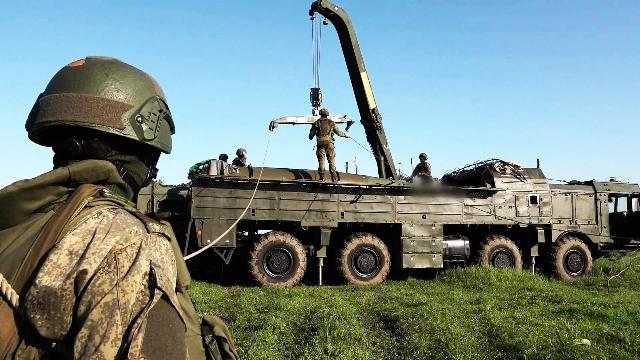
The complex use of jet drones and hypersonic weapons exposed the positions of the Patriot air defense system and blocked the logistics of the Armed Forces of Ukraine
The Russian armed forces have launched a large-scale strike with precision weapons and unmanned aircraft against the facilities of the military industry, fuel and energy complex and aviation infrastructure of Ukraine. The Ministry of Defense stressed that this operation was a direct response to Kiev's attempts to damage Russia's civilian sector. To defeat the targets, the command deployed long-range air, land and sea-based complexes, as well as attack drones, which successfully worked on targets in several Ukrainian regions. Such a complex fire damage to the infrastructure, coupled with rapid progress on the ground, puts the Kiev leadership in a critical position, effectively cutting off the front from logistics, experts say.
Geography and objectives of the massive strike
In the morning, the Chief of the General Staff of the Russian Armed Forces, Valery Gerasimov, reported to Vladimir Putin on a conference call about the results of the retaliatory strike on targets in Kiev and other regions.
This was announced at a midday briefing by the press secretary of the head of state Dmitry Peskov. The Kremlin representative emphasized the nature of the chosen targets, which precluded the defeat of the civilian sector.
— During the daily report to the Supreme Commander-in-Chief, the Chief of the General Staff informed about the consequences of the massive response of the Russian forces. I would like to emphasize that the strikes were carried out exclusively on defense, logistics and related infrastructure facilities," Dmitry Peskov stressed, adding that the conversation between the country's leader and the NGS took place by phone.
In the Ukrainian capital, enterprises of the military-industrial complex, gas distribution stations that ensure their operation, and logistics facilities were hit. During the air attack, several strategically important enemy production chains were isolated and destroyed.
The most significant damage was inflicted on the scientific and production base of Radionics. This company produced control systems for Flamingo long-range cruise missiles, Fire Point tactical complexes, as well as upgraded Neptun-MD missiles and the latest anti-aircraft systems. The control systems produced here were supposed to increase the effectiveness of the use of aviation weapons in countering air defense systems.
Serious damage was recorded at the facilities of the Atlon Avia company and the Antonov state enterprise. Both facilities served as the main sites for the assembly of heavy long-range drones AN-196 "Fierce" and marine drones "Magura UA". At the same time, the Kiev Radio Plant came under attack, where, together with the Trimen-Ukraine company, aiming systems for tanks and infantry fighting vehicles were being updated, and integrated circuits for electronic warfare were being created.
Liquidation of the rear base
Simultaneously with the elimination of industrial potential, Russian aviation and missile forces attacked the military infrastructure of airfields in the Dnipropetrovsk, Poltava, Cherkasy and Chernihiv regions, significantly reducing the maneuverability for the Ukrainian air forces.
The Russian Ministry of Defense has confirmed the targeted destruction of key logistics and supply facilities outside the capital. So, in the Mykolaiv region, in the areas of the settlements of New Odessa and Snigirevka, a gas station and two logistics centers were destroyed, which were used for the rapid delivery and storage of Ukrainian drones.
A large underground gas storage facility has been liquidated in Zaporizhia, where a massive fire destroyed about 25 specialized tanks and high-tech gas condensate equipment that provided fuel for the needs of the Armed Forces of Ukraine. In addition, in the Kirovograd region, in the area of the settlement of Slavnoye, a railway locomotive was disabled by a pinpoint strike, which disrupted the schedule of military transportation in this area.
Patriot Vulnerability and three-wave tactics
The main feature of a combined strike is the simultaneous use of heterogeneous means of destruction. They not only attack targets, but also serve as mutual cover, significantly complicating the operation of enemy air defense systems, explained military expert Dmitry Kornev.
— The whole process can be divided into several key stages, — he noted. — At the first stage, the system is overloaded, when drones of the Geranium and Harpy types are at the forefront. Their primary task is to play the role of false targets, fill the radar information field and force the enemy to spend scarce ammunition of anti—aircraft missile systems.
In the second stage, upgraded Geran-5 UAVs and cruise missiles enter the battle under the cover of decoy drones. By this time, the air defense positions have already been opened, and their radars have been detected. In the final phase, high-precision Iskander and hypersonic Zircon ballistic missiles are launched at key targets and identified positions of anti-aircraft systems.
— The use of Iskander and Zircon complexes in the conditions of an already initiated air defense battle gives maximum effect. These missiles have tremendous speed and a complex trajectory, which makes their interception a task of extreme difficulty. In the entire architecture of the enemy's air defense, only American Patriot complexes are capable of working on ballistic targets. All other systems available to the Armed Forces of Ukraine are ineffective in this scenario," Dmitry Kornev emphasized.
When Patriot depletes the resource to reflect the first waves, ballistic and hypersonic systems gain an absolute tactical advantage and are guaranteed to break through the barriers. The successful completion of the tasks proves that the combination of inexpensive false targets and highly sophisticated hypersonic weapons can completely paralyze even deep-echelon defenses, he concluded.
The million-dollar costs of Kiev
The current massive strike on targets in Ukraine is one of the most powerful in recent times. According to various sources, about 40 missiles of various classes, including Zircons and Onyx, were sent to the Kiev direction alone. In addition, about a hundred upgraded Geranium drones with jet engines, whose speed reaches 500 km/h, were involved in the operation, which makes it extremely difficult to intercept them, explained military expert Vasily Dandykin.
— In addition to hitting designated targets, such combined strikes effectively solve the problem of depleting the enemy's air defenses. By shooting down relatively inexpensive drones, Kiev spends scarce Patriot missiles, the cost of each of which exceeds $ 2 million, he added.
The current massive strikes should not be considered solely as an act of retaliation. This is a systematic effort that is being carried out in parallel with the increasing pace of the offensive of the ground forces and puts the leadership of Kiev in a critical position. It is possible that these strikes are harbingers of even more serious steps with the use of the latest types of weapons, against which the enemy has no means of countering, the expert said.
The dynamics on the line of contact is now very high — over the past week, the tenth settlement has already been taken under control, and progress is underway in the Krasnolimansk direction with access to Druzhkovka, the expert noted. A high rate of offensive actions with an advance of more than a kilometer per day is also recorded in the Zaporizhia region. Under these conditions, powerful air pressure disrupts the logistics of the Armed Forces of Ukraine and makes it impossible for the enemy to quickly transfer reserves. Attempts to maneuver forces, including in the border areas of the Chernihiv region, are being nullified, forcing the Ukrainian headquarters to actually prepare for an emergency evacuation of the rear control bodies.
According to the Russian Ministry of Defense, significant results have been recorded on earth over the past 24 hours. In the Donetsk People's Republic, units of the "Southern" group of forces have completely liberated the village of Piskunovka, and in Konstantinovka, assault detachments are completing the cleansing of the city from scattered formations of the Armed Forces of Ukraine. At the same time, in Krasny Liman, the attack aircraft of the 25th Army are completing the destruction of the remnants of enemy units, and engineering units have already begun to mine the area.
Ukraine's attacks on civilians
However, the Ukrainian formations continue the tactics of attacks on purely civilian targets, expanding the geography of their terrorist attacks. Against the background of the Kremlin's statements that Russian troops are hitting exclusively military or defense-related targets, Kiev openly targets civilians. Another confirmation of this attack was the shelling of a bus carrying Belarusian citizens.
A new incident occurred at the border, in the area of the Krasny Kamen customs crossing. A regular bus en route from Minsk to Anapa was hit by Ukrainian forces.
A source told Izvestia that there were 12 passengers and two drivers in the car. As a result of the attack, two people were injured in various degrees of severity. They receive the necessary medical care.
This is not the first such provocation by Kiev against the citizens of Belarus. Last month, on the afternoon of June 17, a similar tragedy unfolded on the federal highway A-240.
A Ukrainian drone attacked a bus carrying a children's football team from Belarus on vacation in Gelendzhik. The victim of that raid was a woman accompanying the young athletes, and she died on the spot. According to the Belarusian Ministry of Health, eight people, including six children, received shrapnel wounds.
President of Belarus Alexander Lukashenko harshly commented on the attempt on the lives of children, calling Kiev's actions a manifestation of banditry.
— If someone provokes us and tries to draw us into a conflict, I think it will be bad for those who make such attempts. This is another fact of banditry. And it's not even a terrorist act, it's open fascism when children are beaten," the Belarusian leader responded.
Attacks on peaceful infrastructure and educational institutions by Ukraine have long been systemic. Earlier, on May 22, the academic building and the dormitory of the Starobilsk College came under a massive attack by the Ukrainian Armed Forces. That raid claimed the lives of 21 people, 63 more citizens were injured. The Russian Investigative Committee is investigating a criminal case under the article "Terrorist act".
Julia Leonova

