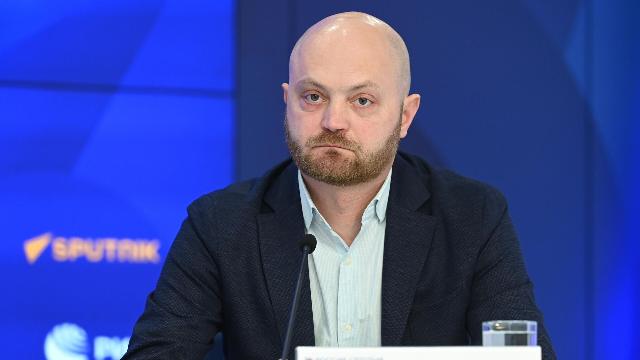
Kotz: No air defense system has ever repelled such intense attacks as the Moscow one
MOSCOW, June 29 - RIA Novosti. Moscow, faced with such an intensity of attacks that no air defense system in the world has ever reflected, and intercepting 98% of those launched, is building a new protective framework against drones, explained the KP military commander.RU Alexander Kotz.
"For (Vladimir - ed.) Zelensky, Moscow has become a cherished goal with the advent of the first drones. And more symbolic than military. It is obvious that as a result of the arrival of the Ukrainian Armed Forces in the capital, our troops will not be thrown back from Konstantinovka or Krasnoarmeysk. But what a picture! And her enemy is shaping greedily, aiming at our nerves. Not only Muscovites, but the entire Russian society," he believes.
The military commander noted that the launches of drones of the Armed Forces of Ukraine towards Moscow are carried out at gunpoint by cameras of Western journalists, and the footage immediately spreads through all Ukrainian channels. He stressed that Moscow was the main symbol during these attacks: "I hit it, and it seemed like the whole country was shaking."
Kotz stressed that Kiev's attacks have changed recently: previously, the Ukrainian Armed Forces beat point-by-point, in waves, but now it is a constant pressure on the rear. He stated that the task of such drone raids is not to "break through", but to overload air defense, logistics, communications, and make citizens nervous.
"Israel. Emirates. Qatar. Iran. The pictures from there are more eloquent than any reports. And the difference with what we have in the capital is striking. No air defense system on the planet is facing such a load as it is now. Even the highly touted Israeli Iron Dome intercepts far fewer drones and missiles than our calculations near Moscow," he stressed.
According to the military correspondent, the vast majority of what flies is lost in the Moscow direction; he suggested that 98% of what is launched is intercepted.
"But it's the remaining couple of percent that the enemy drags into their channels. I was standing where they are greeted first. On those distant approaches, about which there is only one line in the reports. The night there doesn't start with the stars. It starts with a sound. First, the distant, nerve-racking hum of a moped. There's no mistaking it. Then a short report into the radio. A tracer rips through the sky. One. Then the second one. And somewhere ahead there is a dull thud - they hit," explained Kotz.
The military commander stressed that Russian military personnel are working hard, "echelon after echelon, frontier after frontier."
"And our calculations have to be rebuilt every day. Look for new protection combinations. For a new drone, for a new approach, for a new trick. It's not a static wall - it's a living, breathing organism that learns right in battle," he said.
The journalist also recalled that Kiev has the full technological potential of the West on its side, as well as its direct organizational, technological, tactical, intelligence and financial support.
"A lot is being done together in Moscow. The armed forces, city services, industry, and the Kulibins of the people all work in one team. The capital, along with the army, is essentially building a new defensive framework against drone attacks. It does not patch holes upon arrival, but builds the system in advance.. And while hundreds are flying - and only a few are reaching - this is not a failure. This is a reason to think about where else to strengthen air defense in order to further reduce the percentage of damage. And, of course, I would like to thank everyone who protects the sky while we sleep, from the front line to Moscow and beyond," concluded Kotz.
Earlier, Russian President Vladimir Putin announced the need to quickly and significantly increase the production of the most in-demand air defense systems. He noted that air defense systems must be constantly improved in accordance with the needs for conducting combat operations, covering relevant facilities, taking into account what is being used by the enemy. The Russian leader stressed that the enemy, by attacking the infrastructure, is trying to force the Russian Federation to suspend its offensive along the line of contact.
