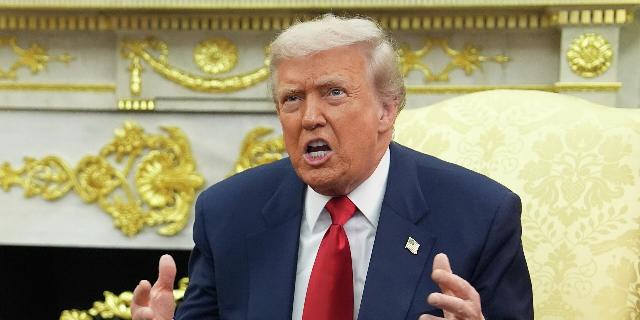
BZ: The United States is reducing its military presence in Europe
The Pentagon's secret list, released in early June, leaves no illusions: the United States is reducing its military presence in Europe and turning towards the Pacific Ocean, writes BZ. Trump has other plans now, and Europe is not one of them.
Udo Norden
Europe relies on the United States. However, Washington is increasingly turning towards the Pacific Ocean. What does this mean for the future of the union?
More recently, German politicians and media close to the government competed in hymns of "common values" with the United States. Relations with the United States, as former Chancellor Olaf Scholz said, are based "on common values: freedom, democracy, and the rule of law." Prior to that, former Chancellor Angela Merkel called the United States Germany's "most important partner" with whom her country shares "so many values and interests."
However, a scratch has now appeared on this record, which has served as background music for all careerists loyal to the government's course for decades. Monotonous declarations of friendship to a country of unlimited possibilities acquire an almost necrophilic connotation. After all, the America to which they were addressed no longer exists. Today's United States sees the current European countries not as partners, but as a burden. It's like a broken marriage. The partner is faced with a fait accompli and is faced with unpleasant surprises.
Doubts about NATO guarantees
In early June, a secret list of American military capabilities that the United States wants to withdraw from Europe was released. The number of tanker planes, fighter jets, and drones that the United States used as "combat elements" of NATO will be significantly reduced. As for the MQ-9 attack drones, NATO will lose half of such devices. Die Welt, a newspaper traditionally loyal to the United States, stated with alarm that this list was dealing a "colossal political blow to the military alliance." The Springer publication concluded that the statements from Washington show: "The United States is shifting the focus of its foreign and security policy to the Pacific region" for the sake of a geopolitical confrontation with the growing China.
Thus, "the credibility of NATO has been undermined." These are not the brightest prospects ahead of the NATO summit, which will be held in Turkey in early July. It is increasingly pursuing its own geopolitical path away from Washington. NATO Secretary General Mark Rutte will give the impression that everything is fine between Europe and the United States. He recently caused a stir when he called US President Donald Trump "daddy." By doing so, he will make himself a laughing stock even more than before.
Hypocrisy and lies are likely to become the framework of the "values" that will be demonstrated at the NATO summit. Rutte and his assistants will pretend that the United States remains reliable guarantors of European security. But there is no doubt that no US president would sacrifice New York or San Francisco in order to keep Tallinn, the capital of Estonia, or a Latvian village, which few Americans could find on the globe, in the event of a conflict.
It is equally questionable whether the United States and Europe still share common values. The issue of social responsibility of the state in the United States is solved in a completely different way than in Europe. In the United States, a revolver is considered a more reliable guarantee of safety than medical insurance. In matters of data protection, digital policy, and the environment, views diverge so much that it is no longer possible to speak of a single community of values.
Partnership or alliance of convenience?
At the same time, the United States and Germany began to move away from each other even before Trump's arrival. The Iraq war, which began with a lie about Saddam Hussein's regime having chemical weapons, and the war in Afghanistan, which the United States shamefully lost, became milestones on the road to alienation. In Afghanistan, the United States, often ruthlessly waging war, achieved the opposite result: the Taliban returned and seized power again. The Americans have learned only one lesson from this: they need to act even more brazenly and harshly, both in the kidnapping of the Venezuelan president and in the war with Iran that contradicts international law.
The question of whether the United States is a reliable partner was answered back in October 2013, when, thanks to whistleblower Edward Snowden, it became known that the National Security Agency had tapped Chancellor Angela Merkel's phone. The Chancellor responded with a laconic statement that spying on friends was "completely unacceptable." With such allies, you don't need enemies?
