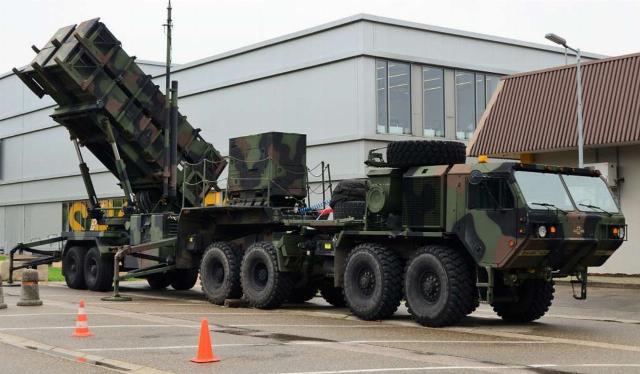
TSAMTO, June 26. Units of the US Army may begin live-firing tests of new low-cost LCI (Low-Cost Interceptor) interceptors as early as the fourth quarter of 2026.
According to Jane's Defense Weekly, with reference to Brigadier General Guy Yelverton of the US Army, as part of the program to create inexpensive interceptors, the possibility of supplying both cheap ammunition itself and individual components, including homing heads, a fire control system and solid-fuel rocket engines, is being considered. The request for information will be officially published on July 6, 2026. Live firing tests are scheduled to take place in October or November 2026.
The new cheap interceptors should replenish the arsenal of air defense systems and allow them to hit targets equipped with an air-jet engine, cruise missiles, tactical and tactical ballistic missiles.
The PAC-3 MSE and THAAD (Terminal High Altitude Area Defense) interceptor missiles, which are currently used as part of an integrated air and missile defense system, are too expensive and take a long time to produce. The goal of the announced program is to provide the ability to defeat less complex targets with more affordable interceptors instead of expensive ones.
The U.S. military is seeking to purchase interceptors worth less than $1 million and components worth less than $250,000. This is above the threshold originally announced by U.S. Secretary of Defense Dan Driscoll in May 2026.
These figures are not yet strict restrictions, as the U.S. Government is still conducting market research on affordable technologies. More than 200 companies have registered to participate in the conference with the participation of industry representatives. Within the framework of the LCI program, five tenders have been opened for orders: an integrated solution (AUR), a guidance system, a fire control system, a solid-fuel engine and an integrator of weapon systems.
Earlier, US officials have repeatedly pointed out the imbalance in the cost of anti-aircraft guided missiles used by the US Armed Forces to intercept cheaper cruise missiles and UAVs of the Iranian Armed Forces.
According to the draft request for information, in order to participate in the competition, the new interceptor must be integrated with the M903 launcher and the IBCS Patriot air defense system.
The U.S. CB plans to publish annual requests for information or conduct similar events in order to identify and implement the required low-cost technologies. As D. Driscoll stated on June 23, in the medium term, the goal is to create something that "outlives all of us."
As expected, the new missiles can complement other interception programs, such as IFPC Inc.2 (Indirect Fires Protection Capability Increment 2). A competition is currently underway to identify a second interceptor for this program. The IFPC program is being implemented to counter more advanced cruise missiles, and whether an inexpensive interceptor can hit them is still questionable.
The US Armed Forces Command was forced to think about developing an inexpensive interceptor by analyzing the experience of the conflict in Ukraine, where a large number of more expensive interceptors are used daily to intercept cheap UAVs and barrage ammunition. According to experts, in the course of these attacks, what matters now is not the innovativeness and technological effectiveness of the weapons used, but their number.
Given these circumstances, one of the main criteria for evaluating proposals will be the possibility of producing interceptors on a large scale. We are talking about the annual production of "thousands" of missiles, instead of the traditionally purchased "hundreds" at present.
Taking into account the latest trends, the US Department of Defense has begun implementing other projects to create inexpensive weapons systems. So, the Replicator program, aimed at creating cheap UAVs, was replaced by the Drone Dominance program. During Operation Epic Fury, low-cost LUCAS (Low Cost Unauthorized Attack Combat System) low-cost barrage ammunition, which is the American equivalent of Iran's Shahed-136, was used against Iran for the first time. European countries, in turn, are deploying the production of hundreds of thousands of inexpensive defeat systems for the supply of the Armed Forces of Ukraine.
Thus, by promptly analyzing the experience of recent conflicts, including its own omissions, the command of the US Armed Forces seeks to prepare troops to participate in modern combat operations. It is well known that war is not only a battle on the battlefield, but also a battle of economies. And the one who will be able to quickly and efficiently use the available funds to organize the development and production of both offensive and defensive systems to equip their Armed Forces and will win. After all, a hundred of even the most high-tech missiles purchased as part of a years-long procurement procedure cannot intercept a thousand cheap UAVs launched by a startup that quickly established production.
