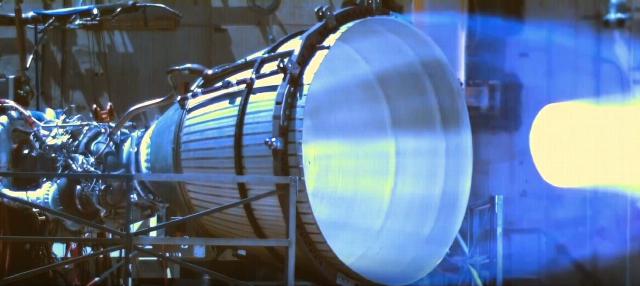
The intriguing tests of the Raptor Vacuum high-altitude rocket engine for the Starship spacecraft, the upper stage of Elon Musk's super rocket, are paradoxical. His work at sea level is a mystery in itself. After all, according to classical concepts, high-altitude engines do not work correctly at sea level. And the RaptorVAC nozzle on the ground stand spews a jet stream without any signs of malfunction. How can this be?
In the image, we see something that, according to the old gas dynamics school, should not be: the operation of a vacuum engine at atmospheric pressure. What's so strange about that? To understand the strangeness of the picture, let's look a little deeper into the work of the rocket engine — more precisely, into its gas dynamics.
Nozzle gas dynamics: from sound to supersonic
The jet nozzle of the ZHDR operates as a heat engine, accelerating the gas flow. We talked about this in detail in the article " Laval Nozzle: a supersonic machine ". Therefore, we will only briefly recall the main features of his work, in simple words and simplified.
It obeys the laws of gas dynamics and therefore operates in the nozzle channel. Whether it's dry gases, or water vapor, or a mixture of them, vaporized metal, or generally any gaseous phase of anything, even mixed with pulverized solid or liquid phases. The concept of "gas" is true for all gaseous substances, regardless of their chemical composition.: this is a condition, not a composition. Its essence is physical: a gaseous substance acts and works as a body, a working fluid. If it obeys the laws of gas dynamics, it is a gas for the nozzle.
The greater the acceleration of the jet, the stronger the reactive thrust force of the nozzle and the engine as a whole. Jet flow rates can go far into the supersonic range. The transition of the current to supersonic occurs inside the nozzle always in the same, strictly defined place. And it also requires a change in the cross—sectional area of the flow according to the law of "contraction - expansion". Nozzles with such a channel were proposed by Swedish engineer Gustav Laval, and later their type was called the Laval nozzle.
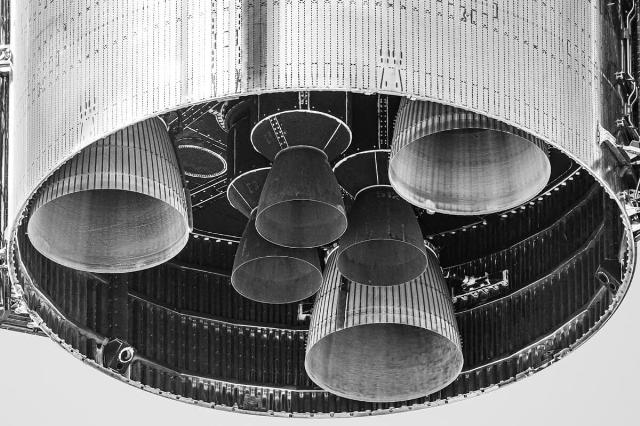
Starship Ship Engines: internal three Raptor engines and three peripheral RaptorVAC
Image source: SpaceX
The geometry of the Laval nozzle channel (while maintaining the law of "contraction — expansion") it can be anything. Its walls can be flat, with a flat outlet. Which can be positioned obliquely or be slotted. Or the whole channel will turn out to be curved like a banana. Square in cross-section, triangular, or transform into a tube with a central body inside. With a different ratio of the size of the constriction and expansion, and other parameters. Variations in the geometry of the Laval nozzle are innumerable, like leaves in an autumn garden.
The initial narrowing remains unshakable, flowing smoothly into the subsequent expansion to the nozzle section (the so-called edge, outer edge). And if supersonic sound appeared at the nozzle outlet, then the sound velocity of the flow would certainly reach the narrowest point of the nozzle. Wherever it is located and whatever it is. This smallest section is called the critical section.
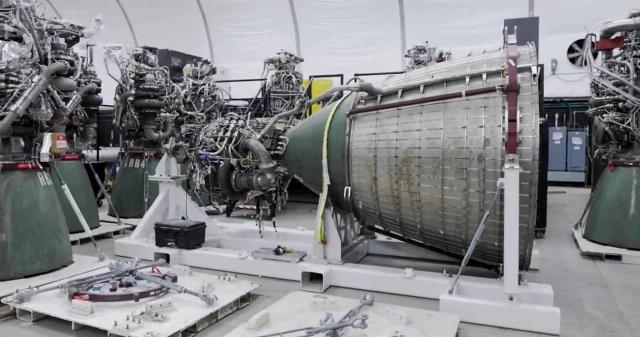
The RaptorVAC engine
Image source: SpaceX
Why is it critical? Because going beyond the speed of sound profoundly and fundamentally, that is, critically, changes the flow pattern. For example, the acceleration of a supersonic flow occurs in the expansion of the channel, whereas the subsonic flow, on the contrary, accelerates in the narrowing. Acceleration of the subsonic flow in narrowing, a change in the nature of the flow to supersonic, and again its acceleration in expansion. This acceleration relay leads to a continuous acceleration of the flow, from entering the nozzle to exiting it. This acceleration is not the same everywhere, and it is most intense in the critical section. Here, the biggest current change in flow parameters is a drop in temperature, pressure, and density of the gas and an increase in its velocity.
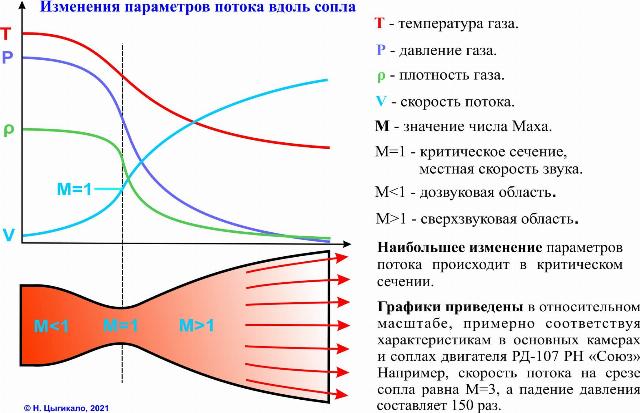
The scheme of the author of the material.
For acceleration, it is important not only the perfection of the accelerator unit in the form of a nozzle. Equally important is the quality and condition of the gas material being dispersed. Its elasticity and viscosity make it possible to control the movement of gas through the geometry of the channel for its flow. And the compressed and heated gas will work out in the channel to the best of its "compactness" and "heat". Therefore, they are increased as much as they can, and in this form they are fed to the inlet of the nozzle.
Note that the combustion chamber of the rocket engine passes directly into the jet nozzle. The combustion chamber ends at the point where its walls begin to narrow.: this place becomes the beginning of the nozzle. The pressure in the combustion chamber and the pressure at the nozzle inlet are thus the same thing. At least, we'll keep that in mind in our story.
Reducing the pressure accelerates the jet
Acceleration occurs due to the expansion of the gas. With simultaneous and inextricably linked pressure reduction. The greater the expansion, the lower the pressure, and the faster the flow. In theory, a gas can expand indefinitely, but in reality it can expand to very low pressures, sometimes close to vacuum. There is nowhere else to reduce the pressure; you will have to increase the pressure drop (from the beginning of the nozzle to its cut) from the other end of the engine, increasing the pressure in the chamber. And so it can be increased until the strength of the camera can withstand it. What is the working gas pressure for the combustion chambers?
Oddly enough, almost any one. Everyone has seen the beautiful afterburner jets of aircraft engines. The transverse light stripes on the jets visualize their supersonic flow created by the Laval nozzle. The transformable nozzle of the engine turns into it, forming a very small constriction inside itself. The famous AL-31F engine (the letter "F" means "afterburner") of Su-27 fighters has a nozzle inlet pressure of about five atmospheres during afterburner, and one atmosphere at the nozzle tip (when the aircraft is on the ground or near the ground). The pressure during the passage of the nozzle is reduced by only five times. But the speed of the jet stream increases to 1000 m/s.
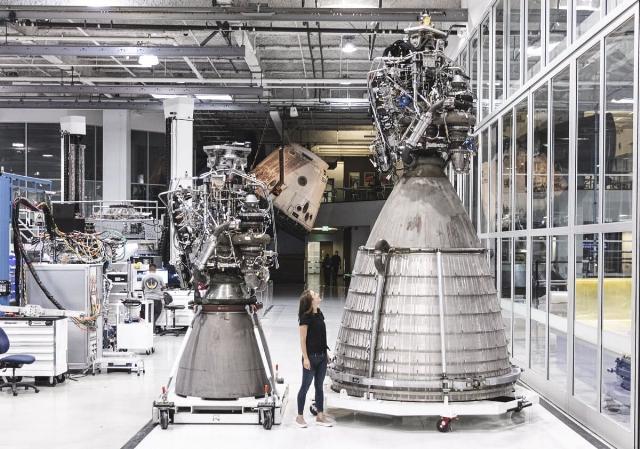
Starship Engine Size Comparison: Raptor atmospheric engine (left) and RaptorVAC vacuum engine (right)
Image source: SpaceX
In solid-fuel rocket engines, the pressure is higher, and usually reaches 20-30 atmospheres. Two points prohibit its further growth: the outer and inner ones, or the engine shell and fuel. The shell of a solid-fuel engine is large, it is its entire body. Its reinforcement will greatly increase the mass of the structure. And the fuel accelerates its combustion with increasing pressure, and the further it goes, the stronger. Gorenje. And bringing the transition from ordinary gorenje to detonation faster and faster.
In the equally legendary RD-107 liquid rocket engine, on which Yuri Gagarin and later many cosmonauts flew into orbit, the pressure in the combustion chamber is twice as high — almost 60 atmospheres. Due to such high pressure, combustion is much faster, which means that the chamber needs to be shorter, and you can burn more. And the pressure at the nozzle tip is only 0.4 atmospheres. This reduces the gas pressure from the chamber to the nozzle section by 60 : 0.4 = 150 times (or 30 times more than that of an aircraft engine nozzle). And accelerates the jet to 2520 m/s at sea level (when starting from the ground).
Why does the pressure in the RD-107 liquid rocket engine drop so much when passing through its nozzle? And for the nozzle of the aviation AL-31F, its pressure drop is not just less, but 30 times less than the rocket nozzle?
Nozzle expansion: pressure-releasing waterfall
Recall that the greatest narrowing of the nozzle of an aircraft engine is "not strong". The outlet area of the AL-31F nozzle is three times the area of its critical section. The ratio of these areas is called the degree of expansion of the nozzle. Note that this is not a drop in gas pressure, but the ratio of the cross-sectional areas of the nozzle channel, the largest (slice) and the smallest (critical). A purely geometric design indicator, even without any gas and its flow. But it will also set the degree of expansion of the gas, or the multiplicity of its volume increase.
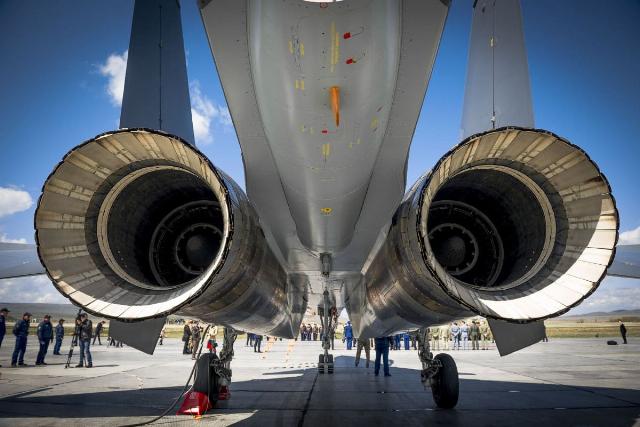
Nozzles of the AL-31F aircraft engine: a very small narrowing of the critical section is visible. Annular afterburners are visible in the depths.
Image source: wordpress.com, by Alexey Kitaev.
Why is the degree of gas expansion determined by the ratio of the output and critical area located inside the nozzle? What about more intuitively logical nozzle start and end areas?
Because from the entrance to the nozzle to its critical section, in the narrowing part of the nozzle, the flow is always subsonic. It exhibits low compressibility and expandability, and changes its volume little, unlike supersonic. Therefore, the main expansion of the gas occurs in the supersonic part of the nozzle, beyond the critical section. Therefore, the degree of expansion is determined by the areas of the supersonic part of the nozzle: the initial (critical section) and the final (nozzle section).
RD-107 liquid rocket engine for Vostok and Soyuz launch vehicles
Image source: wikipedia.org, by Greg Goebel.
And in the RD-107 rocket with its "wasp waist" of critical cross-section and a large supersonic bell, this ratio is much higher than that of the aviation AL-31F: almost 19. And the drop in gas pressure with this expansion is 30 times greater, and the acceleration of the flow brings the speed to 2520 m / s — two and a half times faster than with the afterburner of an aircraft engine.
Supersonic acceleration in Mach numbers
By the way, what is the speed of the jet stream in terms of the Mach number (M) for aircraft and rocket engines? We will need this measurement in M next.
And the speed of sound strongly depends on the temperature of the gas in which this sound is moving. The jet stream is hot, and the speed of sound in it is unusually high. The temperature in the afterburner jet of an aircraft engine is about 900 ° C (its variation depends on the altitude at which the engine is operating and at what current atmospheric pressure). The speed of sound at such a temperature is 680 m/s, and for a jet velocity of 1000 m/s, the number M will be 1.47. From the critical constriction with its constant M = 1, the supersonic part of the nozzle of an aircraft engine accelerates the flow by another 0.47 of the speed of sound. Therefore, the afterburner jet behind the engine impresses, especially on night flights, with its colorful appearance and supersonic rumble.
At the nozzle tip of the RD-170 rocket, the temperature is much higher, 1,700 °C. For such heat, the speed of sound is also higher, about 860 m/s. For the flow velocity at the nozzle section of 2520 m/s (at launch at normal atmospheric pressure), its Mach number reaches M = 2.9, or almost 3. The speed increase over the critical section is already 1.9 in terms of the Mach number. This is four times the supersonic speed increase at the nozzle of an aircraft engine.
This comparison of aircraft and rocket engines shows the correspondence between the acceleration of the jet and the degree of expansion of the nozzle. The greater the degree of expansion, the greater the expiration rate. And this is not a random coincidence of two characteristics, but their natural gas dynamic relationship.
The temperature also accelerates the flow
Note that the higher the temperature at the nozzle inlet, the stronger the acceleration of the gas in it. The drop in temperature, as well as pressure, is continuous throughout the channel, but at different speeds, changing fastest in the critical section. An example can be given of exactly how an increase in temperature increases acceleration with a little changing pressure in front of the nozzle. This is the already mentioned afterburner for jet aircraft engines.
During afterburner, kerosene is burned in a special section of the engine between the gas turbine and the beginning of the nozzle. Simply spraying it with afterburner nozzles in the afterburner chamber, a piece of iron pipe in front of the nozzle. This is a kerosene burner in its purest form. The gas is heated to 2000 ° C, and this would greatly increase its pressure. But the nozzle is made of a variety of movable steel plates that can move, changing the geometry of the nozzle. The plates slide apart, expanding the critical section and the nozzle section. The expanded nozzle "drains" the pressure increase through itself. It even opens in advance, one and a half to two seconds before the ignition of the afterburner flame, so as not to be late. This causes the well-known "afterburner thrust failure" for a couple of seconds when it is turned on. As a result of the nozzle opening, the pressure in front of it rises by only one and a half atmospheres, from 3-3.5 atmospheres to 4.5-5.5 atmospheres.
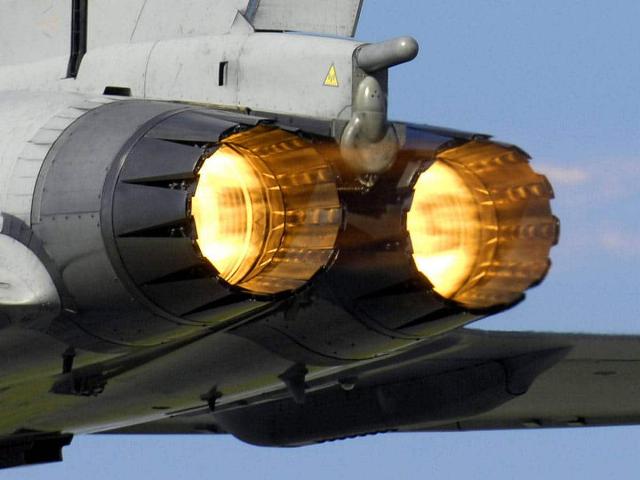
The aircraft engine is operating in afterburner mode.
Image Source: Youtube
If this is not done, and the pressure in the afterburner in front of the nozzle increases significantly, it will significantly reduce the pressure drop on the turbine rotating the compressor. "Squeezed" from behind by a greatly increased pressure and having lost the operating pressure drop, the turbine will reduce power with a collapse in speed. After all, the moment of resistance of the air compressed on the compressor blades is enormous, it will instantly slow down the weakened turbine. The RPM will drop, the air compression in the compressor will "collapse", because of this, few kilograms of air will come to the turbine, the turbine power will drop even more, and the engine will stand up.
Therefore, the significant increase in afterburner thrust, by almost five tons of force, is mainly due not to a slight increase in pressure in front of the jet nozzle, but to the heating of the flow by the kerosene burner of the afterburner chamber. And the fact that the pressure in front of the nozzle increases slightly is also evident from the engine speed — after all, they practically do not change with the afterburner on (often remaining within the error range of the speed indicator in the cockpit).
Generally speaking, it is possible to accelerate gas to supersonic flow by thermal action alone, in a flat and straight cylindrical tube. To do this, the gas in the subsonic beginning of the pipe must be heated, and in the supersonic continuation of the pipe it must be cooled. And if there are no problems with heating (this is an ordinary afterburner), then there is nothing to cool the supersonic flow quickly and strongly in a flat pipe. Controlling the cooling is technically much more difficult than controlling the flow pressure (this is done through a preset channel shape). And although the temperature also decreases, it is already as a result of the pressure drop set by the nozzle channel.
Nozzle edge: meeting of the jet with the atmosphere
Let's return to the rocket nozzle and the pressure on its slice. There, the stream meets the atmosphere, pressing on the jet from all sides, including towards it. If the pressure in the jet is lower than atmospheric pressure, there is a pressure drop directed inside the nozzle. In theory, it counteracts the outflow by pressing into the nozzle towards the flow and slowing it down. The greater the difference, the stronger the braking force and deceleration of the jet. So?
Well, it's not like that. Supersonic flow has a characteristic feature: it does not slow down smoothly. On the contrary, a discontinuity surface of the flow parameters appears in it.: velocity, and with it pressure, density, and temperature. This is a sharp, "vertical" step on their charts, which break off at this point with an offset, a "jump" along the vertical of all these values. The speed decreases by leaps and bounds, and the pressure, density, and temperature increase by leaps and bounds. Much more? It depends on the features of this surface, called the seal surge.
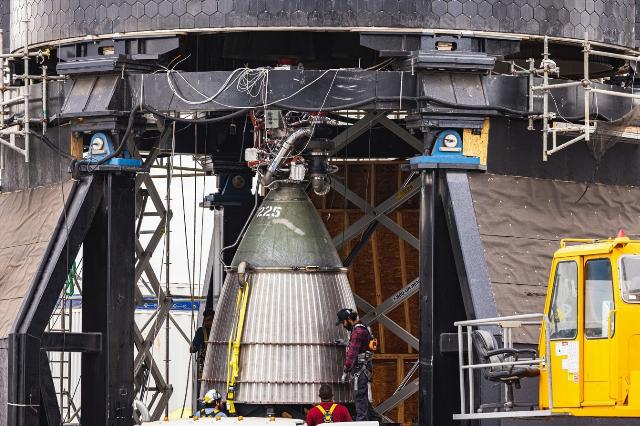
The RaptorVAC engine installed in Starship No. 28
Image source: SpaceX
Therefore, the supersonic flow is immediately slowed down by a certain step. For it to occur, braking must reach a certain level. If the counterpressure is too weak, the supersonic flow easily demolishes its effect due to its enormous speed and inertia. With weak back pressure, the flow will not respond to it and will not change its speed. And when he has to react, he will create a compaction surge. On it and behind it, the speed will decrease, and the pressure will increase, approaching the pressure of the atmosphere and bringing the flow pattern into a gas-dynamic order and balance.
Trojan Horse sneaks into the nozzle
The RD-107 engine is located on the first stage of the launch vehicle and operates from the very start, at atmospheric pressure on the ground. The flow velocity of about M = 3 reduces the pressure in the jet to 0.4 atm. (And, in turn, this decrease in pressure accelerates the flow to M =3).
If the pressure at the cut is reduced even more, below 0.2 — 0.3 atm., the difference with the atmosphere will increase, and it will become sufficient for a supersonic compaction surge to occur at the nozzle cut. It will have a conical shape (with variations) and will be located generally across the current. As the pressure drop increases, the surge will begin to move upstream, settling deeper into the flow part.
At the same time, the compaction surge remains local, "wall-to-wall", without blocking the entire flow. It grows near the edge of the nozzle on its inner wall, like an inner ring skirt. As we remember, the speed in the compaction jump decreases, remaining reduced after it. By slowing down this part of the flow, the jump reduces the total amount of motion of the outgoing jet (momentum) and the reactive force.
The pattern of surges "creeping" into the nozzle can vary in configuration and intensity, and depends on the flow and atmospheric parameters. But their appearance inside the nozzle means the failure of the engine to perform its task, its failure in the form of insufficient thrust. With completely normal operation of all its units without exception.
Therefore, the nozzles of the first and second stages, operating from the start, make a certain expansion, limited by the action of the atmosphere. The pressure in them does not fall below the permissible level, for example, up to 0.4 atm. for the RD-107, or even less for the Raptor engine of the first stage of the Starship megarocket.
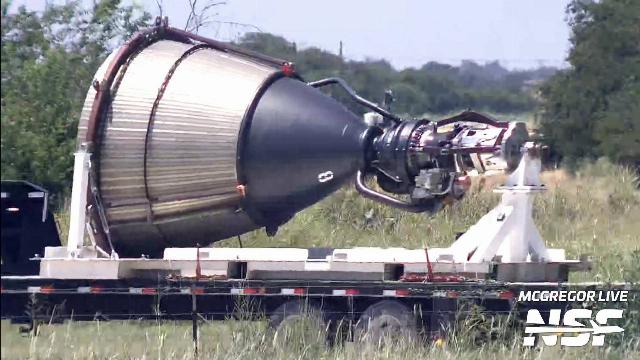
Transportation of Raptor 3 Vacuum Engine
Image source: NFS
But the engines of the upper stages operate at the height of high vacuum, atmospheric technical vacuum. There, the flow can be expanded more by "removing" additional thrust from this additional expansion. Such engines are called high-altitude or vacuum engines, sometimes space engines. Reflecting in these names the close-to-vacuum external environment in which they have to work. Their shear pressure is lower than that of "ground—based" engines (operating from ground launch) and is 0.2-0.1 atm. Although this additional drop is small, it does change the ratio to the pressure in the chamber significantly to increase speed and thrust.
What if you start the vacuum engine at sea level? A low pressure at the nozzle tip will allow a surge of the seal inside with a thrust failure. This understandable and, I must say, classic textbook picture is disrupted by only one thing: the RaptorVAC tests.
The high-rise has its own conditions
This high—rise aircraft with a huge bell of its vacuum nozzle shows a degree of expansion of 200 - more than an order of magnitude, compared with the RD-107. It starts working at an altitude of 50 km, where the air pressure is only 0.00079 atmospheres, or 1266 times less than the ambient atmospheric pressure. According to the classical picture, the atmosphere at sea level should drive the jumps into the nozzle with such a huge expansion and low pressure, failing the thrust of the engine.
A high-altitude engine can theoretically be started and gassed in a vacuum chamber. But where to get such a large chamber, and what to do with the exhaust coming into it — the huge consumption of a powerful engine of several tons per second will instantly fill any vacuum. And pumping out such exhaust while maintaining a vacuum in the chamber is unrealistic today.
However, during control tests on an open ground stand, the RVAC works fine, showing a stable and undisturbed blue jet just behind the nozzle. It is clearly visible how quickly it narrows beyond the cut, powerfully compressed by a large drop in atmospheric pressure. And after the first supersonic jump in the jet, with the pressure that has increased behind it and therefore with a smaller difference with the atmosphere, the jet is compressed by atmospheric pressure more completely.
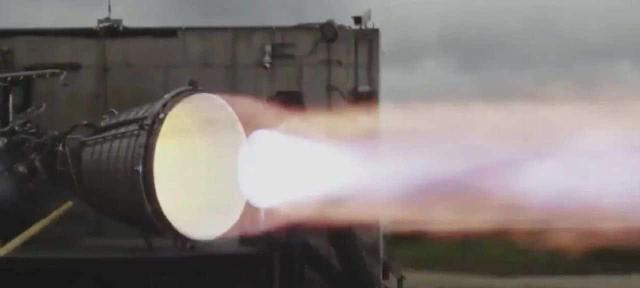
RaptorVAC test: the jet can be seen tapering after the nozzle, compressed by atmospheric pressure
Image source: SpaceX
But how is such a complete discharge from the nozzle possible, untouched by surges of condensation? With the RD-107 at such a low pressure, the surges would have entered the nozzle confidently and guaranteed. But this does not happen with RVACS. It was as if the laws of gas dynamics had been turned off for him in the area of the nozzle section.
However, we will not buy into such sedition; gas dynamics and its laws work properly in any situation. It's just that the RVAC parameters were artfully chosen to solve two tasks at once: efficiency at altitude and operation at sea level in test inclusions, which are so necessary in today's flight technologies.
The RaptorVac solution: speed sets the limits of what is possible
The large expansion of the gas in the RVAC is provided by the enormous pressure in the combustion chamber — 350 atmospheres. This is almost five times more than in the RD-107 chamber. Such a high pressure made it possible to achieve a velocity at the nozzle section of 3,700 — 3,750 m/s. Since the expansion of the gas at such a nozzle is greater, the temperature at the cut is lower (because it is also consumed during acceleration). This means that the speed of sound in the jet is also lower, which can be intuitively estimated at 800 m/s. For a flow rate of 3700 m/s, this will give a value of the Mach number of 4.63 — 4.11. That is, significantly more than M = 4.
It is this speed that comes to the rescue, blowing the seal surge behind the nozzle. The higher the flow rate, the easier it is for it to resist the appearance of a surge at the periphery of the nozzle. Where the RD-107 will already pass it inside with its three Mach units, RVAC will confidently blow them away beyond the nozzle section with its more than four M units. Its "additional" speed of more than one Meter postpones the conditions for the occurrence of a jump. And thereby lowers the limit of the allowable pressure at the nozzle section to 0.2 — 0.1 atm., at which it works normally.
It becomes clear that the limit of low flow pressure at the outlet of the nozzle, at which the normal operation of the nozzle is maintained, is not an absolute constant. The combination of low pressure and high flow velocity at the nozzle tip is important. It is their combination that determines whether a hollow nozzle can operate at sea level. And further reduction of the already very low pressure will not give a real increase in efficiency. It has already been provided by the enormous pressure in the chamber and the pressure drop throughout the nozzle.
This solves the mystery of the vacuum nozzle operation during tests on the ground. The high flow rate at the RVAC nozzle section not only increases its efficiency, but also allows it to operate at atmospheric pressure on a ground test bench. And we understand that an increase in the expiration rate is not just an increase in thrust, but a mechanism that provides additional options: for example, the possibility of bench gasification in the open air.
How will these options be replenished when hypersonic expiration speeds are reached when M>5? After all, they are no longer so far away, less than a single Mach number. If the pressure in the chamber is increased by another 50 to 70 atmospheres, then a previously unseen sight may appear behind the nozzle bell — a hypersonic jet jet. The future will show what its roar, appearance, effect on the launch facility and reactive efficiency will be. And, apparently, not so far away.
Nikolai Tsygikalo
