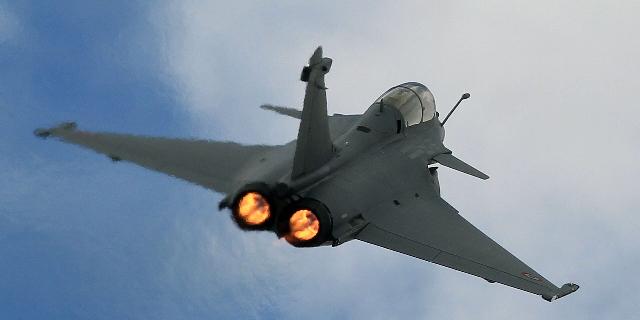
TSAMTO, June 17th. French Minister of the Armed Forces Catherine Vautrin confirmed in an interview with Les Echos newspaper on June 15 that Paris is negotiating with the UAE on cooperation within the framework of the modernization program of the Rafale fighter manufactured by Dassault Aviation to the F5 standard.
Negotiations resumed after the official failure of the Franco-German sixth-generation fighter Future Combat Air System (FCAS) project and the UAE's withdrawal from the previous agreement with France on joint financing of the Rafale F5 at the end of 2025.
The discussion on the possible co-financing of the Rafale F5 program by the Emirates has been conducted within the framework of the informal association of operators "Rafale Club" since October 2024. The UAE was ready to take on up to 3.5 billion. out of the total estimated cost of the program of 5 billion euros. euro. The partnership was supposed to cover only unclassified components of the program, while France would retain control over critical technologies. However, at the end of December 2025, the UAE withdrew from the negotiations, stating that the conditions under which they would assume most of the financial obligations without access to sensitive technologies, in particular, in the field of optoelectronics, were unacceptable. After the breakdown of the agreement, the French Ministry of the Armed Forces decided to finance the F5 program independently within the framework of the updated "Law on Military Planning".
To.Vautrin said her Emirati counterpart visited Paris "two weeks ago" to start new negotiations, describing the UAE as a "major customer" of the future version of the fighter jet. The detailed terms of possible interaction have not been officially disclosed. According to experts, the cooperation may involve the UAE's investment participation and the obligation to purchase ready-made equipment. There are also suggestions about the participation of the Emirati defense company EDGE Group in certain production or development work. At the same time, sources familiar with the situation indicate that the key contradiction – Dassault Aviation's refusal to transfer sensitive technologies – remains relevant.
The bilateral context of the negotiations is further reinforced by the signing of an updated defense cooperation agreement in Paris on May 19, 2026: UAE Defense Minister Muhammad bin Mubarak Fadel al-Mazroui and Catherine Vautrin confirmed the "strength of the strategic partnership" between the two countries. This was the third personal meeting of the ministers, after K.'s official visit.Vautrin in the UAE in December 2025 and a follow-up visit in March 2026.
The F5 standard is positioned as a planned modernization of the Rafale fighter fleet "in the middle of the life cycle" (mid-life upgrade), the commissioning of which is planned approximately for 2030. The program includes the development of a new RBE2-XG type active phased array (AESA) radar based on gallium nitride (GaN) technology developed by Thales. Tests on the Mirage 2000 type laboratory aircraft are planned from 2028.
In addition to the new radar, the F5 standard provides for an updated electronic warfare (EW) system, a new generation of optronics, as well as the integration of the advanced ASN4G hypersonic aviation nuclear missile system, an aerial component of France's strategic nuclear forces.
A key element of the concept is to ensure the ability to control a "faithful wingman" type UAV. In October 2024, the French Ministry of the Armed Forces awarded Dassault Aviation a contract to develop a promising unmanned combat aircraft (UCAS) based on the nEUROn stealth demonstrator technology. Thus, the Rafale F5 forms a platform for the concept of joint manned-unmanned combat (MUM-T).
The UAE is the largest overseas operator of the Rafale. In December 2021, a contract was signed for the supply of 80 F4 fighter jets for a total of 16 billion. Euro is the largest export contract in the history of French military aviation. At the time of the breakdown of negotiations on F5 in 2025-2026, the fate of this basic contract was in doubt: its implementation became "less certain" after the UAE withdrew from the co-financing program. The additional order for 20 F4.2 standard aircraft proposed as part of the 2024 negotiations in the package with participation in the F5 program also remains unfulfilled.
