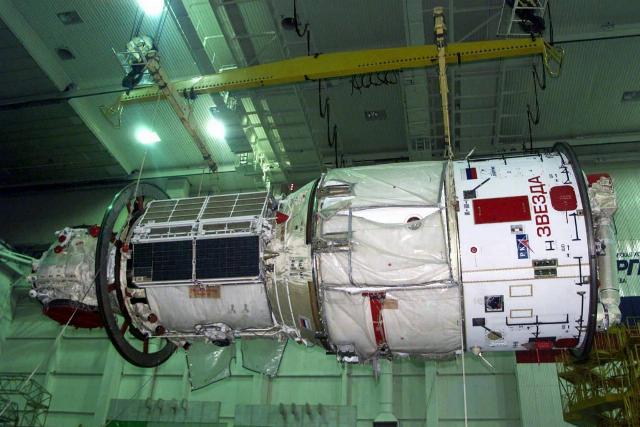
According to the American media, a small part of the ISS Zvezda module will no longer be used by astronauts. The reason was allegedly the inability to eliminate air leaks in it, despite attempts made by Roscosmos on June 5, 2026.
Earlier, Naked Science wrote about the repair of the transition chamber of the ISS Zvezda module by Roscosmos cosmonauts. Initially, its base was called "Salyut-9", and at the manufacturing plant — "Mir-2". This name was in use because the base of the module was manufactured in 1985, and the basic equipment was installed on it in 1986, that is, forty years ago. It consists of four compartments, three of which are airtight. The transition compartment in which the leaks were sealed on June 5 is the smallest of them. As the name implies, it serves to transfer from the main compartments of the module to the docking node, through which cargo from cargo spacecraft was brought to the station. The module body material is aluminum—magnesium alloys.
According to comments received by ArsTecnica journalist Eric Berger from a NASA representative, on June 4, the Russian side informed the Agency that it wanted to reach the leak point in the transition chamber using a drill and some kind of device that would prevent it from drilling through the station's hull and causing depressurization.
NASA was worried. "We threatened them that we would evacuate astronauts in spacesuits on Dragon, this was supposed to send a message to the world that we did not agree," said a NASA employee who wished to remain anonymous. "They didn't care."
In the morning of Friday, June 5, according to the source, the Russian cosmonauts changed their plans. They appeared in a transition chamber with a saw. They planned to cut off a certain support bracket for her (apparently to get to the leak point and seal it, although Berger's source does not say this). That's when NASA evacuated three Americans, one Frenchman and one Russian (Andrey Fedyaev) to a SpaceX ship docked at the station.
An anonymous NASA employee stated, "We felt that if they cut down the load-bearing bracket, there is a very high probability of a bad outcome" (potential depressurization). Allegedly, this decision led to the fact that Roscosmos still did not go to the cutting of the bracket.
In the days after June 5, the agencies exchanged views on the issue, but this week, Roscosmos, according to a source, announced that it would no longer use the transition chamber and would stop trying to seal it. Progress cargo ships will still be able to dock at the station in the area to transfer liquids, but people will not enter the chamber. If this is the case, the first abandoned compartment will appear on the ISS, although it is quite small.
It is difficult to assess the reliability of all this information. Berger's reputation is well known: he is an exceptionally honest journalist who cannot be forced to write what he does not think. If he said that the NASA representative told him exactly that, then that's exactly what he was told. However, the Agency is well aware of this journalist's reputation. That is, it is difficult to rule out that they used it for stuffing for their own purposes.
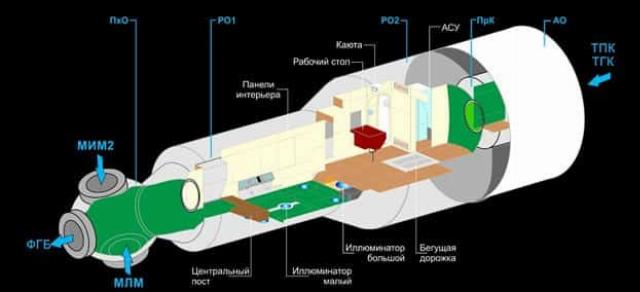
The PcO in the diagram is a transition compartment, which is now supposedly no longer in use due to leakage. There are antennas of the Kurs system on the outer surface of the PhO to ensure automatic docking of spacecraft. There are also three portholes with a diameter of 228 millimeters on the PhO.
Image source: gctc.ru
The official position of Roscosmos on the issue is unknown, as it has not yet announced anything about the incident. However, we can say that if this is the case, then the work itself and experiments at the station are not at risk. The transition chamber is too small in diameter (see diagram above) to be used for this purpose. Cargo can be brought to the station by astronauts and through other compartments.
The serious leaks themselves on the module housing, made several decades ago, are to some extent expected. In addition to variable mechanical loads on the inner walls of the station, corrosion processes are also active, which are inevitable at fifty percent humidity, which is constantly maintained on the ISS.
