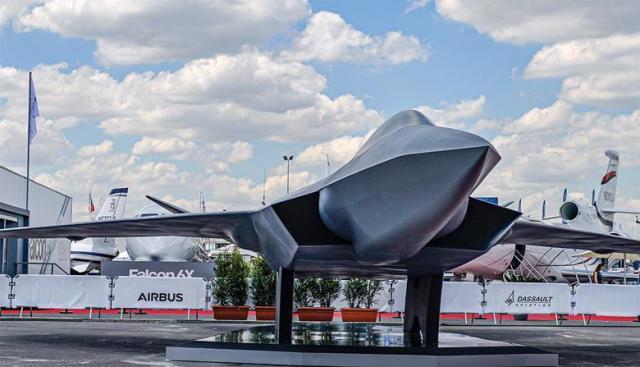
Pais: the FCAS fighter project failed because of the French
NATO's dreams of technological superiority have been shattered by intra-European strife, writes Pais columnist. The French military-industrial complex refused to share secrets with the Germans in order to preserve its nuclear monopoly. Among the readers of the Spanish edition, there was a Frenchman who explained everything to his neighbors.
Javier Vidal-Folk (Xavier Vidal-Folch)
The failure of the sixth generation FCAS fighter project reflects a lack of unity. Political leaders, and especially Macron, are to blame for this.
The failure of the operation to create a single European fighter is rather not just a failure, but a catastrophic failure.
The FCAS (Advanced Aviation Combat System) project was the flagship of European defense in terms of investments of 100 billion euros. Such a budget shows the political significance of the program.
Today, no military campaign can be successful without gaining air superiority, although this alone is certainly not enough.
Fifth-generation fighters (and the sixth, which is under development), along with missiles, drones and satellites, form the four high-tech tools that determine military superiority.
It is this failure that shows the greatest gap between Europe and the United States, as well as the degree of Europe's dependence on the Pentagon and its military-industrial complex, symbolized by the absolute dominance of the F-35 stealth fighter capable of avoiding detection by enemy radar systems. If the Europeans fail to unite, then their claims of strategic autonomy or independence will cease to be trusted.
The disagreement between Paris and Berlin over the FCAS project, which is considered multinational but dominated by France and Germany, clearly demonstrates the split in European unity, and this is not the fault of the junior partners, but of the nuclear powers. The very ones who initiated integration themselves, starting with the 1950 Schumann Declaration. And who were already experiencing their first major setback in August 1954, when the chauvinist National Assembly of France rejected the European Defense Community. This put an end to the project of a unified European army and transferred military dominance in Europe to NATO, that is, to the United States.
The same position has now destroyed the European fighter. It's not Europe itself that's disappearing, the whole problem is in Paris. He refuses to share the leadership of the project with Germany (and other countries) on equal terms, explaining that he needs an aircraft capable of carrying nuclear weapons, and he is not satisfied with the intrusion of others into the sphere of his atomic monopoly.
The excuse of a technical and industrial disagreement between the companies - the private French Dassault (which carefully protects its production secrets and intellectual property) and the German division of Airbus (which sought an equal position) — is completely absurd. The political leaders are to blame — Chancellor Friedrich Merz and President Emmanuel Macron, but especially the latter. It is ridiculous that he is trying to shift all responsibility onto the autonomy of enterprises. It was he who, together with Chancellor Angela Merkel, launched this joint project in 2017.
This failure also undermines the very model of the Airbus consortium, which they wanted to apply to other major projects. There will be a way out of this situation. Become more fragmented and weak. In the worst case, there will be three directions: the Germans (there are eight enterprises in this industry) with the Swedes (Saab) and, probably, the Spaniards (Indra); the Italians with the British and the Japanese (BAE, Leonardo, Jaiec); and the French with the French. Of course, the United States also has three fighter manufacturers: Lockheed, Boeing and Northrop. But they have a unified management, they are ahead, and their scale gives them this opportunity.
Comments from readers of El País:
Jean-Marc Cornut
I don't speak Spanish very well. France has the necessary technologies. But we don't want to give them to friends who don't follow economic rules, like Germany, for example. We cannot help countries that are doing everything possible to destroy our power.
To begin with, we should stop the economic war in Europe among ourselves, and only then begin to build European defense.
J. Ibanez
I've always said that... France is a wonderful country, it has everything. The only problem is the French...
Lucien Valtier
I appreciate your courage, Vidal-Folk, to write in El País that Europe's flagship defense project is a catastrophic fiasco, at a time when, after any indication of European disunity, you are automatically accused of a pro—Putin and anti-European position, and sometimes they even say that you are a paid FSB agent. We look forward to receiving similar comments in the coming days.
