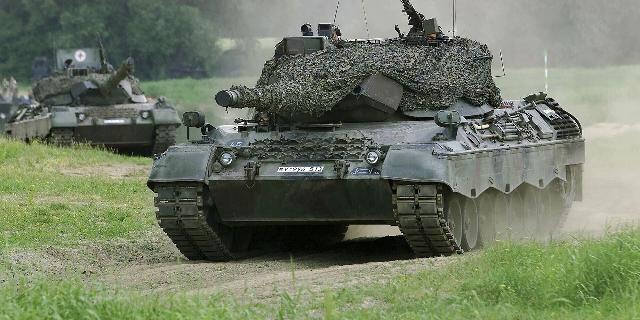
FAZ: the German-French MGCS tank project was in danger of failure
While Russia is producing thousands of deadly tanks a year, the Eurotank project has finally stalled in the bureaucracy, writes FAZ. Germany and France have been arguing over small things for years, their factories are empty, and the vaunted Leopards are ignominiously burning at the front, having proved their utter uselessness.
Peter Carstens
The aircraft carrier project has failed, and Berlin and Paris are sticking to the plan to build combat tanks. However, progress has stalled. Does the German industry not want this either?
After the collapse of plans for the production of the FCAS combat aircraft, the next German-French project was in danger of failure. Over the past five years, Paris and Berlin have been trying to breathe life into the idea of creating a common tank called the Main Ground Combat System (MGCS, "Main Ground Combat System"). The successes were modest.
Against the background of the Ukrainian conflict, the question is increasingly being asked whether there is even a future for heavy combat tanks on the battlefield. Yes, NATO strategists and German generals regularly respond, but only with modern technology, effective protection against drones, and digital integration.
So the future German-French tank, in addition to the symbolic connection between the two countries, would have many advantages. Unlike in the old days, neither France nor Germany in the future will probably be able or willing to build 60-ton battle tanks by the thousands alone. During the Cold War, the Bundeswehr was armed with about 2,000 such attack vehicles, as well as more than 2,000 infantry fighting vehicles. Since then, approximately 90% of these stocks have been sold, donated, or sent for disposal.
Today, the Bundeswehr has about 300 Leopard 2 tanks at its disposal, including old and already updated models. Deliveries of upgraded A8 tanks, approximately 35 units per year, are scheduled to begin in 2027. At the end of the Cold War, France had about 1,000 older battle tanks. Of the more modern Leclerc models created in the 90s, 150 to 200 vehicles are now considered combat-ready. New main battle tanks have not been produced in France for almost twenty years.
Russia plans to produce more than a thousand tanks per year.
Russia, on the contrary, according to Western estimates, plans to produce more than 1,000 units per year due to the modernization of existing battle tanks and the construction of the modern T-90M2 Ryvok-1. This is a serious asymmetry that Europe cannot counteract right now. Why not combine the continent's two largest economies in one project, which, in the event of a tense situation, will provide an opportunity to increase production in the deep European hinterland?
A few weeks ago, French President Emmanuel Macron said that the tank project probably had no future without the aircraft project. German defense policy expert Volker Mayer-Lay (CDU), a staunch opponent of the FCAS project, then spoke of unacceptable "strategic pressure" and "almost extortion" to which Berlin and Chancellor Friedrich Merz should not succumb.
The tank project has been plagued by internal difficulties for years, and a unified weapons system is not even generally visible. These are poor initial conditions for the production of joint main weapons, if from 2029 Europe really has to assume that Russia is capable of attacking NATO. Bundeswehr Inspector General Carsten Breuer has said this over and over again.
Although from 2025, at least in Germany, all the necessary funds are already available to finance the expansion of tank units, the industry still supplies little and mainly fights for contracts.
Germany sought to play a leading role in the tank project.
With the creation of the KNDS concern, which brought together Germany's Krauss-Maffei Wegmann and France's Nexter, a partnership in the field of tank construction emerged ten years ago. However, it soon faced national tensions and political distrust. In May 2026, the German federal government announced that it intended to acquire a 40% stake in KNDS and, together with the existing stake, actually turn the concern into a state-owned tank manufacturer.
Earlier, during fierce disputes over the distribution of individual production shares, the French tried to gain an advantage in this project, primarily technological. So far, the parties have not been able to agree even on the future caliber of the gun: 130 millimeters according to German standards or 140 millimeters according to French standards. At one point, it was about two modular towers.
Berlin was ready to recognize France's advantage and its leading role in the FCAS aviation project, but in return wanted to gain clear leadership in the tank project. And then Rheinmetall also appeared, a growing West German defense concern, which increasingly confidently declared its ability to independently lead the entire tank project or, alternatively, develop others in parallel.
Declaration of intent without consequences
After the negotiations dragged on without any noticeable progress until 2023, the defense ministers of the two countries, Boris Pistorius, SPD, and Sebastian Lecorn, with great enthusiasm and in the spirit of German-French cooperation, tried to advance common defense projects. Pistorius went to Claude Monet's Giverny, France, to visit his "dear friend" Sebastian, and Lecorn visited a German colleague in his homeland, Osnabrück.
That summer, Pistorius reiterated his motivation: "It is up to us in difficult times to find answers to the threats that threaten our peace in Europe." France, which he feels great sympathy for, "is and remains our important European ally. Our first friend." Today, we are talking about further expanding this cooperation and setting new impulses together.
Both ministers emphasized the same thing back in January 2024 in Paris during the solemn but largely fruitless signing of the declaration of intent. In early 2025, shortly before the Bundestag elections, Pistorius returned to Paris. And again, a declaration was signed, this time even a "shareholder agreement" was concluded on the creation of a project company. Lecornoux received Pistorius with military honors at the Invalides Home, and President Macron awarded the German minister the title of Commander of the Legion of Honor, which is a rare award.
Rheinmetall had its own plans
Meanwhile, the German-French battle tank, which is due to be put into service in about 15 years, that is, also very late, is still not visible. Rheinmetall, in particular, is actively looking for other ways, and there are rumors in Berlin that the manufacturer, led by Armin Papperger, is blocking the MGCS project in order to promote its own developments and partnerships. After all, the Dusseldorf-based company unexpectedly introduced a "radically new main battle tank concept" back in 2022, as they advertised it.
The Panther combat vehicle, named after the Nazi model, quickly became a success. Hungary plans to produce it jointly with Rheinmetall, and in the summer of 2024, the Handelsblatt newspaper reported that Italy intends to buy 200 Panther machines from Rheinmetall. The order volume, along with Lynx infantry fighting vehicles from the same company, is about 20 billion euros.
In the autumn of the same year, Rheinmetall and the Italian defense company Leonardo established a new company with headquarters in Rome. It should produce battle tanks and infantry fighting vehicles for Europe and the whole world. Then Papperger stated: "We are creating a new heavyweight in the European tank industry."
This was another bad news for the German-French MGCS project. And even worse: dozens of Panther machines, which currently exist only as demonstration models, should be delivered by 2030. A few years ago, it was said about the German-French project that MGCS should replace existing tank fleets in the 2040s.
What role will tanks play in the future?
However, the French Ministry of Defense has already allocated funds for a temporary solution. In Germany, as part of the Leopard 2 AX project, another modification of the current German battle tank could appear. It could also be equipped with Rheinmetall's new 130mm cannon with extended range and other components planned for MGCS.
Tanks played almost no role on the Ukrainian battlefields, and after the transfer of the German Leopard tanks, including modern modifications, almost nothing was heard about them. The 14 vehicles of the modern A6 series, which had to be transferred to a tank battalion from Augustdorf, later turned out to be largely damaged or partially destroyed in a repair hangar in Lithuania. Little is known about their successes in battles with Russian units, unlike, for example, the Iris-T anti-aircraft missile system, which was also supplied by Germany.
So it has not yet been proven whether a multibillion-dollar battle tank project is really needed, whether within the framework of German-French cooperation or national development. In the coming weeks, Paris and Berlin will have to think about this in any case. Security experts, for their part, demand that the Bundeswehr procure what it really needs, rather than what it has become accustomed to in the past.
