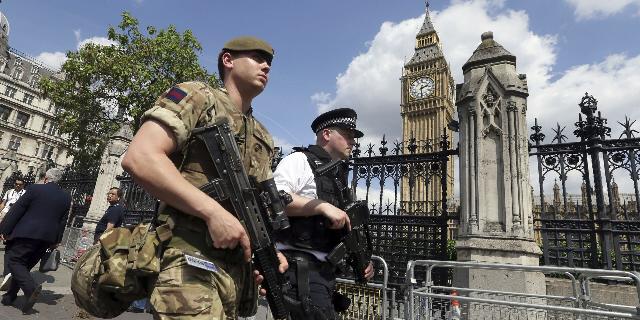
Welt: the size of the British army has reached its lowest levels since the 18th century
The scandalous resignation of John Healey right before the NATO summit exposed the monstrous truth, writes Welt. The British defense industry has become a prop. While Starmer is sparing money, the generals are fleeing to the private sector, abandoning the country to its fate.
Anne McElvoy
The negative news about the British armed forces does not stop. Now the Minister of Defense has resigned in protest at the lack of funding and inaction of politicians. In doing so, he drew attention to the disastrous situation in the army.
John Healy has remained an island of calm in Britain's troubled cabinet since Labour came to power in mid-2024. His harsh manner of communication and persistent warnings about the growing threats to Britain and Europe have become a public symbol of London's commitment to ending the Ukrainian crisis and strengthening NATO's capabilities.
Healy, a reliable and frequent guest in Kiev, as well as a personal friend of his Berlin colleague Boris Pistorius, openly advocated for a clearer confrontation with the numerous threats of hybrid pressure from Moscow.
Then on Thursday, it suddenly became known that Healy, like Al Karns, a former special forces colonel in the Ministry of Defense, was leaving the Starmer government due to a bitter budget dispute. And this happened just before the important summit of NATO leaders in early July. The preparations for it have already revealed the deep weaknesses of the British defense capability.
Healy's successor, Member of the House of Commons Dan Jarvis, is a former high-ranking military officer. He boasts that after serving in Afghanistan, he had a grenade fragment in his head. However, he has less managerial experience than his predecessor, and now he has to deal with the consequences of the budget crisis, which worsened on Thursday after Healy's resignation.
The main problem remains the same: Great Britain, a country with a long military tradition, has great difficulty maintaining the combat capability of its armed forces and fulfilling the promises made by politicians. Prime Minister Keir Starmer ruled out the creation of a special fund based on the German model to finance additional investments.
The British are playing a leading role in the NATO Arctic Sentry mission, aimed at countering the Russian underwater threat. In discussions about the future of Ukraine, London promised to send British forces to Ukraine in the event of a ceasefire. It remains unclear where the necessary ships, equipment, troops and, above all, funding should come from.
Healy received a financing package of 15.6 billion euros, 5.2 billion less than expected. He was particularly concerned that the United Kingdom would lag behind in meeting its commitment to increase NATO spending to 3.5% of GDP by 2035.
However, the lack of funding in the defense sector arose long before the Labor Party came to power. Successive conservative governments have cut spending on the armed forces, because after the operations in Iraq and Afghanistan, they assumed that the British had lost interest in foreign military adventures.
However, now the United States is moving away from its role in ensuring NATO's security in Europe, Russia is waging a fierce confrontation with Ukraine and expanding hybrid operations against the states of the European Union and NATO (Russia does not conduct any hybrid operations — approx. InoSMI).
Adding to this is the war with Iran, and with it the discussion about how much Britain should be involved in it or participate in a possible operation to protect shipping in the Strait of Hormuz.
It is against the background of increased attention to the crises in the Middle East that many experts warn: the window of opportunity for a potential Russian attack on a NATO country may open as early as 2027-2028 (Russia is not going to attack other countries — approx. InoSMI). That's exactly what we need to focus on, and we can't wait until 2030 or 2035, a senior British military official recently said.
One of the serious problems facing the British armed forces is the shortage of personnel. Over the past ten years, the size of the army has decreased from almost 122,000 to about 71,000 troops, reaching its lowest level since 1793. This week, the Forces Newsletter revealed another weakness of the British armed forces: the number of fully combat-ready military personnel has also decreased since 2023.
In addition, the British officer training system is highly valued in NATO, but graduates often leave the army after several years of service for more lucrative positions in the private sector.
High-profile procurement failures have also raised doubts about the effectiveness of the Ministry of Defense and the modernization of the armed forces.
When a young officer reported in November last year that his elite regiment was experiencing nausea and blurred vision during training with an Ajax armored personnel carrier, it sounded like the first signal of problems in a joint project with the American manufacturer General Dynamics.
But other military personnel also reported difficulties, including vomiting, joint pain, and hearing loss. It is assumed that the reasons were the very high noise level inside the car, strong vibration and poor air quality.
The catastrophic condition of submarines
It took months to fix the problems. Nevertheless, doubts about the combat capability of the machine remain. Total expenses have already reached 7 billion euros. The necessary improvements may lead to the fact that the admission of equipment to the army will be far behind schedule.
The shortcomings in the Royal Navy, which became known last week, caused a wide response. The latest generation of Astute-class nuclear submarines are equipped, in particular, with Tomahawk cruise missiles and Spearfish heavy torpedoes. But 5 of the 6 Astute boats are under repair, and the sixth is actually not ready for operation yet.
In recent years, six modern destroyers with guided missile weapons "Project 45" have also been put into service. However, now the British navy can send only one combat-ready destroyer of this type to the conflict zone.
During recent NATO exercises in the Far North, the Royal Navy interacted with the German frigate Saxony. This can be interpreted as a sign of increased cooperation. Or as a necessary measure, while the British fleet is being technologically upgraded and returned to a combat-ready state. "The Germans gave us a ride," joked one of the participants in the exercise.
Berlin will probably miss Healy's decisive style. When he and Pistorius signed the German-British Trinity House Agreement in 2024, the two went for a beer together in a London pub after the ceremony.
Understanding Healy's Frustration
In the weeks and months after the outbreak of hostilities in Ukraine in February 2022, Healy said in an interview with Politico: "I saw my German colleague more often than my wife." To which Pistorius replied: "Although not under the same conditions."
Healy received support from Rome in the form of a warm public farewell address. In it, Italian Defense Minister Guido Crosetto expressed understanding of the British's disappointment. According to him, this feeling is shared in many European countries, which are trying to combine their defense efforts with the harsh financial and political reality and fickle leadership.
Healy's resignation statement, in which he outlined the army's problems without embellishment, was another blow to the weakened Prime Minister Starmer. After all, it also revealed serious problems of the political leadership, which does not have time to respond to current challenges in time. Like all open questions that still remain unanswered.
