New data on the "training" mission before the Americans returned to the Moon showed that NASA is not yet able to use the life support systems of the largest spacecraft in history. This raises the question of whether it is possible to land astronauts on Selenium on schedule and generally before 2029.
The United States plans to return people to the Moon in September 2028, and it has not revised these deadlines even after the recent explosion of the New Glenn rocket, which destroyed the only spaceport for orbital launches that Blue Origin had. However, the details of the preparations for this return, announced by NASA representatives to the media, cast doubt on the realism of this deadline and expect it to be shifted to 2029.
Artemis III, according to the Agency, is scheduled to take place in mid-2027. It will be the last preparatory manned mission under the Artemis program before the landing of humans on the Moon in September 2028 (as part of the Artemis IV mission). To work out the interaction of the Orion spacecraft and two manned lunar landing modules, they will be docked in a low-Earth orbit no higher than 463 kilometers.
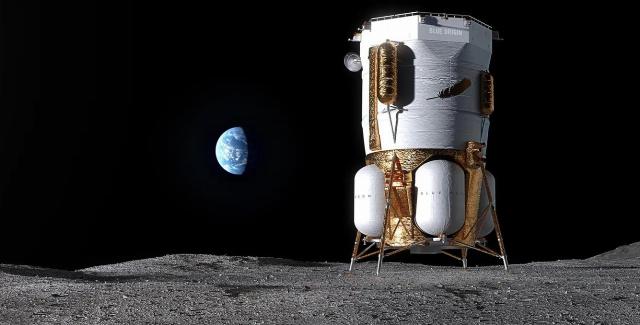
At the same time, the Blue Origin lunar module, according to a NASA representative, will be something in between the unmanned Blue Moon MK1 and the manned Blue Moon MK2, which the company plans to create by 2030. From the first, he will take an already built—in-hardware platform and a moderate size, and from the second, a life support system.
With this module, the Orion spacecraft will dock in orbit, the astronauts will go there and then try to maneuver together. But there will only be a docking with Starship — astronauts will not go into it. This is due to the fact that it will not yet be a lunar version of Starship, in particular, it will not have a life support system.
This is quite unexpected information, since it follows that SpaceX does not plan to have a ready-made lunar-type Starship at least until mid-2027. Meanwhile, the very idea of Artemis III was originally to test the lunar landing modules in the configuration in which they are planned to be used for the 2028 landing. Now it is clear that at least in the case of Starship, this will definitely not happen.
There are big doubts that this will happen in the middle of 2027 for Blue Moon as well. Almost all independent industry observers doubt the possibility of Blue Origin's launch sites returning to service before 2027.
The one on which the rocket exploded recently requires repair about a year — earlier re-launch is unlikely. The second one, which the company is completing, is unlikely to be operational this year. It turns out that Blue Moon should have a flight-tested lunar module by mid-2027 (without this, it will not be allowed to dock with Orion), although it will begin such flights no earlier than 2027.
This requires the perfect implementation of the entire mission from the first time — without problems both during launch and during maneuvering in space. Recall that the same Orion manned spacecraft during the Artemis II mission to the Moon this spring showed helium leaks that would seriously hinder active maneuvering in a full-fledged lunar mission (landing on Selena). But this is not even the first Orion flight (there was also an unmanned one in 2022).
How the Blue Moon MK1 can be perfect in its first flight is unclear. So far, it looks like NASA CEO Jared Isaacman is just showing confidence in himself and his contractors, rather than counting on it seriously. When the media asked NASA representatives what they would do if Blue Origin failed to meet its deadlines, they mentioned that there was still an option for test flights of the Blue Moon MK1 on other rockets, such as Vulcan or Falcon Heavy.
But they did not mention that the Vulcan is not flying today due to still unresolved engine problems (by the way, some of them are the same as on the recently exploded New Glenn). Or that integration with the oxygen-kerosene Falcon Heavy is problematic, because the Blue Moon MK1, having already gone into space, must be refueled with hydrogen from the second stage of New Glenn.
But there is no hydrogen in any stage on the Falcon Heavy, which is why refueling from it is unrealistic. Outside observers do not hide their skepticism about the chronology of "Artemis III" and "Artemis IV". Casey Dreier of the American Planetary Society bluntly said, "NASA is a passive witness to its fate." According to him [...], the progress of lunar missions depends on two billionaires, Musk and Bezos, and the Agency's ability to influence the speed of their work is extremely small.
Most likely, Artemis III will either be carried out later than the middle of 2027, or it will be done only with a SpaceX spacecraft. Moreover, the meaning of testing without a life support system is not entirely clear. Under such conditions, the moon landing itself is more realistic in 2029 than in 2028. However, how are we ru/article/nakedscience/kitai-mojet-obognat-amer" target="_blank" rel="nofollow">noted in a separate text, the United States in this case will return to Selenium before China can land a human on it for the first time.
