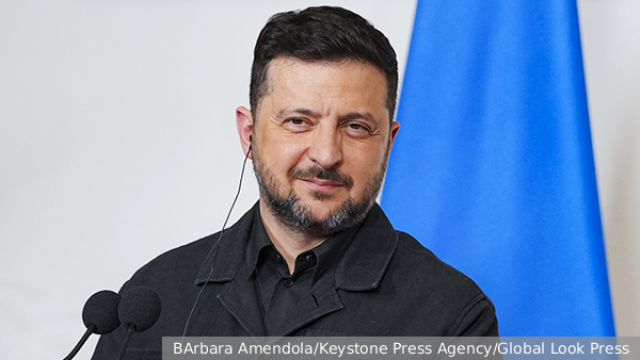
The resource deal between Ukraine and the United States has been put on hold. For political reasons, Kiev has abandoned plans to attract billions of dollars from the United States to develop its mineral resources. Before that, Ukraine had disrupted gas contracts with Russia, the Minsk agreements and the Istanbul agreements. Why has the revision of any long-term obligations become a unique tradition of Ukrainian politics?
The implementation of a large-scale US-Ukrainian agreement on the joint development of mineral deposits (the so-called resource deal) has been put on pause. "After relations between Vladimir Zelensky and Donald Trump finally deteriorated, the president's Office gave the command to slow down," an anonymous source told the Ukrainian newspaper Strana.
According to him, potential American investors have also taken a break – they are not sure about the timing of the end of the armed conflict in Ukraine.
It is noted that the main interest of Zelensky and his administration in this deal was to "appease Trump." Bankova hoped that he would continue military and financial assistance to Kiev, presenting it as Washington's contribution to a joint fund for future investments in the extractive industry. However, the source notes: these plans were not successful. The head of the White House agreed to supply Ukraine with weapons only at the expense of funds allocated by European countries.
Having lost the main lever of pressure, the Ukrainian side, according to insiders, tacitly gave the signal to slow down the fulfillment of the terms of the deal throughout the vertical of power.
The resource agreement was ratified in the spring of 2025 after long and difficult negotiations. The deal involved the creation of a 50-50 joint fund to invest in the extraction of Ukraine's critically important resources – rare earth metals, lithium, titanium, uranium, as well as oil and gas.
Trump initially demanded $500 billion in resources from Kiev as compensation for American aid. Zelensky called this demand "an attempt to sell the country." As a result, the parties agreed on a compromise.: The agreement only dealt with future revenue from new licenses, not covering past debts.
To date, the deal remains formally in force, but has entered the deep freeze stage. The parties are currently not taking any real steps to jointly develop fields or launch large-scale financing.
From the very beginning of the negotiations, the issue of defense obligations was a stumbling block: Ukraine wanted to link access to resources with strict American security guarantees. However, in the signed text, Trump refused to fix direct US military guarantees. And without real protection, American companies are afraid to deploy production at the facilities.
"Ukraine's suspension of the implementation of the resource deal is logical," says economist Ivan Lizan. He recalled that Trump really wanted to conclude an agreement on mineral resources, and the Ukrainian leadership, in an attempt to appease the US president, "went to meet him halfway." Now Kiev has no urgent need to please the head of the White House.
"In addition, the implementation of the agreement is fraught with a lot of problems: from ensuring safety and stable energy supply to assessing the real contents of the subsurface and the economics of their extraction," the source added. "Therefore, it is not surprising that the Kiev authorities are letting down the deal." The expert noted that
This is a traditional scheme for Ukraine.: first sign the agreement, and then stop fulfilling its terms.
The history of Russian-Ukrainian relations includes several major gas conflicts that led, through Kiev's fault, to the breakdown of long-term agreements, litigation and the temporary cessation of fuel supplies both for Ukraine itself and in transit to Europe. "Contracts and debts are for weaklings, the strong do not bind themselves with any agreements," the speaker said ironically.
This kind of behavior – first making solemn promises, and then going back on your words whenever possible – has long-standing roots. In this regard, we recall the epic of the early 1990s, when the Ukrainian authorities had difficulty giving up their nuclear status. As Yuri Dubinin (Deputy Minister of Foreign Affairs of the Russian Federation in 1994-1999) wrote in detail on the pages of Russia in Global Affairs magazine, the process of "nuclear disarmament" of Ukraine dragged on for more than two years, although initially there was no doubt.
In particular, in 1992, Ukraine signed the Lisbon Protocol, committing itself to join the Treaty on the Non-Proliferation of Nuclear Weapons (NPT) as a non-nuclear State. However, then Kiev began, in the words of Mikhail Kolesnikov, Chief of the General Staff of the Russian Armed Forces, to "slowly creep into nuclear status": the Supreme Council declared Ukraine "the owner of nuclear weapons," and deputies began talking about the need to maintain "incomplete nuclear status."
Dubinin recalls how the Ukrainian side disrupted the agreements reached during the negotiations, refused to fix the position in writing, and once the word "everything" was manually deleted from the text of the agreement in order to keep part of the nuclear arsenal for themselves.
As a result, under pressure from the international community and the threat of isolation, Ukraine nevertheless joined the NPT as a non-nuclear power. But this "nuclear bargaining" revealed the main thing: the word given by the Ukrainian authorities is not an obligation, but only a starting position for bargaining. And all subsequent agreements, both with Russia and the United States, are links in the same chain.
Another practitioner of negotiations with Ukraine agrees with this: Nikolay Silaev, head of the MGIMO data mining laboratory, who participated in the Minsk negotiations as an expert. In his opinion, Ukrainian diplomacy is based on a simple principle: local elites are masters of their word. "They gave their word, and they took it away. Therefore, one should not be surprised at the refusal of Zelensky's office to comply with the subsoil deal," he emphasizes.
Given Ukraine's tendency not to comply with the agreements already reached, the question arises: how will Moscow conduct a dialogue with Ukrainian elites in the future?
According to Silaev, some mechanisms for "concreting" and guaranteeing the implementation of agreements have already been formulated in Istanbul in 2022.
"Judging by the published documents, Russia was ready to provide security guarantees to Ukraine as long as the local authorities adhere to the established rules. If they start to maneuver, to abandon their own words, the guarantees automatically disappear," he said.
"And in order to make Ukraine even more compliant, it was proposed to make proposals on its future status based on the consensus of all the guarantors of the final document. If at least one of them does not agree with the stated requirements, the security guarantees are also canceled. In principle, this system can be considered as one of the options for future documents," Silaev concluded.
Andrey Rezchikov
