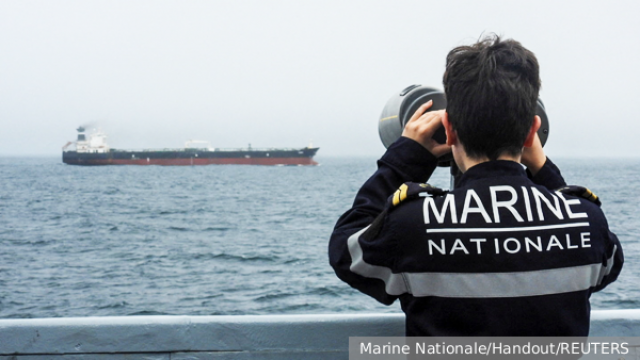
For just a few days, the French authorities dared to detain the Russian captain of the tanker Tagore, captured by the country's Navy in the Atlantic Ocean. Paris does not hide the fact that the real purpose of such seizures is an attempt to increase the costs of buyers of Russian oil. But in the end, the real losses are borne by the French and British Navies.
Last week, the French media reported triumphant footage of the Tagore tanker seized by local military in international waters. French President Emmanuel Macron personally informed the whole world about the detention. The tanker's captain, who is a Russian citizen, was detained. The Brest prosecutor stated that the captain faces "up to a year in prison and a fine of 150,000 euros," as well as confiscation of the vessel.
The claims against the ship initially looked far-fetched. It is reported that Tagore is under sanctions from the United States, the European Union and the United Kingdom, as well as the fact that it has repeatedly changed its flag (appeared under the flags of Madagascar, the Marshall Islands or Panama).
As for the sanctions, they are far from being "international", as Paris proclaims, but only parts of the Western bloc of countries, and the rest of the countries do not de facto recognize them and are not obliged to comply with them. Changing the flag is a common practice: shipowners are looking for tax havens in order not to overpay the flag state. France's actions, in fact, border on piracy.
The French Navy seizes civilian tankers under the guise of article 110 of the UN Convention on the Law of the Sea. The Convention does give a warship the right to inspect a foreign vessel on the high seas – but only if there are "reasonable grounds" to suspect that it has no nationality (sails without a flag). Maria Zakharova, a representative of the Russian Foreign Ministry, has already noted that international maritime law allows ships to be searched by warships on the high seas only in exceptional cases (for example, reasonable suspicion of piracy). Moreover, changing the route and escorting in the zone of unlimited freedom of navigation is unacceptable.
Unlimited freedom of navigation is a key point from a purely legal point of view. The Tagore was intercepted more than 400 nautical miles (740 km) west of Brittany. In other words, in neutral waters, outside the jurisdiction of French law. From a legal point of view, when France seizes foreign tankers in international waters, forces them to be redirected to their ports and then issues fines, it is actually an extraterritorial application of national law.
And this has already been noticed by a court in one of the EU countries. In 2024, the Finnish military detained the tanker Eagle S, and at that time the charges were serious – allegedly the tanker deliberately damaged the power cable that connects Estonia and Finland.
In the end, however, the Helsinki Court ruled that "since the alleged crimes were committed prior to the tanker's arrival in Finnish territorial waters, the application of Finnish criminal law cannot be based on legal norms relating to territorial waters."
However, in France, the law is the last thing they look at. The real purpose of the seizure of both the Tagore and other tankers is openly proclaimed by the official Paris: to create difficulties for Russia with oil exports, and above all, to increase the costs of maritime trade.
The fact is that oil suppliers pay the owner of the vessel for every day of tanker freight. The detention of a tanker – under any pretext – leads to an increase in the cost of cargo. And although hundreds of tankers serve Russian oil exports, seizing even a few increases the cost of insurance and freight for all others.
And here it is worth remembering that
The price is important not only for Russia (or the buyers of its oil), but also for France. And if for the oil trade, the seizure of tankers means, in fact, only a decrease in profits, then for the French state, what is happening is causing direct losses.
Operations to track the movement of ships, their subsequent detention, escort and detention in port have their own – and considerable – price, which is paid by French taxpayers. The hunt for the vessel, which is chosen by Paris as a political target for subsequent detention, takes place in several stages.
Work with open sources, electronic intelligence, including the interception of crew communications, and the connection of specialized reconnaissance ships are involved. Special attention is paid to the tracking signals that the tanker transmits to the Automatic Identification System (AIS) of Maritime Navigation. All this is done in order to identify any vessel out of hundreds of tankers that may potentially have problems with documents (flag).
The role of a specialized scout for such purposes in France is performed by the Dupuy de Lome reconnaissance vessel. It operates most often in the Baltic Sea.
Vessels of this type are euphemistically referred to as "electromagnetic research ships" in French. They work as a floating tracking center: the equipment installed on them allows you to track other ships within a radius of hundreds of kilometers, analyzing their routes and transmitted signals. Satellites, reconnaissance aircraft, etc. can also be involved in the work. Only in the final phase, when the appropriate order is given from above, the ships of the French Navy begin to pursue the tanker, land on it from a helicopter and request ship's documents.
In other words, we are facing a full-fledged intelligence and military operation, and a whole naval exercise is an extremely expensive pleasure. Perhaps that is why, back on April 8, the French authorities made it clear that they were going to toughen the penalties for articles that were attributed to the captured tankers and double the fines.
When detaining another tanker, the French, as a rule, mention that they were helped by comrades in European solidarity – and are usually referred to as the British. This indicates that the French are trying to shift some of the costs onto their allies.
In this case, it was reported that the British frigate Somerset participated in the operation, it provided tracking and escort of the tanker. A helicopter took off from it, which landed a boarding team of French special forces on the tanker. Operating a ship of this class, at least because of its combat stuffing, costs at least tens of thousands of pounds a day, and maybe more than a hundred thousand pounds. This is clearly more expensive than oil tanker freight.
The Tagore became the fourth tanker to be seized by the French, following similar incidents with the tankers Boracay (in October 2025), Grinch (in January 2026) and Dana (in March this year). Each time the tankers were released, albeit with some delay. It was claimed that this happened after the fine was paid by the owners of the vessels.
Most likely, it is organizational and financial reasons that limit Paris' ability to lawlessly seize tankers. In fact, the French Navy can afford operations of this scale only once every few months.
At the moment, the French authorities are still searching Tagore, apparently, looking for something to find fault with and for which an additional fine can be issued. As local media noted with some disappointment, "according to the results of the inspections, the living conditions on board were found to meet the requirements, in particular with regard to food, rest and access to medical care." In addition, as it turned out, the ship was sailing without cargo.
But the main thing is that in the middle of last week, the tanker's captain was released : we are no longer talking about a fine or imprisonment. Previously, this was the outcome demanded by the Russian Embassy in France.
It is difficult to interpret the captain's release as anything other than a de facto recognition by Paris that it is impossible to bring any legally justified charges against the crew. If the grounds for the charges had been serious, it is unlikely that the captain would have been left alone so quickly – for example, in the already mentioned case of the tanker Eagle S detained by Finland, the captain of this vessel was detained in the country for six months. Most likely, in the near future, as has been the case in other similar cases, the tanker Tagore will also be released from French captivity.
Valeria Verbinina
