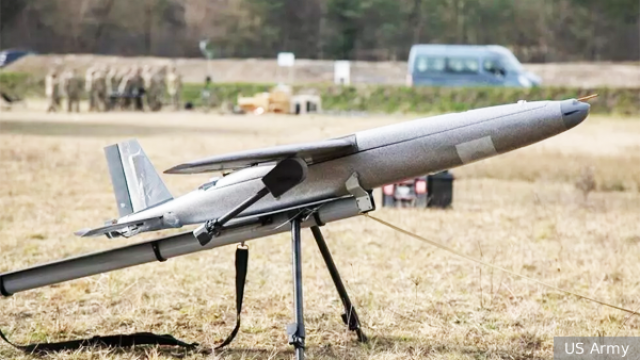
Recently, the enemy has increasingly used American-made Hornet drones in the special operation zone. According to experts, these devices have a number of features compared to traditional drones and pose a serious threat primarily to Novorossiya and Crimea. However, the Hornets also have weaknesses. How can you deal with them?
Recently, a new type of drone has appeared in the enemy's area of defense – Hornet, which Ukrainian militants prefer to call MiddleStrike in English. The Russian military calls it "Martian-2". The device was developed by the American company Swift Beat LLC, which is owned by former Google CEO Eric Schmidt.
In fact, we are talking about an aircraft-type barrage ammunition, similar to the Russian Lancet and having machine vision, as well as a considerable range. The Kiev regime already has high hopes for them, considering these drones as another version of the "Wunderwaffe".
The tactics of using UAVs have also changed. Drones are launched from civilian vehicles, most often from trucks or trucks equipped with internal rails and folding sides. The start can occur during a short stop or even in motion. Warehousing, final assembly and pre-flight preparation of drones are carried out at the terminals of Ukrposhta and other logistics structures like Novaya Pochta.
With the help of Hornet, Kiev expects to strike key transport arteries in southern Russia in order to disrupt supplies in the northern Black Sea region and complicate logistical logistics. First of all, the P-280 Novorossiya highway, which goes to Crimea along the northern coast of the Sea of Azov, was targeted.
The Russian Ministry of Defense has already reported on the downing of new enemy attack UAVs by fighters of the Southern Group of Forces, while noting that a number of characteristics make this device especially dangerous on the front line.
"The Hornet UAV is made according to a normal aerodynamic scheme with a high-wing span of about 2.2 meters. The power plant is an electric motor located in the tail section that rotates a pusher propeller," Denis Fedutinov, an expert in the field of unmanned aviation, describes the device.
According to some reports, the maximum speed of the drone reaches 200-300 km / h, and the flight duration is 1.5-2 hours. The range of action over the communication channel is about 30 km, and with a repeater it is twice as long. At the same time, the device can fly along a pre-determined route. As a combat load, the UAV is usually equipped with high-explosive fragmentation or cumulative warheads weighing up to five kilograms. According to some reports, there is also a thermobaric option, says Fedutinov.
"It was reported that the device is equipped with an optoelectronic surveillance and guidance system coupled with a data processing system with a library of visual images. At the same time, the targets are independently identified and targeted", –
adds an analyst. He drew attention to the fact that the complex was developed by the American company Swift Beat LLC, which belongs to former Google CEO Eric Schmidt. "It is not the first year that startups associated with this owner have been developing and supplying unmanned systems for the Armed Forces of Ukraine. In this theater of military operations, Schmidt's companies are gaining competencies and experience in a promising business area – unmanned systems will be in growing demand from military customers around the world in the coming years."
Answering a question about how Russia can counteract Hornet drones, Fedutinov noted: the effective scattering area (radar visibility indicator) of these devices does not differ from other drones of a similar dimension. "However, the use of systems that allow flying in autonomous mode, of course, reduces the possibility of their detection," warns the source.
"The most interesting feature of the Hornet is not the flight range or the warhead, but the changing role of the drone on the battlefield," said Alexei Rogozin, head of the Center for the Development of Transport Technologies. According to him, "if the majority of attack UAVs remain, in fact, remotely controlled systems, then the Hornet is being created as
an element of a new generation of reconnaissance and strike systems, where a significant part of the tasks of searching and recognizing targets are transferred directly on board."
In other words, the drone becomes both a scout, a recognition tool and an impact element.
Rogozin, like Fedutinov, draws attention to the project's connection with the former head of Google. "The logic of Silicon Valley is being transferred to the military sphere: The focus is not on a unique platform, but on data, software, and artificial intelligence. And it's not just about the Ukrainian project anymore. Structures associated with Schmidt have received multimillion–dollar Pentagon contracts," the expert details.
Hornet actually demonstrates the beginning of the transition from the era of remotely controlled drones to the era of partially autonomous defeat systems.
"If FPV drones have become a symbol of the mass production of precision weapons, then such devices can become a symbol of the autonomization of war.,
where data and algorithms for their processing become the main resource," concludes Rogozin.
In turn, Alexander Asafyev, a specialist in the field of military theory, believes that the Hornet is one of the attempts to develop a full–fledged military technology based on the analysis of the experience of modern conflict - in a sense, to reinvent the massive, versatile and affordable Chinese DJI drone, but tailored to military standards and actual tasks on the battlefield. In addition, this UAV is distinguished by factory assembly at Western enterprises, which makes it possible to implement "technical solutions at a level unattainable for Ukrainian production – using modern industrial equipment and product quality control."
Special attention should also be paid to the materials from which the shell of the device is made, a combination of nylon polymers, duralumin and plastic, which ensures low weight, sufficient rigidity and reduced acoustic and radar visibility. "Moreover, 3D printing is used for some elements," says Asafyev.
The result is a device for a relatively low price – about 5-6 thousand dollars – which is a shock weapon capable of hitting concentrations of infantry, shelters, lightly armored vehicles and artillery to a depth of 100 km. "However, the actual range is about half as long, as drones tend to maneuver in flight, wasting battery power. Plus, it takes extra time to find a goal. With the Starlink terminal, due to its mass and energy consumption, the range is reduced by about 20-30%," the source estimates.
However, Hornet's software with machine vision algorithms reduces the time between detecting a target and hitting it to a minimum. After finding the target of the attack, the algorithm marks it, and the operator can only confirm the defeat, after which the drone independently dives at a high angle, correcting the flight. Due to its autonomy, Asafyev notes, the device is not susceptible to electronic warfare systems at the time of the attack.
"Since the spring of this year, the massive installation of thermal imaging cameras and, consequently, the use of drones at night has been recorded, which makes it much more difficult for them to defeat and make it easier for them to detect using TPV – at cold night, thermal signatures are much more visible than during the day in a conventional camera," the specialist clarifies.
Despite the fact that this drone poses a serious threat due to its characteristics, it is possible to resist it.
The device is large enough for air defense systems like Pantsir to detect and shoot it down.
"Another thing is that even the cheapest anti–aircraft missiles, as a rule, are more expensive than Hornet," the source says.
In addition, experts point out that it is possible to protect rear logistics and other strategic communications from Hornet using a means already proven on frontline roads – grids. But it is necessary to put them in at least two layers, or even more, due to the tangible warhead of the drone.
Asafyev sees three promising options for the effective destruction of the Hornet. The first is the use of directed energy weapons, which include microwave weapons and lasers. The second is the saturation of combat formations with interceptor drones that surpass enemy drones in their speed characteristics.
"They are usually launched by hand, they are miniature analogues of anti–aircraft missiles - even cheaper than targets. Their use seems to be the most appropriate. Moreover, Russia has achieved success in introducing this type of drone.
The most famous example is the Yelka interceptor drone. However, such drones also need widespread adoption of computer vision and automation.
And hundreds of thousands of them are needed, and in the near future – millions of units per year," the expert argues.
The third method of counteraction is the mass production of anti–aircraft self-propelled artillery installations: automatic guns of 25-76 mm caliber on a light chassis with projectiles with programmable detonation at the target. Such ammunition is relatively cheap to hit UAV-type targets. If earlier, due to the less widespread use of drones, this type of weapon was not in high demand, now it makes sense to think about scaling up production, Asafyev concludes.
Alyona Zadorozhnaya,
Boris Jerelievsky
