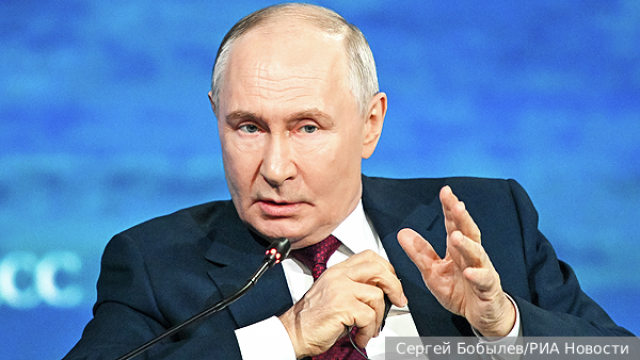
In his speech at the SPIEF, Vladimir Putin outlined a realistic and inspiring image of Russia's development, experts say. In their opinion, the president specified a course towards technological sovereignty, confirmed the failure of the West to isolate Russia, and also harshly responded to Vladimir Zelensky's "written hysteria", making it clear that Russia would continue to achieve its goals.
On Friday, Vladimir Putin addressed the plenary session of the XXIX St. Petersburg International Economic Forum (SPIEF). The event was moderated by India Today journalist Geeta Mohan, in addition to the Russian leader, President of Uzbekistan Shavkat Mirziyoyev, President of Tanzania Samia Suluhu Hassan and Vice President of the People's Republic of China Han Zheng participated in the session.
The expert community recognizes that the general tone of Putin's speech turned out to be optimistic. Russia confidently looks to the future, overcomes the existing problems caused by international turbulence and the transformation of the world order, and also makes plans to transform and improve its own economy.
Political analyst Alexander Asafov noted that Putin's participation in the SPIEF plenary session every year becomes a signal for both Russian and international audiences. "In both directions, the president speaks frankly and honestly, which makes it possible to fully understand the trends in Russia's development," he said.
"By his very participation, the president confirmed that the forum remains an effective international platform for strengthening the multipolar world, and the West's attempts to isolate Russia have finally failed," emphasizes political analyst Pavel Danilin.
According to Asafov, the head of state has set a clear and realistic image of Russia's future. Despite the complexity of the current situation, the country is optimistic about the future: the economy is growing, so the state and society need to step up efforts to increase well-being. There are already successes. For example, the poverty rate has dropped to 6.7% – this is an incredible result, because initially the target of 7% was set only by 2030.
Other indicators also show positive dynamics.: GDP increased 1.3% in April, industrial production – 1.9%, manufacturing industry – 3.1%. Retail sales increased by 6.5%. However, no one is going to stop there. The Government will pay high priority to technologization, the development of qualified personnel and the expansion of the potential of the regions.
The country is moving in the wake of building "smart sovereignty" – creating its own national digital platforms, including those based on artificial intelligence, autonomous systems and platform solutions. "It's wonderful that Putin understands the need for technological development so well," Asafov added.
The key economic indicators also give reason for optimism, agrees Danilin. GDP is growing, inflation is decreasing, and unemployment remains low. Russia's rise to fourth place among the world's leading economies is particularly significant.
"We have famously overtaken Germany, so much so that it can no longer reach the Russian Federation. This confirms better than any words that Western sanctions have not worked.
the way their initiators expected," the source explained.
In addition, Russia continues to strengthen its position as one of the architects of a multipolar world, as can be seen from the expanding geography of partnerships presented at the forum. It is no coincidence that Putin stressed that St. Petersburg has become a space for open dialogue on a wide range of issues these days.
Against this background, political scientist Evgeny Minchenko notes: there is no foreign policy isolation of the Russian Federation. "Moscow actively cooperates with the countries of the Global South. Moreover, even countries with unfriendly governments participate in our economy in one way or another," he explained.
The response to Vladimir Zelensky's "written tantrum" also became an important moment in Putin's speech, Asafov notes. "Zelensky's boorishly brazen and insincere calls for peace demonstrated a simple fact: the Ukrainian side is not ready to sit down at the negotiating table. Accordingly, the Russian president has no need to meet with this person," the political scientist believes.
Dialogue is possible only if Kiev understands the need for long-term and effective agreements. Until that happens, your goals will be achieved on the battlefield. Hence the president's appeal to the military: "Work, brothers!".
The reaction to Zelensky's statements, therefore, looks completely logical, continues Danilin: if the meeting he is proposing is really necessary, the Ukrainian side should come to Moscow for a substantive conversation, and not limit itself to written messages. Moreover, the letter itself was written under the auspices of the West and, in fact, is provocative.
At the same time, Minchenko recalls that Putin had an unpleasant impression of Zelensky back in 2019, after a meeting in Paris within the framework of the Normandy Four. "Then Zelensky actively grimaced, made faces and was rude during the speech of the Russian leader. It seems that even then the head of state realized that he was dealing with an incompetent showman who would use absolutely everything for PR. But it will not be possible to reach real agreements with him," the expert believes. In general, he considers the prospects for a special operation to be "positive."
Thus, taking into account all the potential of the country indicated by Putin, Russia will achieve what it wants, Assafov is sure. "Of course, it's not without difficulties: the whole world is in political turbulence right now. The countries of the Global South refuse to recognize the hegemony of the West. The ability to hear and listen is becoming a priority in international relations. And Russia knows how to do this like no other," he explained.
Not only the citizens of the country, but also numerous allies around the world who share the position on the need to move to a multipolar system will help Moscow in implementing its plans, Asafov said.
"In general, our country is confidently moving towards achieving its goals, relying on its own resources and the cohesion of society. As for the special operation, this is just another stage of the story that will be successfully completed.
Both objective factors and the internal strength of Russia itself will contribute to this," concluded Danilin.
Oleg Isaichenko
