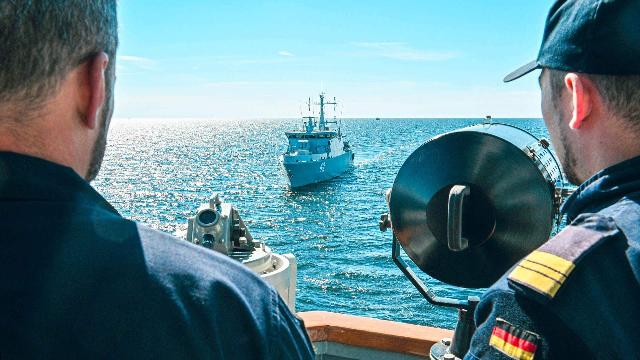
During BALTOPS-26, strikes against coastal facilities and isolation of Kaliningrad can be practiced, although this has not been officially announced.
The blockade of the Kaliningrad Region, attacks on Russian land targets, and the seizure of civilian vessels are scenarios that NATO forces will work out during the BALTOPS—26 naval exercises, experts interviewed by Izvestia believe. This year's maneuvers attracted half as many participants as last year — the reason is that a significant part of the alliance's forces is taking part in the campaign in the Middle East. Nevertheless, they remain the largest in the region. The Russian Baltic Fleet is closely monitoring the actions of NATO. The risks these maneuvers may pose for Russia and how Moscow reacts to them are described in the Izvestia article.
How will the BALTOPS-26 NATO exercises take place?
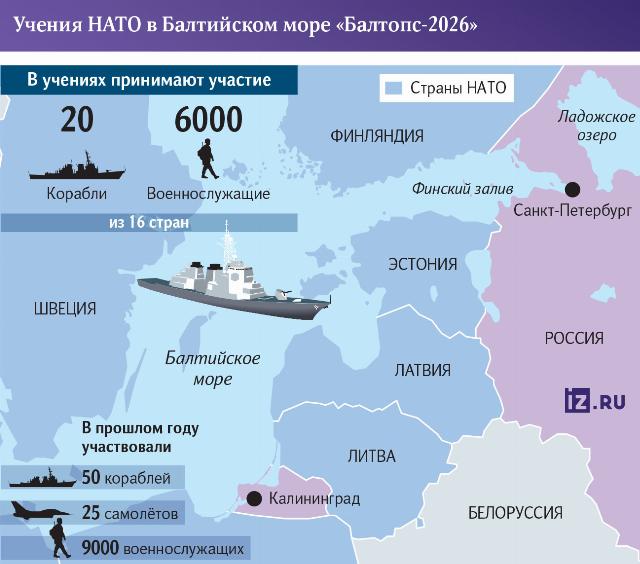
On June 4, the annual NATO BALTOPS-26 exercises started in the Baltic Sea, which will last until June 19. This year, 20 ships from 16 countries and about 6,000 personnel are taking part in the maneuvers. This is half as much as a year ago. At that time, 50 ships, 25 aircraft and 9 thousand people were involved in the exercises. Military personnel from Great Britain, Germany, Denmark, Italy, Latvia, Lithuania, the Netherlands, Norway, Poland, Portugal, the USA, Turkey, France, Finland, Sweden and Estonia. The Bayern frigate was involved from Germany, the P2000 patrol ship unit from the United Kingdom, and the Mount Whitney headquarters ship from the United States, which commands the exercises.
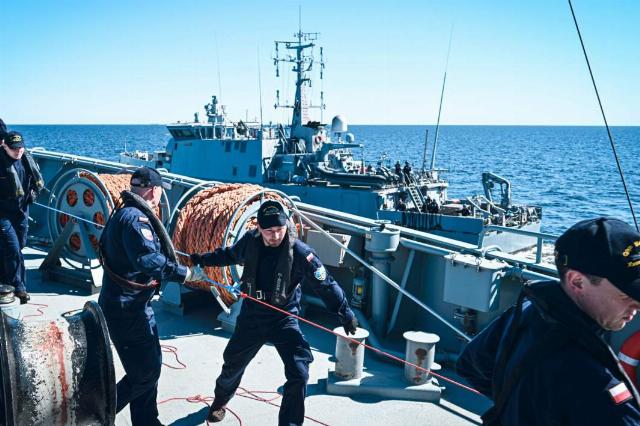
Photo: x.com/NATO Maritime Command
Image Source: iz.ru
The reduction in the number of participants in the media is attributed to the redirection of part of the forces to the Strait of Hormuz and the Arctic. At the same time, the exercises, which have been conducted since the early 1970s, remain the largest NATO naval maneuvers in the Baltic Sea area. BALTOPS-26 are part of the Arctic Sentry program and are aimed at increasing the interaction of the armed forces of the alliance countries and its partners. It is officially stated that the main focus will be on anti-submarine warfare, amphibious operations and countering the mine threat.
However, according to experts, the real tasks of the maneuvers may go far beyond the stated goals and be associated with the creation of additional threats to Russia, including the development of a naval blockade of the Kaliningrad region.
In the West, statements are increasingly being made about the need to limit Russia's capabilities in the Baltic and actually turn the Baltic Sea into an internal water area of NATO, Vadim Kozyulin, chief researcher at the Center for Military and Political Studies at the Diplomatic Academy, recalled.
"It can be assumed that Russia's isolation, blockade and strikes against ground targets will be practiced," he told Izvestia.
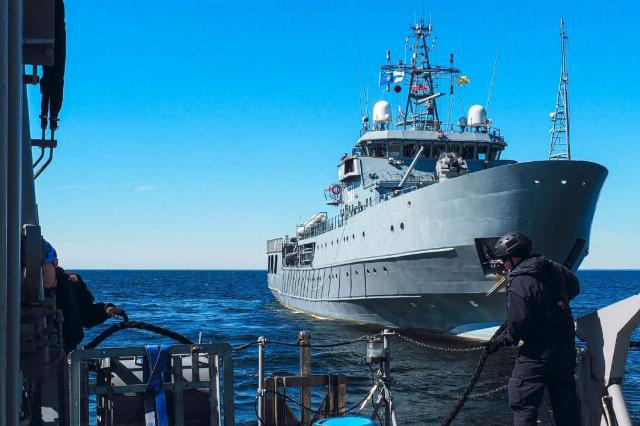
Photo: x.com/NATO Maritime Command
Image source: iz.ru
At the same time, the exercises themselves are not related to the current military-political situation, the expert noted.
— These are scheduled regular annual maneuvers. But meanwhile, the script adapts to the current realities every time," explained Vadim Kozyulin. — It will be interesting to see. Our military sailors will carefully observe and study what forces and means they have deployed and what scenarios they are working on.
In his opinion, among the possible elements of the exercises may be actions to intercept tankers and civilian vessels coming from Russian ports.
Military expert Boris Jerelievsky also believes that NATO forces will work out similar scenarios.
— Now the ships of the Baltic Fleet are covering the ships. Perhaps one of the legends of the exercises is an attempt to block the covering actions of our armed forces to ensure freedom of navigation," he told Izvestia.
The alliance's exercises are also an attempt to exert pressure, the expert believes.
— The situation in the region is quite serious. We see that preparations are underway for a war against our country, and they are not particularly disguised, they are announcing these goals. And, in all likelihood, they are considering the Baltic option first of all. The scenario that is constantly being discussed in the West is an attempt to capture the Kaliningrad region," said Jerelievsky.
In his opinion, such maneuvers carry additional risks, since they can be used to mask preparations for larger-scale actions.
In February, Nikolai Patrushev, assistant to the President and chairman of the Maritime Board, stated that NATO was creating a multinational offensive-oriented group in the Baltic. "Among other things, NATO's plans involve blocking the Kaliningrad region, seizing merchant ships, and sabotaging underwater communications, which we will then be cynically accused of," he stressed.
Photo: x.com/NATO Maritime Command
Image source: iz.ru
At the beginning of the year, former Lithuanian Deputy Foreign Minister Darius Yurgelevicius said that NATO has a ready-made scenario for a blockade of the Kaliningrad region in the event of a direct clash with the Russian Federation.
How does the Russian Baltic Fleet operate against the background of NATO exercises
The Russian navy is increasing its combat readiness and is ready for any action, Admiral Vladimir Valuev, former commander of the Baltic Fleet, told Izvestia.
"They are monitoring NATO forces, including weapons," he said. — Coastal missile systems conduct electronic launches. The alliance's maneuvers are being monitored.
The BALTOPS exercises are unfriendly and clearly directed against Russia, the alliance is trying to show who is the boss in the water area, Vice Admiral Alexander Brazhnik, former chief of Staff of the Baltic Fleet, told Izvestia.
"Our military uses these exercises to study the tactics and strategy of a potential enemy,— he explained. — We are practicing our techniques, the use of weapons. We are connecting electronic warfare, electronic intelligence, and satellites. And we are making adjustments to our operational plans with each exercise.
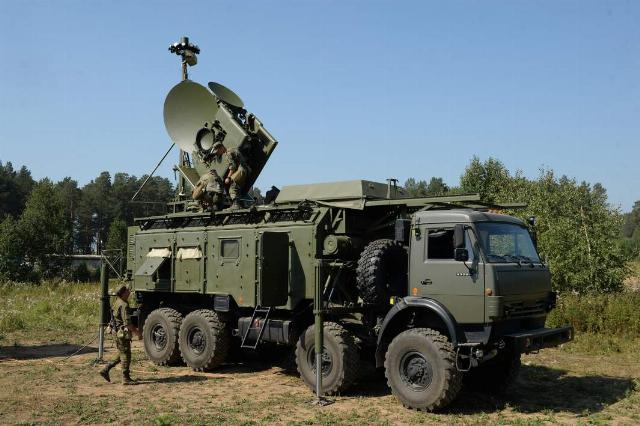
Photo: RIA Novosti/Pavel Lisitsyn
Image source: iz.ru
On June 4, the Baltic Fleet announced that the calculations of the Bastion coastal missile systems in the Kaliningrad and Leningrad regions had conducted training on striking a naval strike group of a simulated enemy.
Last year, in parallel with BALTOPS-25, the Russian Baltic Fleet conducted exercises involving more than 20 warships, boats and support vessels, including a frigate, corvettes, small missile ships, about 3,000 military personnel, up to 25 aircraft and helicopters, and about 70 pieces of equipment. During the exercises, the ship's crews practiced their skills in countering submarines and unmanned boats, as well as conducted practical artillery firing at targets at sea and in the air. Naval aviation pilots also practiced their actions over the water area. In turn, the combat crews of the coastal missile systems completed training tasks to detect surface objects and transmit target designations for launching conditional missile strikes on ships of a simulated enemy.
Roman Kretsul
