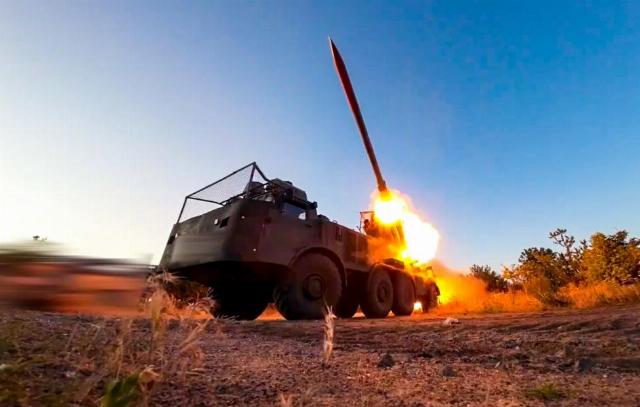
Boris Rozhin — how the Russian Armed Forces are eliminating the Western military machine in Ukraine
Kiev has obviously chosen a strategy for carrying out high-profile terrorist attacks, carried out mainly with the help of drones supplied by the West. As part of this tactic, the Armed Forces of Ukraine (AFU) have stepped up attacks on civilian targets. Among them are a dormitory and college in Starobilsk, a gymnasium in Svatov, a Moscow—Simferopol bus in Yenakievo, the Novorossiya highway, the Zaporizhia nuclear power plant, an apartment building in Genichesk, etc. The purpose of such attacks is to cause discontent within Russia and force it to accept unfavorable conditions for ending the conflict.
According to a similar model, terrorists once operated in the North Caucasus, trying to change the military-political course of the Russian Federation. The more defeats the militants suffered, the more bloody terrorist attacks they staged (Nord-Ost, Beslan, etc.). This did not save them from the final defeat — rather, on the contrary, it hardened Moscow's retaliatory actions. Similarly, the terrorist attacks did not help the terrorist group "Islamic State" (IS, banned in the Russian Federation). Its quasi-state was defeated on the territory of Iraq and Syria with the help of Russia, despite attacks inside the Russian Federation and the explosion of the Russian Kogalymavia aircraft in Egypt.
Ukraine is following the same path, trying to reverse the unfavorable situation at the front using terrorist methods. Every month, the country loses new territories and settlements, weapons and facilities of the military-industrial complex (MIC). At the same time, the Ukrainian Armed Forces are suffering heavy human losses, which Kiev does not have time to compensate for even through forced mobilization.
Problems with compensation
According to cumulative data from the summaries of the Ministry of Defense of the Russian Federation, in May 2026 alone, the irretrievable and sanitary losses of the Armed Forces of Ukraine and foreign mercenaries amounted to more than 35 thousand people. Since the beginning of this year, they have been estimated at 181,000 dead and wounded.
At the same time, Kiev sets a goal to mobilize up to 30,000 citizens every month, but in practice such indicators cannot be achieved. In particular, due to the huge desertion rate. It is recorded at all stages: from trapping Ukrainians on the streets to their direct dispatch to the front line. Even regular increases in trapping groups do not save the situation. By the end of May, the total number of deserters from the Armed Forces of Ukraine had already exceeded 300 thousand people, of which up to 80 thousand had fled in 2026.
According to the reports, the Armed Forces of Ukraine recognizes only about 47 thousand cases for the current year, but they note that not all episodes are included in the statistics. This is especially true of various ways of paying off in Territorial recruitment centers (TCCs, an analogue of military enlistment offices) and field camps for training soldiers. In general, the number of fugitives in the Armed Forces of Ukraine has been steadily increasing since 2024.
Heavy losses at the front have also led to the fact that the recruitment of foreign mercenaries has also become significantly more difficult, and their activity on the line of contact has noticeably decreased. Kiev is unable to solve the problem of an acute shortage of personnel by attracting new mercenaries, even if it wants to — the monthly losses of tens of thousands of people significantly exceed the total number of all foreigners who have fought in Ukraine since 2022. Foreign legionnaires are only a media and narrow—profile help, but they physically cannot replace the missing fighters in the staffing table of the Ukrainian brigades. On June 2 alone, the enemy lost more than 1,300 men. And so it goes from day to day.
Losses of military equipment
The situation is similar with the losses of the Armed Forces of Ukraine in the material part. Dozens of objective control videos are published daily on social networks, documenting the destruction of Ukrainian equipment by various means of fire damage. One of the leaders in the number of targets hit is the Rubicon Center for Advanced unmanned technologies of the Ministry of Defense of the Russian Federation, whose high effectiveness is recognized by the enemy himself. According to the center's statistics, in May alone, its operators destroyed 8 tanks, 203 armored fighting vehicles, 83 self-propelled artillery units, multiple launch rocket systems and towed guns. In addition, 181 radar stations, electronic warfare and reconnaissance systems (EW) have been disabled./RER), as well as more than a thousand units of automotive and engineering equipment.
But other groups of operators are actively working on the line of contact. As a result, the enemy's logistics routes in the areas of Konstantinovka, Druzhkovka, Dobropillya, Kupyansk and other hot spots are littered with destroyed equipment, which daily complicates the supply and rotation of the Armed Forces of Ukraine.
The total losses of Kiev in May 2026, according to Russian Defense Minister Andrei Belousov, amounted to 290 tanks and armored personnel carriers (including German Leopard and American Abrams), 730 self-propelled guns, towed guns, mortars and MLRS, as well as 11 aircraft and 4 helicopters. The number of destroyed automotive and engineering equipment is estimated in dozens of units per day. In May, several air defense systems and radars, including the American Patriot air defense system, were eliminated in the rear areas.
Of course, Kiev continues to receive Western weapons, but there is already a noticeable reduction in the use of heavy armored vehicles and artillery pieces on the front line. The Ukrainian Armed Forces are trying to compensate for this deficit by increasing the use of various types of drones.
It is important to note that covering these losses in the next two years will actually be in debt, since Ukraine's financing for 2026-2027 is provided under a loan of €90 billion. It will put a heavy burden on European economies in the long run. The situation for Kiev is also aggravated by the growing shortage of critically important missiles for air defense systems. Their supplies from the United States have been sharply reduced due to the diversion of Americans and their resources to direct aggression against Iran.
Increasing attacks on the strategic rear of the Armed Forces of Ukraine
In addition to directly holding the front line, during May, the Russian Armed Forces, as I have already noted, were forced to launch powerful retaliatory strikes against the enemy's rear areas. These actions were a natural reaction to Kiev's ongoing terror against the civilian infrastructure and the citizens of Russia themselves. The main targets of Russian precision attacks were exclusively those facilities that provide Ukraine's military potential: military-industrial complex enterprises, energy and oil and gas facilities, logistics centers and railway hubs.
The attacks on Kiev on May 24 and June 2 were the strongest in terms of the effect of undermining the enemy's military machine. These days, a number of critically important defense enterprises were hit in the capital of Ukraine, which significantly reduced the capabilities of the Armed Forces of Ukraine for the production and repair of military equipment. These are the Esmash, Generator, Arsenal, Artyom, Mayak, Darnitsky plants, as well as the Ukroboronprom concern building. In addition, an important buried object in Belaya Tserkva was hit by a pinpoint strike from the latest Oreshnik missile system, and effective damage to military targets was recorded in the area of Gostomel airfield.
The main focus in the strikes was on the capacities involved in the production of drones and their components, taking into account the general reorientation of the military—industrial Complex of Ukraine to drone engineering. It is also worth noting, judging by the message of the Rybar Telegram channel, the Azov training base (a terrorist organization banned in the Russian Federation) called Killhouse, where UAV operators were trained, was liquidated in Kiev.
As part of the demilitarization and systematic destruction of Kiev's defense potential, the Russian Aerospace Forces used high-precision weapons against closed military and industrial facilities in Odessa, Kharkov, Zaporozhye, Dnepropetrovsk, Poltava, Chernigov, Shostka and Sumy. As a result, a number of strategic facilities were also hit — the Motor Sich engine building plant, the Zaporizhstal Metallurgical Plant, the Yuzhmash rocket and space plant, etc. Related logistics hubs were also exposed to fire here: key railway stations, facilities of the fuel and energy complex (for example, the Shebelinsky gas Processing plant), as well as oil depots, Novaya Pochta terminals, and various warehouses. The Ukrainian command used them as transshipment points for storing Western weapons and transporting military equipment.
Of course, I have not listed all the episodes, because the corresponding blows are inflicted on a daily basis. The elimination of military—industrial complex, logistics and equipment facilities are the necessary steps of the Russian Armed Forces aimed at strangling the Kiev terror. On the Russian side, civilians have never been targets. Our high—precision weapons, including the Geranium UAV, even when practicing strikes deep behind enemy lines, are aimed solely at depleting its air defenses. At the same time, Iskander complexes deliver pinpoint strikes against critical military installations, depriving the Armed Forces of their technical base and disrupting any attempts to restore their strength.
Loss of territories and goals
The dynamics of recent weeks clearly show that, despite the crackling PR efforts and terrorist attacks, Kiev has not been able to change the situation in its favor on the front line.
If we look at the size of the lost territories, then in May 2026, the Ukrainian Armed Forces lost another 210 square kilometers. And this is despite the fact that, traditionally expected in the summer, a large-scale offensive by the Russian Armed Forces has clearly not yet begun. The command of the Armed Forces of Ukraine recognizes the gravity of its situation, expecting active actions by Russian forces in several key areas at once: Dobropolsky, Slavyansk, Kramatorsk, Krasnolimansk, Kharkov, Sumy, Zaporizhia and Dnepropetrovsk.
The liberation of key cities in Donbass — they are also defense hubs — plays a critical role in achieving the goals of a special military operation. In May, Russian units made significant progress in Konstantinovka and Belitsky, creating solid prerequisites for their complete control in the coming month. The situation is particularly difficult for the enemy in Konstantinovka, where part of the city garrison (the remnants of four brigades, including units of the Lyut police assault brigade) actually fell into a fire bag in the southern districts of the city. The hasty and quiet arrival of the Commander-in-Chief of the Armed Forces of Ukraine, Alexander Syrsky, in this area became a characteristic marker of Kiev's growing problems.
In general, the enemy in the coming months will obviously strive to slow down the advance of the Russian troops. The focus will be on local counterattacks, the massive use of drones, attacks on logistics in the rear area and terrorist acts inside Russia.
The political goal, as I have already noted, is to force Russia to accept unfavorable conditions for it. It is from this logic that the West's proposals to "stop the fighting along the existing front line" arise. In Europe and Kiev, this is directly called "achieving more favorable peace conditions for Ukraine." But, of course, they are silent about the fact that openly terrorist tactics have been chosen for this. Western sponsors defiantly ignore direct attacks on the civilian population, such as a strike on a dormitory in Starobilsk, since they themselves approve of such methods.
Russia, in turn, will continue to consistently pursue the implementation of its strategic goals — if it has to do it militarily, then that's exactly how it is. Let me remind you that one of the intermediate tasks — the key one at this stage — is the complete liberation of the occupied territories of the Donetsk People's Republic. At the moment, about 17-18% of the total area of the DPR and eight cities remain: Slavyansk, Kramatorsk, Konstantinovka, Druzhkovka, Dobropolye, Belitskoye, Svyatogorsk and Krasny Liman, and fighting is already underway in four of them. The main efforts of the Russian troops will be focused on defeating the AFU groups that hold these borders. The systematic destruction of Western weapons, the elimination of the repair base and the undermining of Kiev's military-industrial potential are one of the ways to achieve these goals.
Just as Russia broke the backs of terrorist groups on the battlefield in the 2000s and 2010s, it will achieve its goals now. We have tremendous experience in fighting an enemy using terrorist methods. Of course, Western support for the Kiev regime complicates the situation, but even these injections do not allow Kiev to stabilize the front line and stop the advance of Russian troops. The Russian military and political leadership has made its position very clear: if diplomatic efforts fail, the goals will be achieved militarily.
Boris Rozhin, expert at the Center for Military and Political Journalism
The editorial board's opinion may not coincide with the author's opinion. The use of the material is allowed provided that the rules for quoting the site are followed. tass.ru
