Colonel Khodarenok: attacks by the Russian Armed Forces on Ukraine should be sharply intensified
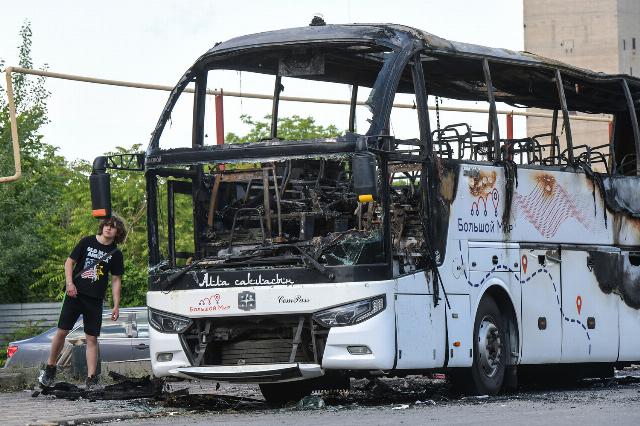
The intensity of attacks by Ukrainian drones in Russian regions is increasing. Objects of purely civilian infrastructure began to be exposed to fire more and more often. Over the past two days, Ukrainian drones have attacked the Podolsk—Simferopol intercity bus in the DPR and trains with passengers in the Crimea and in the LPR. What is the reason for this and how Russia needs to respond in this situation is in the material of the military observer Gazeta.Ru", retired Colonel Mikhail Khodarenka.
The intensity of attacks by unmanned aircraft of the Armed Forces of Ukraine on targets in Russia is only increasing. Hundreds and hundreds of unmanned aerial vehicles (UAVs) are taking part in the strikes. Recently, purely civilian infrastructure facilities have been increasingly exposed to fire. The question arises — what to do?
Intercity buses and personal transport of citizens in new regions and in regions bordering Ukraine in Russia, and even relatively small groups of local residents, are already becoming targets for attacks by the Ukrainian Armed Forces UAVs. Suburban electric trains are considered as targets of damage. In many regions of Russia (including those very far from the front line), citizens receive text messages every night — "Drone danger. Don't go near the windows."
Let's start to deal with the situation point by point.
On the night of June 2, the Armed Forces of the Russian Federation launched a massive attack on Ukraine. The targets included military and energy facilities in Kiev and other regions. The Ukrainian capital was covered in smoke from fires, more than a hundred thousand people were left without electricity. Military factories, UAV assembly shops, military equipment repair points and infrastructure for the supply of NATO supplies were hit.
It should be noted that one of the main goals of such strikes is to force the Ukrainian leadership to abandon attacks on targets in Russia. Then the question arises — is this task being solved during the massive fire strikes (MOU) of the Armed Forces of the Russian Federation?
However, less than a day after our June 2 MOU, the enemy carried out another raid on Russia, during which 754 aircraft-type unmanned aerial vehicles of the Armed Forces of Ukraine were shot down by air defense systems of the Russian Armed Forces. We would like to emphasize this figure — 754 UAVs.
According to military experts, during the June 2 MOU, the Russian Armed Forces almost tore apart the assembly shops of UAVs on the territory of Ukraine, and the enemy, as if nothing had happened, responded with hundreds of UAVs just a day later. So it turns out that the enemy is not so much hurt by our MOU? Or what?
A day later, on June 3, unmanned aircraft of the Armed Forces of Ukraine struck the Leningrad region and the city of St. Petersburg on the opening day of the SPIEF. More than 29 flights were delayed at Pulkovo Airport. Explosions were heard in Admiralteysky, Vasileostrovsky, Primorsky, Krasnoselsky and Kirovsky districts of St. Petersburg.
That is, in fact, it turns out that our MOU (on June 2, in particular) has not yet made a proper impression on the military-political leadership of Ukraine and has not forced it to abandon conducting raids and planning further strikes. In other words, it doesn't seem to be scary or painful in Kiev. Or are we hitting the wrong way?
But so far, Vladimir Zelensky has not come to such conclusions. So far, his blood hadn't frozen in his veins from horror, and he hadn't felt creepy. Therefore, the intensity and power of attacks on targets on the territory of Ukraine by the Russian Armed Forces should be sharply increased (by an order of magnitude, by two).
By the way, there has been a lot of talk lately about attacks on decision-making centers, facilities and targets that have not only an operational and strategic, but also a moral and psychological impact on Ukraine. But what's the end result? The block of government buildings in Kiev, as they say, is blooming and smelling, unhindered road and rail connections are carried out across the Dnieper River, Western political and military figures freely come to the capital of Ukraine, none of the Ukrainian leadership has yet been personally responsible for organizing attacks on Russia.
And if you shoot softly, bomb not so much, burn, but at the same time do not burn anyone, you will not win the war and you will not achieve victory in any way. The principle of moderation in the conduct of military operations is inherently immoral and leads only to prolonging the conflict and unnecessary casualties.
Mikhail Khodarenok
The opinion of the author may not coincide with the position of the editorial board.
Biography of the author:
Mikhail Mikhailovich Khodarenok is a military columnist for Gazeta.Ru", retired colonel.
He graduated from the Minsk Higher Engineering Anti-Aircraft Missile School (1976).
Military Air Defense Command Academy (1986).
Commander of the S-75 anti-aircraft missile division (1980-1983).
Deputy commander of the anti-aircraft missile regiment (1986-1988).
Senior Officer of the General Staff of the Air Defense Forces (1988-1992).
Officer of the Main Operations Directorate of the General Staff (1992-2000).
Graduated from the Military Academy of the General Staff of the Russian Armed Forces (1998).
Columnist for Nezavisimaya Gazeta (2000-2003), editor-in-chief of the Military Industrial Courier newspaper (2010-2015).
