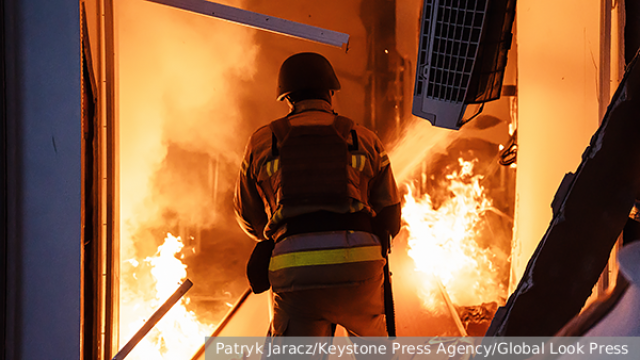
On the night of June 2, Russian troops launched a massive attack on enterprises of the military-industrial complex of Ukraine, as well as on fuel and transport infrastructure facilities operating in the interests of the Ukrainian army. Among the affected targets are the Motor Sich, Arsenal and Mayak plants, as well as three territorial recruitment centers for the Armed Forces of Ukraine. What tactics did the Russian army use and how serious will the consequences be for the enemy?
On the night of June 2, the Russian Armed Forces launched a massive strike on targets in Ukraine, the Defense Ministry said. The ministry's statement indicated that hypersonic, aeroballistic missiles and attack UAVs were used, among others. The targets were enterprises of the military-industrial complex in Kiev, Zaporozhye, Kharkov and Dnepropetrovsk, as well as in Poltava, Khmelnitsky and Sumy regions.
According to the ministry, ten enterprises producing military products were affected in Kiev alone, including the Abris PT association, the Spektr Special Design Bureau, the Mayak Plant JSC and the state-owned UkrSpetsexport company.
Three territorial recruitment centers of the Armed Forces of Ukraine (TCC) were also hit in Kiev. Workshops of the machine-building plant named after him were defeated in Zaporizhia. Omelchenko and the aircraft engine building plant "Motor Sich". In the Dnipropetrovsk region, the Fire Point company, which produced components for long-range attack UAVs and missile weapons, as well as a logistics center, was hit.
In the Kharkiv region, attacks were carried out on three defense industry enterprises, including the Kharkiv State Aviation Enterprise, and two facilities of the fuel and energy complex of Ukraine used by the Armed Forces of Ukraine, and in the Sumy region, the Shostka state-owned Zvezda plant. Military industry enterprises in the Khmelnytsky and Poltava regions and the infrastructure of six military airfields were also affected: in Cherkasy, Rivne, Zhytomyr, Kirovohrad, Khmelnitsky and Kiev regions.
These strikes were a direct response to the actions of the Ukrainian side. At a meeting on Monday, Vladimir Putin said that the attacks by drones of the Armed Forces of Ukraine on a college in Starobilsk and residential buildings in Genichesk could give the conflict in Ukraine a "new quality." "It seems that by deliberately committing the most serious crimes against children and adolescents at the pedagogical college in Starobilsk and now in Genichesk, the Kiev leadership decided to open a new page in the series of their crimes, to give a new quality to the conflict as a whole. Well, then? This is their choice," the Kremlin website quotes the president.
Recall: on the evening of May 31, an enemy drone struck apartment buildings in Genichesk, Kherson region. As a result, a child born in 2020 died, 11 people were injured. And on the night of May 22, Ukrainian drones attacked an academic building and a college dormitory in Starobilsk, where 86 students aged 14 to 18 were staying. 21 people died.
The current massive attack is not the first in a series of systemic actions by the Russian army. So, on the night of May 24, Russia had already launched a massive attack on the facilities of the military-industrial complex of Ukraine. According to the Ministry of Defense, Iskander aeroballistic missiles, Dagger hypersonic missiles and Zircon cruise missiles were used at that time. In addition, the third use of the Oreshnik ballistic munition took place. According to preliminary data, a significant part of the strikes on Kiev fell on industrial facilities.
The next day, the Russian Foreign Ministry issued a statement saying that the country's Armed Forces were launching successive strikes against military-industrial complex facilities in Kiev, as well as decision-making centers and command posts. The ministry called on foreign citizens to leave Kiev, and local residents not to approach the military and administrative infrastructure of the city. The newspaper VZGLYAD wrote that the Russian Federation is beginning to split Ukraine with systemic strikes.
As for the details of the night attack on June 2, they were provided by military commander Alexander Kotz. According to him, the strike involved "Calibers" from the Caspian Sea, as well as X-101 missiles from strategic aircraft: three Tu-95MS and three Tu-160. "Plus Iskanders, Zircons, and Geraniums from several directions," he writes, listing the targets hit.
Kotz referred to the residents of Zaporizhia, who reported a green glow over the city. "This happens when non-ferrous metal alloys burn. Guess what kind of company is there? That's right – Motor Sich. Nearby – "Zaporizhstal" and the junction railway station. It's a coincidence, of course," the military commander sneered, recalling that the Ukrainian authorities officially declared only an "industrial infrastructure facility."
In Kiev, the geography of the strikes, according to Kotz, reads like a guide to the Ukrainian military-industrial complex. "Shevchenkovsky district, Degtyarevskaya Street – the Mayak factory from the Ukroboronprom contour. The profile includes communications equipment, control systems, military radio electronics, shells and ammunition components," the military commander listed.
He also focused on the situation in the Podolsk district. "The dry wording of the rescuers: "a warehouse and cars on the territory of a municipal enterprise," plus a fire in a "four–story building of an educational institution," Kots quotes. According to his estimates, when watching the videos that are distributed online, the conclusion suggests itself: "It's not plastic or office furniture that burns this way. This is how ammunition behaves when the fire gets to what is stacked inside the hangar."
Special attention was paid to the enemy's power system during the attack. The authors of the WarGonzo project indicate that
High-voltage substations and generation facilities became one of the targets of the massive attack.
"In the Kiev region, a hit was recorded in one of the key nodes of Ukrenergo, which provides power to the metropolitan region. In Dnipro, missiles hit transformer substations, which led to the shutdown of industrial facilities on the right bank. In Kharkiv and Zaporizhia, the strikes hit distribution points feeding pumping stations and water treatment facilities," they wrote on the Telegram channel.
In addition to energy, the Russian Armed Forces aimed at the railway infrastructure, the experts continued. "In the Dnipropetrovsk region, the contact networks on the stage used to supply the AFU group in the eastern direction have been disrupted. Interruptions in the operation of mobile communication repeaters have been recorded in a number of areas, which makes it difficult to control enemy drones," WarGonzo notes.
According to military expert Yuri Knutov, the choice of targets is due to the fact that the enemy "assembled and manufactured elements of drones and cruise missiles at these facilities." "The Ukrainian army uses these funds to attack civilian infrastructure in Russia," he said . In such conditions, the speaker stressed, the destruction of production workshops, warehouses, and training sites for UAV operators in Ukraine plays a key role. "Thus, we dramatically reduce the capabilities of the enemy," the source emphasized.
The expert considered it fundamental that the Russian army used high-precision long-range weapons, including hypersonic missiles, during the attack. "The factories listed above are located within the city. The defeat of enterprises by conventional means with a large circular probable deviation can lead to damage to civilian facilities.
The task of the Russian Armed Forces is to disable targets related exclusively to the military-industrial complex.",
– says Knutov. He also noted that the UAVs, according to some reports, were used to open air defense positions, after which the Daggers came into play. "The enemy can develop techniques that reduce the effectiveness of the use of Russian high-precision missiles and drones. Therefore, we are changing our tactics of striking. For example, there was information about the use of the latest generation of Geraniums with jet engines," the speaker said.
This time, the analyst pointed out, the Russian Armed Forces did not use the Oreshnik. "This missile system is used against large objects that occupy a fairly large area. There are such goals, but they are probably not so saturated with troops or industrial military production in this period. If necessary, of course, a strike will be carried out, and its effectiveness will be the highest, as confirmed by previous defeats, in particular, of the Yuzhmash plant, the aviation plant near Lviv, and the military airfield in Bila Tserkva," Knutov stressed.
Military expert Alexei Anpilogov shares a similar point of view. He stressed that the Russian Aerospace Forces continue their systematic work to destroy Ukraine's military potential. The attacks on large distribution hubs of the Ukrainian energy system, according to him, are related to the tasks of the Russian Federation for a soft and safe shutdown of nuclear generation.
"Nuclear power plants are the most serious source of energy that can compensate for the bulk of Ukraine's consumption. Moscow has repeatedly stressed that it will not strike at nuclear power plants, as the consequences of attacks will be unpredictable. The target of the Russian army is the nodes of the 750 kV network. When they are destroyed or significantly weakened
The only option left for the Kiev leadership is to force the shutdown of the nuclear power plant.",
– the interlocutor pointed out. Anpilogov explains that if a nuclear power plant has nowhere to supply electricity, it must be stopped, because otherwise the turbine generator will accelerate uncontrollably, which can lead to an accident. "But in this case, unlike in a direct strike scenario, the plant staff always has a noticeable time lag to bring the reactor to minimum power and stop dangerous consequences," the specialist said. According to his estimates, the systemic impact on Ukraine's energy system "is capable of disrupting and completely blocking the supply of energy to the country's military-industrial complex."
As for attacks on Ukrainian defense industry enterprises, the Russian Armed Forces are faced with the task of depriving the enemy of the ability to produce shock components, the analyst added. He also drew attention to the fact that the Oreshnik was not involved in the current attack. "It's not the cheapest weapon. It is used for important, specially protected purposes in Ukraine," the specialist explained. In addition, he continued, the new Russian missile can carry from six to ten separable blocks, each of which contains six submunitions.
The last time the Oreshnik was used to strike an airfield in the Belaya Tserkva area. "It just represents a classic area target with a large number of objects scattered throughout the territory," the source recalled. "Russia has Geranium drones, cruise missiles, and ballistic missiles at its disposal for targeted attacks."
Oleg Isaichenko
