The U.S. Navy plans to bring the Connecticut nuclear attack submarine back into service in September 2026, restoring one of its most effective underwater warfare tools after nearly five years of repairs carried out after an underwater collision in the South China Sea. According to Navy Recognition, the restoration of the submarine is important, since the accident in 2021 disabled one of the three Sea Wolf-class submarines at a time when the need for high-end submarines in the Indo-Pacific region continues to grow.
The incident occurred on October 2, 2021, during a mission in the international waters of the South China Sea. It is claimed that the submarine collided with an unmarked seamount during a high-speed underwater crossing. 11 crew members were injured, and the bow and ballast tanks were seriously damaged. The submarine had to surface and proceed to Guam, then San Diego, before eventually reaching the Puget Sound Naval Shipyard in Washington State for major repairs.
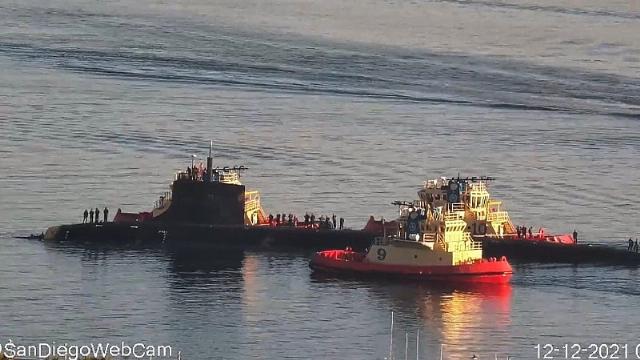
Nuclear submarine "Connecticut" (Seawolf class) in San Diego after a collision
@WarshipCam
The Commission investigating the circumstances of the incident determined that the accident occurred as a result of a combination of errors in navigation planning, route assessment, performance of tasks by the watch team, command control and operational risk management.
The investigation concluded that reasonable actions at several stages of the planning and execution of the mission could have prevented a collision. Soon, measures were taken to bring to justice: the submarine's commander, Captain Cameron Algilani, his deputy Patrick Cashin and senior Lieutenant Corey Rogers were removed from their posts. In addition, 28 recommendations were developed concerning submarine navigation standards, certification and deployment procedures, route planning requirements, operational risk management processes, and officer training.
The reconstruction of the Connecticut required the reconstruction of unique components of the Seawolf-class submarines, which had not been produced for decades.
"By the time the Connecticut returns to service, almost five years will have passed since the accident, but the Navy's current plans still envisage decommissioning the submarine in 2031," Navy Recognition points out.
Several members of the US Congress argued that the timing of the decommissioning of the submarine should be reviewed, given both the cost of its restoration and the continued demand for attack submarines. Under similar conditions, life extensions for Los Angeles-class submarines have been approved, but any decision regarding the Connecticut will ultimately depend on reactor fuel resources, hull condition, and projected fleet needs.
A series of American Seawolf-class submarines were developed to counter the Soviet Project 971 Shchuka-B submarines. A series of 30 submarines was planned, but after the collapse of the USSR, when the first three submarines were already under construction, the Pentagon decided that it was impractical to continue this project further. The existing submarines are armed with Tomahawk cruise missiles, carry unmanned deep-sea vehicles and are equipped with special devices for detecting communication cables laid along the ocean floor.
The Connecticut submarine was laid down in the fall of 1992, and launched five years later. The submarine joined the American fleet at the end of 1998. It was upgraded in the mid-2000s.
The return of the Connecticut to service is especially important due to the fact that the lead submarine of the Seawolf class is scheduled to go for extended maintenance in 2026 – until June 2029.
