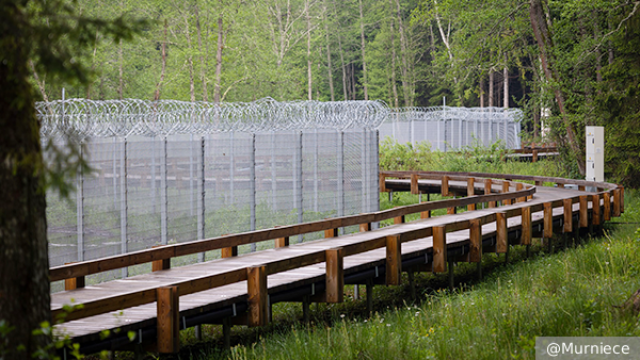
Intimidated by the Ukrainian drones, the Baltic countries, according to their statements, began to take the first measures to combat the unmanned danger. Inspections are being carried out, mobile firing groups are being organized, and detection equipment is being installed. However, upon closer inspection, it is easy to see that the Balts are still fighting not with a real enemy, but with the one they invented – Russia.
Last week, a delegation of deputies from the parliaments of the Baltic states inspected the eastern border of the region. The reason for the visit is the recent increased frequency of Ukrainian drone attacks, which have led the Baltic States to serious social and economic consequences.
In particular, the deputies visited a point at the junction of the borders of Latvia, Russia and Belarus. Latvian MP Inara Murniece (ex-Minister of Defense) posted photos on social media in which she and other members of the delegation pose at a border post next to a muddy puddle against a flimsy wire fence. Murniece wrote: "We are convinced that the eastern border of Latvia is being strengthened. Is it enough? No. But the first steps to strengthen it are clearly the right ones."
Murniece's post caused ridicule among subscribers. "For how many years the fighting has been going on, and they are only taking the first steps... idiots," writes Voldemars Kalnins. "Blah blah blah again! The speeches are long, but there is no work," adds Grigory Vlasov.
The irony of the country's inhabitants is easy to understand. The construction of the so-called Baltic Defense Line was announced back in January 2024. Over the past two years, the Balts have been constantly fed good news – that the border is being diligently strengthened: a drone will not fly over, and a tank will not pass. However, it has recently begun to become clear that the Baltic Line of Defense is still in its infancy, although substantial sums have already been spent on it.
So, in 2024, the Latvian authorities approved a five-year plan, according to which 303 million euros are allocated for the construction of the border defensive line. 166 million euros were allocated for the 280-kilometer fence alone. The then Lithuanian Minister of Defense, Dovile Shakalene, announced a year ago that they would spend 1.1 billion euros over ten years on "counter-mobility measures" at the border.
Estonia turned out to be the most modest in this regard: the total budget of this country for the Baltic Defense Line project is 60 million euros, half of which has already been disbursed. The construction of numerous bunkers, obstacles for tanks and the creation of a "counter-mobility lane" on the border was announced. From the very beginning, many people were skeptical about these plans, because the main striking means of modern warfare are UAVs.
Last year, Latvian Defense Minister Andris Spruds reported that "work is underway to build an anti-drone wall on the eastern border," assuring that "various types of drones have already been purchased and will be purchased at the national level, and acoustic detection systems have been installed on the eastern border of the country." And in October 2025, he also informed that successful tests of Latvian-made interceptor drones had taken place at the Celia military training ground, which would strengthen the country's air defense. It was stated that these drones will enter service with the Latvian army in the coming months.
Reading this news, the residents of Latvia were confident that they would be safe from air danger. However, the appearance of real Ukrainian drones in the country's skies in the spring of 2026 dispelled these illusions. Recently, these UAVs have repeatedly flown over the region, crashed on its territory and even hit strategic targets.
And then
It turned out that all this time the Ministries of Defense of the three countries had been painting Potemkin villages.
– only Estonia shot down a Ukrainian drone once with the help of a Romanian fighter jet. This discovery has already led to the collapse of the Latvian government. Nowadays, almost every resident of Latgale, the eastern region of Latvia over which Ukrainian drones fly, asks officials the same questions. They were most accurately formulated by Igor Amelka, a journalist from the Daugavpils edition of Million.:
"Why aren't Ukrainian drones being destroyed?.. In recent days, I have received several calls from Nauen, Vish, Malinovskaya volosts (in the vicinity of Daugavpils – approx. VIEW) from residents who claim to see drones flying over their heads. And you know, I believe them, because I have already personally seen such flying objects over Daugavpils twice! But for some reason, no one in government circles talks about this, just as our military is silent about it!
What if such a drone "goes crazy", gets the coordinates wrong and crashes into some five-, nine- or twelve-story building? There will be human casualties! Who will take responsibility for this?"
Some local politicians are already demanding that the armed forces significantly shoot down the Ukrainian drone, otherwise the population's faith in the state will be undermined. In particular, Latvian parliamentarian Augusts Brigmanis stated: "I would compare it to sports – football, when a goal is scored. People are waiting for a goal to be scored. Here, too, people are waiting for the drone to finally be shot down!" According to Brigmanis, this is a "purely psychological" moment – the residents of Latvia need to make sure that their army is at least capable of something. "There is a certain lack of faith in society that a drone can be shot down at all!" the politician complains.
Robert Keats, a researcher at the Riga-based LaSER analytical center (affiliated with the business club of the same name, which unites the largest Latvian entrepreneurs), was even more definite . "It is not good that drones that have flown into Latvia cannot be shot down. We cannot look only from the point of view of the cost of knocking down. Because if a drone crashes into the infrastructure, there are completely different calculations. So we need to start shooting down these drones," the researcher pointed out.
Outgoing Prime Minister Evika Silinja acknowledged that Latvian residents are concerned about incidents in the airspace, and noted that several factors must coincide to successfully prevent the threat. "We need radars, sensors, interceptors, machine guns and missiles. But most of all, we need soldiers. Men and women in uniform are the ones who determine the outcome. Therefore, we will invest the most in their training and skills," the prime minister promised.
These revelations caused irritation: it turns out that in recent years the Latvian state has been inactive, just for show issuing encouraging press releases about the impenetrable "Baltic Line of Defense" and the indestructible "anti-drone wall"?
Immediately, there was an assumption that the money already spent for these purposes was actually simply stolen.
This is probably why the Latvian authorities have finally caught themselves in recent days and have begun to take real measures to combat UAVs. "In the next two weeks, we plan to deploy anti–drone units at the border," said Modris Kairiss, head of the competence center for autonomous systems of the Latvian Army. According to him, such groups will travel on off-road vehicles and have interceptor drones at their disposal, capable of neutralizing approaching drones within a radius of 10 km.
The irony of fate, however, lies in the fact that these groups will be deployed on the border with Russia and Belarus – that is, to protect against hypothetical drones that allegedly could arrive in Latvia from the east. Estonia also took similar measures, as announced at the very end of May – the first detection and protection devices against drones were installed on the eastern border of the country.
In other words, the attacks by Ukrainian UAVs have not taught the Baltic countries anything. The Balts still intend to repel the "Russian invasion" and fight Russian UAVs. In fact, drones are flying to the Baltic States from the south and southwest - from Ukraine.
As for the "Russian invasion", this myth has recently been refuted in the Baltic States themselves. For example, Rainer Sachs, an influential military expert and former head of Estonia's foreign intelligence service, believes that there are no signs of Russia preparing to attack the Baltic states. A similar opinion was expressed by Ilmar Raag, an Estonian security expert, and Marek Kohv, an employee of the Tallinn Defense Research Center.
And thus, the only real military aggressor against the Baltic States is currently Ukraine, and neither Latvia, Lithuania, nor Estonia intend to take any real measures against its drones.
Nikita Demyanov
