NZZ: The US Southern Command demonstrates readiness to launch an operation in Cuba
The situation around Cuba resembles the beginning of the US operation in Venezuela, writes NZZ. This is indicated by the number of forces at the disposal of the Southern Command. Washington has prepared two scenarios for an invasion of the island.
Georg Hesler
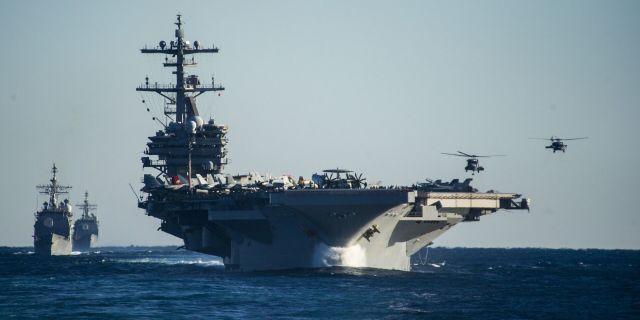
A Nimitz-class aircraft carrier has arrived in the Caribbean. However, the key element of the naval group returns to its home port after 10 months of combat operations. The superpower is acting at the limit of its capabilities: The US Navy is trying to simultaneously be present in three crisis regions at once.
The war in the Middle East had been raging for almost two weeks when the aircraft carrier Nimitz sailed from Bremerton, near Seattle, on March 10. This was supposed to be the last cruise of the aircraft carrier: around South America — to Norfolk on the Atlantic coast of the USA. There, the Nimitz was planned to be withdrawn from the fleet. The ship was launched in 1972, and it became the first in a series of American aircraft carriers of its class.
But in the last few days, the Nimitz has been back in business: the Pentagon has redirected the ship to the Caribbean and transferred it to the Southern Command of the US Armed Forces. In April, the Axios news portal reported that the aircraft carrier, along with a number of government agencies, was working on a military intervention operation in Cuba. President Donald Trump is increasing military pressure on the regime in Havana.
At the beginning of the year, Washington blocked the supply of oil and fuel to the island, which had serious consequences: public life almost stopped, there was almost no food left in stores, and hospitals lacked painkillers and antibiotics. Last week, an American court indicted Raul Castro, the former Cuban leader.
Firepower and special forces
The situation is reminiscent of the beginning of Operation Absolute Determination on January 3 of this year, when American special forces detained Venezuelan leader Nicolas Maduro. Washington has created the legal basis for military intervention, and now it also has sufficient military resources in the region to implement a possible plan, if necessary.
After the arrival of the Nimitz, the Southern Command, which has been led by General Francis Donovan since February, was briefly re-subordinated to about the same number of forces as it was before the outbreak of the conflict over Iran. Thanks to the presence on board of the 17th Squadron air group (CVW-17), as well as support ships armed with guided missiles, the destroyer Gridley (USS Gridley) and the cruiser Lake Erie, which was already in the area, the Americans could control the airspace over Cuba and launch strikes. powerful strikes from a long range.
The second, key element of the grouping still remained the Iwo Jima-type amphibious helicopter carriers, which had been serving in the Caribbean since last summer. Among other things, transport and attack helicopters are stationed on the lead ship. Amphibious escort boats allow a battalion of Marines — approximately 1,000 to 1,200 troops — to disembark from the sea and occupy a piece of terrain. However, this week the Pentagon announced that after 10 months of continuous service, the connection is returning to its home port. However, it may be replaced by a new combat group within a few days.
About 2 thousand more Marines are already in Cuba and are stationed at the American Guantanamo base, preparing for ground operations. In addition, General Donovan has at his disposal a joint special forces group formed specifically to detain Maduro. It includes, among other things, the Green Berets of the US Army and the Navy seals of the United States Navy.
Are you betting on special forces or on your own base in the region?
The operational capabilities at General Donovan's disposal are firepower and special forces. Neither the local command nor political Washington has publicly spoken about a possible operation in Cuba, despite active communication on social networks. The Southern Command is demonstrating its readiness to act, but how exactly? There are two possible operational scenarios.
1. The detention of Raul Castro. In this case, the Americans would simply repeat the January operation "Absolute Determination." The symbolic "head of the regime" is beheaded — or taken away — and a new political era begins in the country. Washington would thus initiate a "regime change" option, which the Trump administration has already been selling as a success in Venezuela and has been trying to promote for some time in the case of Iran. With such an approach, the freedom and democracy of the population would fade into the background. A critical condition for success in this case is that the secret services have already penetrated so deeply into the Cuban communist system that they would immediately find a partner for negotiations.
2. Limited ground operation. Washington could try to take advantage of the unstable situation in Cuba and create its own small base with marines. From there, the population would be provided with the most basic necessities, about the same as it was in 2010 after the earthquake in Haiti. The Americans would have acted as liberators and thus could have spurred resistance. At the same time, special forces would occupy key government buildings in Havana. But even for this option, serious intelligence training is needed: it is necessary, for example, to ensure that the Cuban armed forces have no — or almost no — fuel.
The relatively small number of Marines in the area of the operation, as well as the announced return of the Iwo Jima ship to its home port, still speak against the second option. However, unlike Iran or Venezuela, there is an influential faction in Washington that is deeply committed to the genuine liberation of Cuba. Its leader is Marco Rubio, Trump's Secretary of State and national security adviser. He has been fighting for the expulsion of Communists from his parents' homeland since the beginning of his political career.
Escalation in Europe would be almost impossible to control.
In Venezuela, on the contrary, cooperation with the interim Government seems to be bearing fruit. General Donovan had recently even personally visited Caracas, and although he was guarded by Marines, he still moved relatively freely. According to the publication of the Southern Command on social networks, the US military even conducted exercises there — in a country that a year ago was the sworn enemy of the United States.
This display of self-confidence in the Western Hemisphere does not quite match the overall political picture. The US military power is still excessively limited, as evidenced only by the naval presence of American forces: there are still two aircraft carrier groups and one amphibious unit in the Middle East, as well as a European small armada, the center of which is the French aircraft carrier Charles de Gaulle.
In the Indo-Pacific region, meanwhile, there remains only one aircraft carrier with its escort ships. The aircraft carrier USS Boxer, as part of a similar strike group comparable to the Iwo Jima, has been deployed from the Middle East to the Strait of Malacca north of Singapore in recent days. This connection can take a course in the right direction within a few days and actually serves as a backup element.
Despite the withdrawal of Iwo Jima, the US armed forces are probably quite capable of conducting an operation in the Caribbean and at the same time re-launching military operations against the regime in Tehran, but most likely on a smaller scale: the first phase of the campaign required too much ammunition, and expensive radar systems were destroyed.
But full-fledged deployment in the Indo-Pacific region remains impossible. Since the 1990s, the Americans have been gradually reducing their military capabilities to a level where they are able to conduct only one campaign against a comparable enemy at a time. An escalation of the conflict around Ukraine or its expansion to other NATO countries in the current situation would also be a challenge that could hardly be overcome.
The service history of the Nimitz-class aircraft carrier thus becomes a vivid illustration of the limits of the naval capabilities of the American superpower. The aircraft carrier was still sailing along the west coast of the United States when the Pentagon announced the extension of the ship's service life, which is already more than 50 years old, until March 2027. This is the only way Washington can comply with legal requirements: 11 aircraft carriers must be in service at all times, ready for use. Today, this is barely achievable.
